
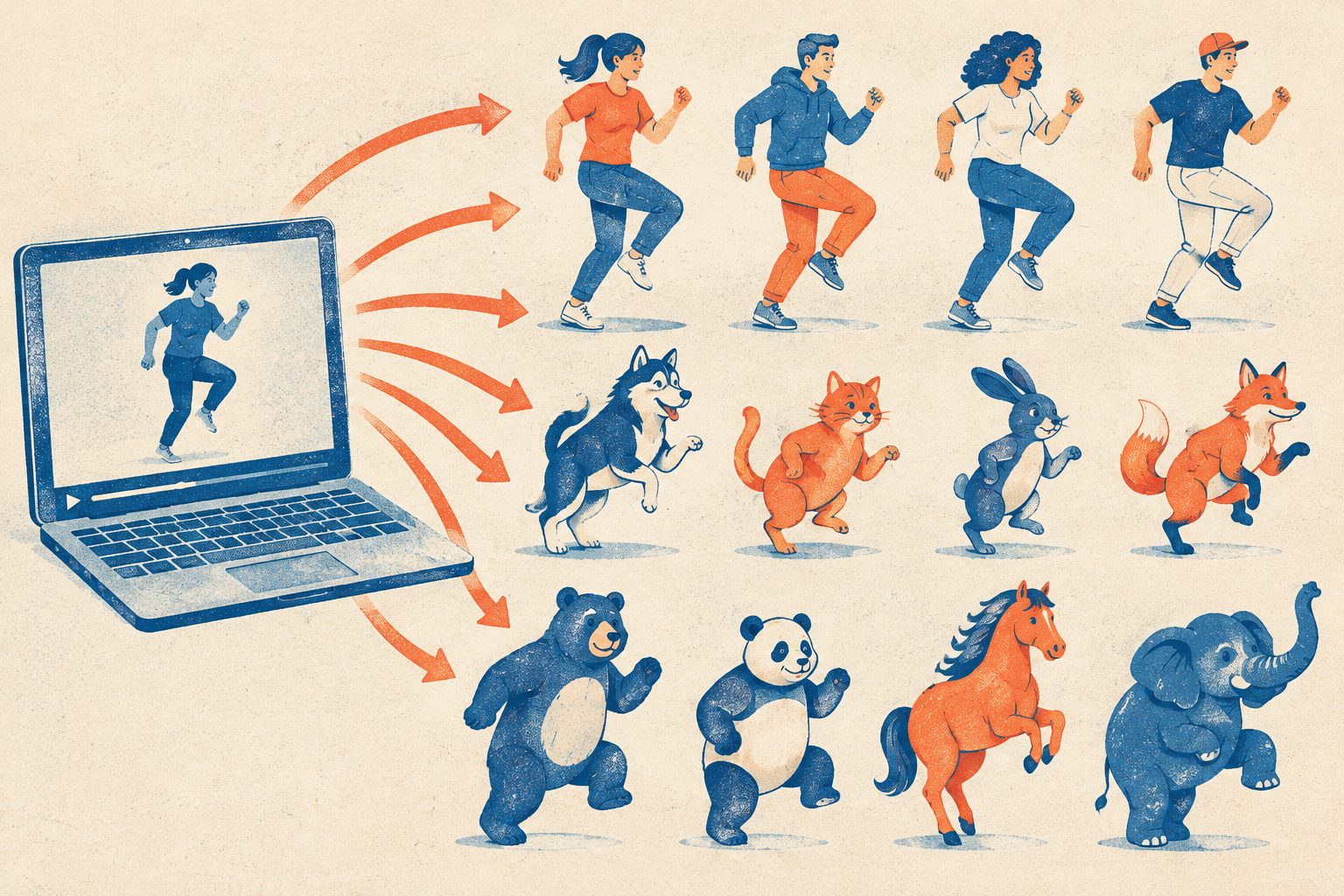
The system predicts 3D joint positions from video and then converts them into rotations for a target character. Unlike earlier pipelines that use a separate mathematical solver for this conversion, both stages are learned together. A rest pose and one example pairing of a pose with its rotations provide information about the target skeleton’s coordinate system.
Tests on the Truebones Zoo and Objaverse collections included skeletons with different structures and conventions. The researchers report lower rotation errors, including 6.54 degrees on unseen skeletons, and qualitative results on internet videos. The system does not use a mesh as an intermediate step, which the researchers say helps it run about 20 times faster than mesh-based pipelines.