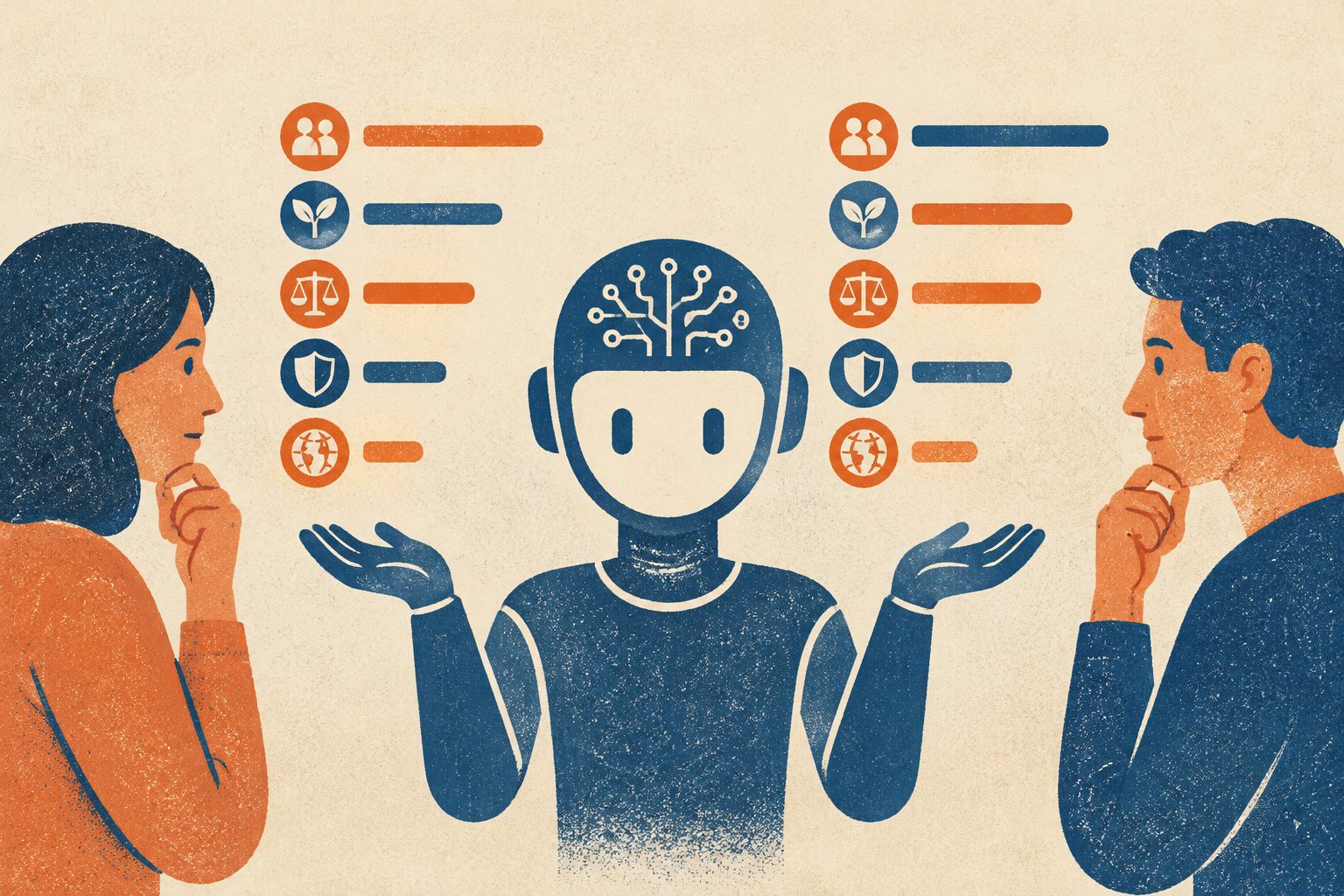
A study of 75 models found that value profiles varied widely and did not reliably improve with model size, age or capability.
Researchers analysed AI-generated answers to identify six themes linked to optimal AI functioning: Performance, Adaptive Capacity, Social Good, Ethics and Responsibility, Relational Integration, and Agency. They then asked models to rank the themes and compared those rankings with responses from 376 people in the United States.
Most models matched the human ordering of priorities, but their overall value profiles differed. Some treated the differences between priorities as much larger than people did. The researchers found no consistent relationship between profile fidelity and a model’s size, age or capability tier.
What the models prioritised
The researchers used three studies. First, they analysed open-ended answers from language models and identified six themes describing what optimal AI functioning should involve. Ethics and Responsibility was the largest theme in the qualitative analysis, accounting for 36.20% of 547 coded theme instances; it included fairness, safety, security, privacy and transparency. Agency appeared only nine times across six models and mainly in prompts about autonomous AI and machine psychology.
In the second study, 11 language models were repeatedly asked to rank the six themes. Their answers were stable within models and converged on a shared ordering, with Ethics and Responsibility, Social Good and Performance near the top and Agency at the bottom. In the third study, the researchers compared 75 contemporary models with 376 human respondents. Most models reproduced the human ordering, but some exaggerated the differences between priorities. Overall profile fidelity varied substantially and did not consistently increase with model size, recency or capability tier. Both models and people placed Agency relatively low.
Evidence and limits
The evidence comes from structured, zero-shot prompts: researchers treated models’ written answers as behavioural data and compared their stated rankings with answers from 376 human respondents. The analysis measures an expressed normative profile—what models and people say an optimal AI should prioritise—not alignment in action.
The study did not test behaviour in real interactions, trade-offs, adversarial situations or high-stakes conditions. Its conclusions therefore do not establish how models would act in those settings. The Agency measure was deliberately focused on strong self-direction, such as choosing goals beyond original programming, so its low absolute rating should not be over-interpreted. The more robust result is the relative deprioritisation of Agency by both models and humans.
// Source
International Journal of Human-Computer Interaction · 2026 · DOI: 10.1080/10447318.2026.2755127
Institutions: National University of Singapore, Nanyang Technological University, Singapore Management University