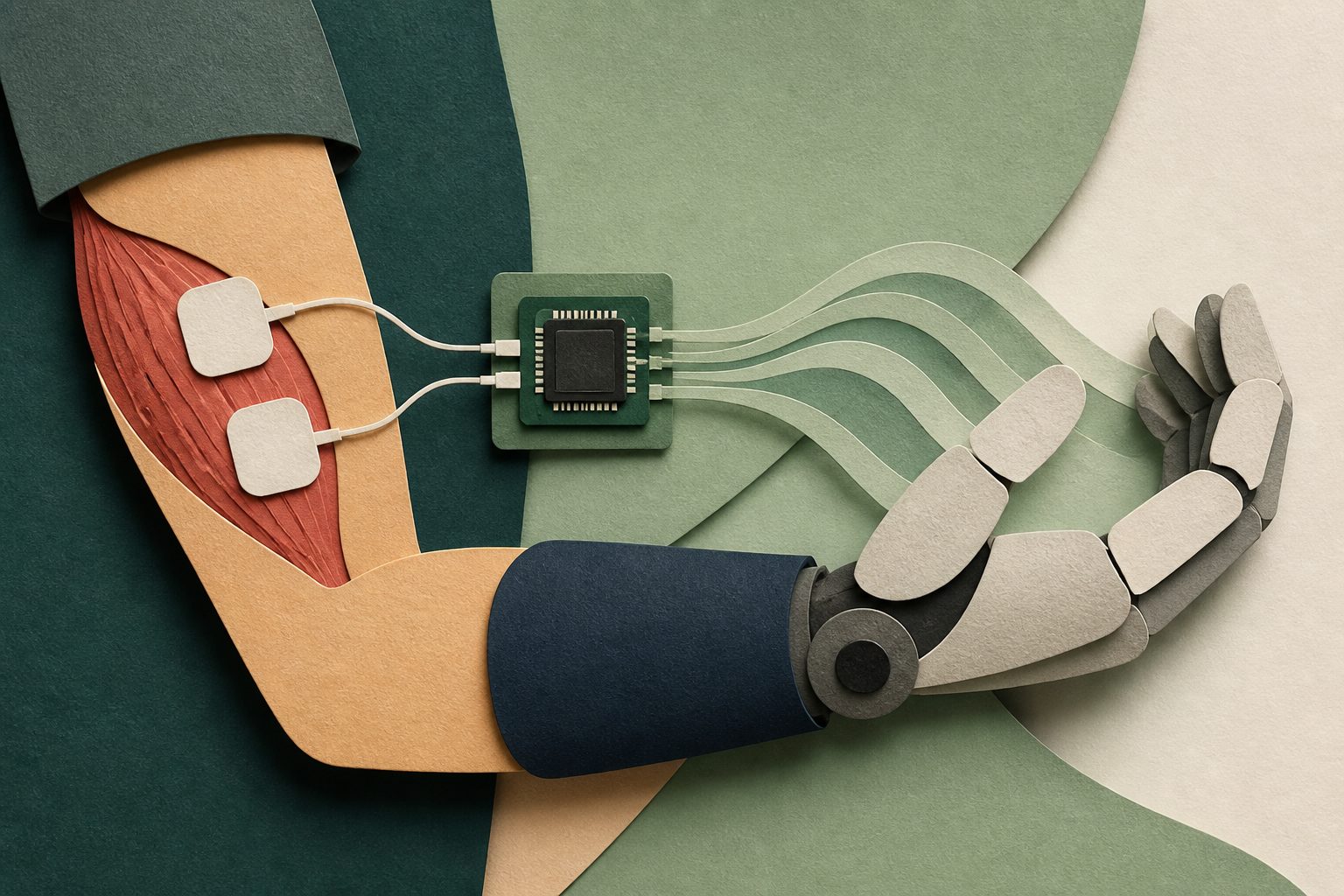
The systems matched or exceeded earlier accuracy while using far fewer operations, and were tested on small STM32 microcontrollers.
Researchers developed neural networks that decode surface muscle signals while using far fewer computer operations than earlier systems. On the emg2qwerty benchmark, structured models for long sequences outperformed transformer-based systems while requiring up to 1,000 times fewer operations.
A two-stage system combining several types of neural networks improved the balance between accuracy and computing cost in settings suited to small, low-power devices. The researchers also ran their best models on STM32 microcontrollers and measured real-time operation in distributed and end-to-end edge setups.
How the models performed
The researchers first tested structured linear state-space models, a type of neural network designed to process long sequences efficiently, on the emg2qwerty surface electromyography benchmark. These models exceeded the performance of earlier transformer-based systems while requiring up to three orders of magnitude fewer operations.
They then introduced a two-stage architecture that combines linear state-space models with convolutional and event-driven networks. The simpler, homogeneous state-space models performed best at higher computing budgets below 100 million multiply-accumulate operations per second. In more constrained settings, the two-stage models improved the accuracy–efficiency trade-off, matching or exceeding earlier state-of-the-art accuracy with up to 5,000 times lower computational cost.
The researchers deployed their best models on low-power STM32 microcontrollers. Measured processing latencies agreed with their analytical estimates, supporting real-time operation in both distributed and end-to-end edge implementations.
Evidence and caveats
The study reports benchmark results on emg2qwerty, along with real-time deployments on low-power STM32 microcontrollers. The abstract does not provide dataset size, participant details, task-specific accuracy values or comparisons with real prosthesis users. The findings therefore show computational efficiency and measured latency for the tested systems, but do not establish how well the models would work across users, tasks or clinical devices.