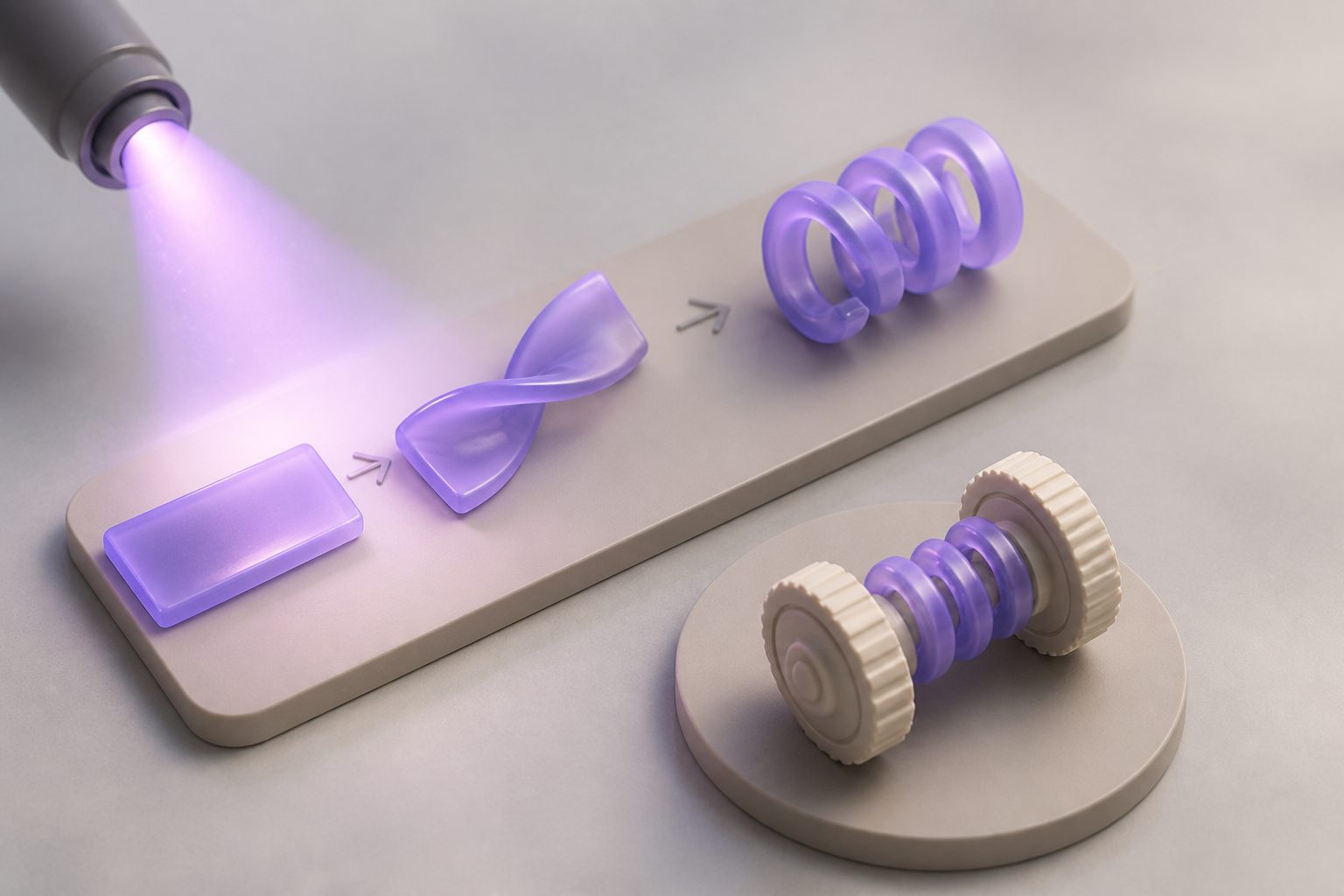
A uniform light-sensitive gel can form and erase handed shapes, then use those shapes to rotate for movement.
The study describes uniform hydrogels that change shape in response to spatially controlled light. They can form structures with a defined left- or right-handed character, including helices, twists and tendril-like shapes, despite having no built-in handedness.
The transformation is driven by photoexpansion: the gel's volume grew by more than 80,000% within 40 seconds. By coordinating regions with opposing handedness, the researchers used the resulting structures to produce self-propelled rotation for robotic locomotion.
Evidence and open questions
This is an experimental research article reporting demonstrations in photoactive hydrogels. The abstract describes the material's shape changes, expansion and rotational motion, but it does not give sample sizes, operating conditions beyond the reported illumination-driven expansion, performance comparisons, or information about long-term durability and energy efficiency. It also does not establish how broadly the method applies beyond the demonstrated hydrogel designs and robotic movement.
// Source
Nature Communications · 2026 · DOI: 10.1038/s41467-026-76133-y
Authors: Zhaomiao Chu, Zicong Zhou, Keao Jin, Linghui He, Chuang Li
Institutions: University of Science and Technology of China