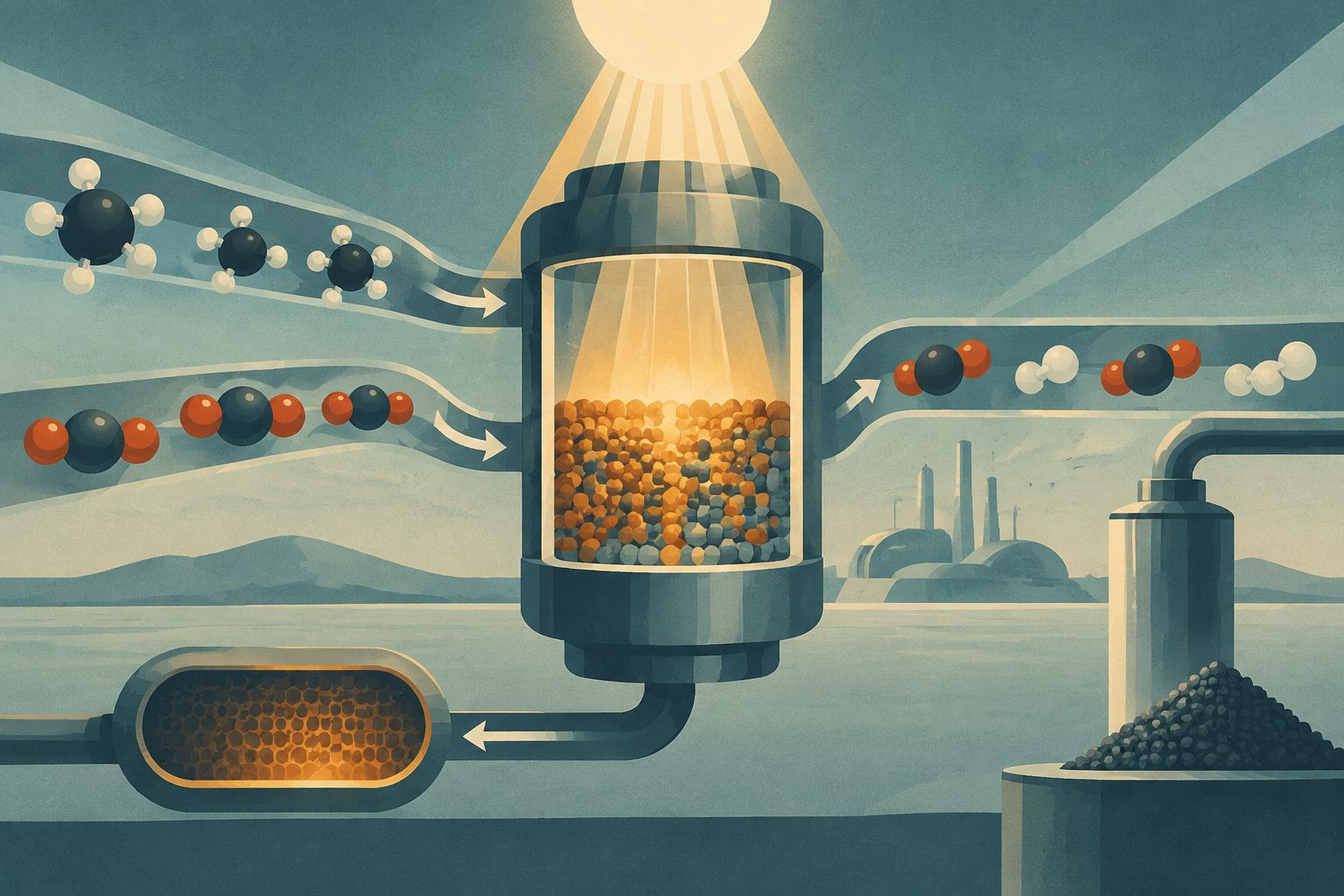
A ruthenium-modified perovskite produced hydrogen and carbon monoxide for 100 hours while limiting carbon deposits in reactor tests.
The catalyst is based on La2Ti2O7, a layered material whose titanium sites were partly replaced with ruthenium. The researchers report that this change created more oxygen vacancies—missing oxygen atoms in the crystal—and improved the movement of oxygen through the material.
Under light from a xenon lamp, the modified catalyst produced hydrogen at 339.58 millimoles per gram per hour and carbon monoxide at 494.46 millimoles per gram per hour. The unmodified material produced 9.3 and 12.4 millimoles per gram per hour, respectively. Tests and chemical analyses supported a reaction pathway in which lattice oxygen helps process methane-derived carbon intermediates, while carbon dioxide helps restore the oxygen vacancies.
What the catalyst produced
In photothermal dry-reforming tests, the ruthenium-substituted La2Ti2−xRuxO7 catalyst produced 339.58 millimoles of hydrogen and 494.46 millimoles of carbon monoxide per gram of catalyst per hour. Pristine La2Ti2O7 produced 9.3 millimoles of hydrogen and 12.4 millimoles of carbon monoxide per gram per hour under the same type of light-driven testing. That corresponds to increases of more than 35-fold for hydrogen and 39-fold for carbon monoxide.
The researchers attribute the higher activity to changes in the catalyst’s electronic structure, more oxygen vacancies and stronger interactions between ruthenium, oxygen and titanium. Infrared, X-ray photoelectron spectroscopy, electron microscopy and thermal analyses supported a mechanism in which light helps dissociate carbon dioxide, while mobile lattice oxygen reacts with carbon-containing intermediates. The researchers also report reduced carbon deposition and stable operation for 100 hours.
Why the result matters
Dry reforming uses methane and carbon dioxide to make syngas, which contains hydrogen and carbon monoxide and can serve as a chemical feedstock. The study suggests that modifying a perovskite catalyst with ruthenium can improve the reaction while addressing two problems that can reduce performance: limited oxygen movement and carbon buildup.
The reported stability and carbon suppression are relevant because carbon deposits can block active sites and contribute to catalyst deactivation. The work provides a materials strategy for combining light absorption, charge transfer and oxygen exchange in a catalyst for this reaction.
Evidence and caveats
The evidence comes from laboratory photothermal reactor experiments using about 0.1 grams of catalyst, a 50:50 methane–carbon dioxide feed and a 300-watt xenon lamp. Product formation was measured by gas chromatography, while spectroscopy and thermal and microscopy-based analyses were used to examine the reaction pathway and carbon deposition. The researchers tested stable operation for 100 hours.
These results do not establish how the catalyst would perform at larger scale, under outdoor sunlight or with industrial gas streams. The excerpts also do not report a life-cycle energy assessment, economic analysis or performance beyond the 100-hour stability test. The specific ruthenium content associated with the headline production rates is not identified in the provided excerpts.
// Source
Langmuir · 2026 · DOI: 10.1021/acs.langmuir.6c05014
Authors: Kamran Kamran, Muhammad Tahir
Institutions: United Arab Emirates University