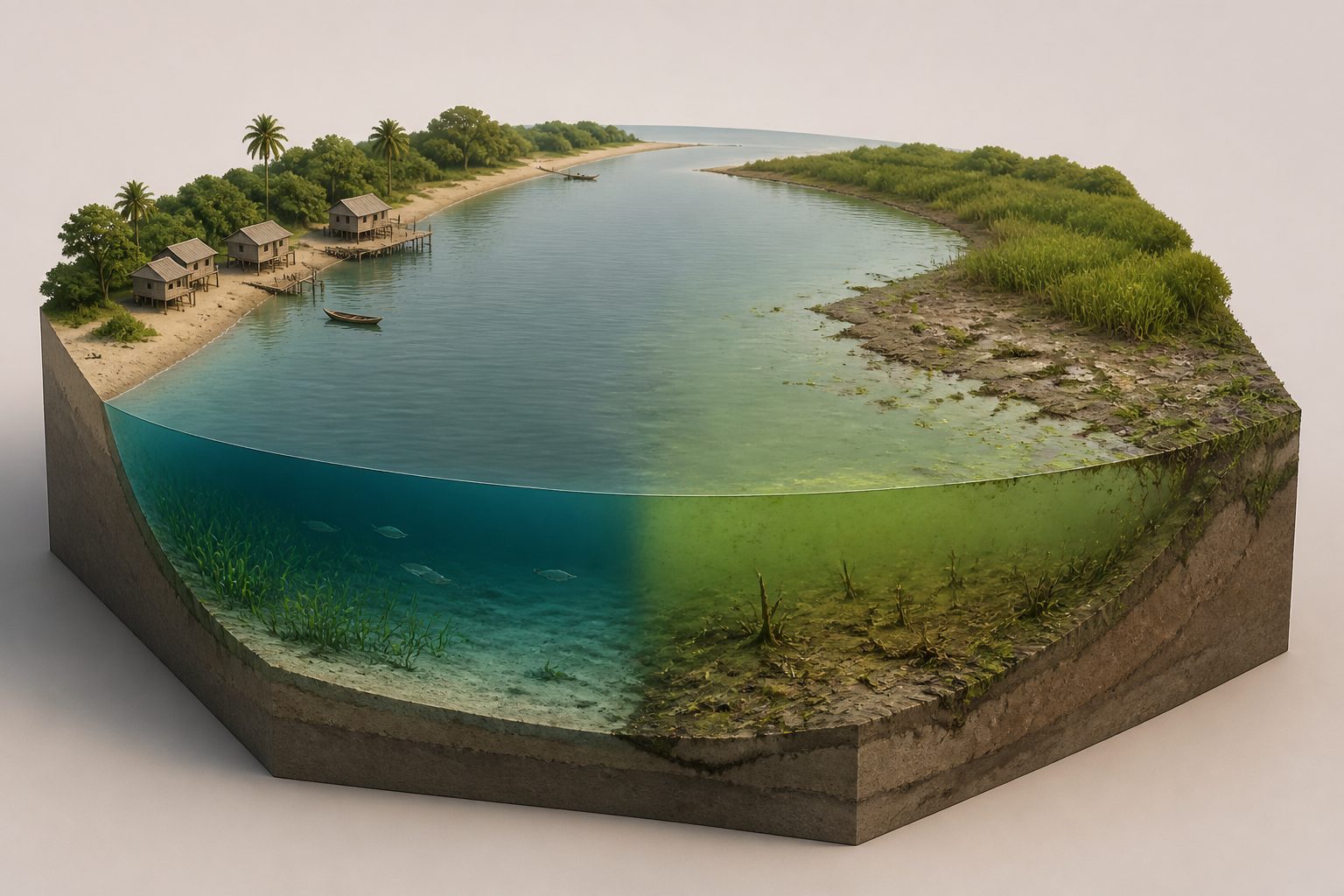
Water and sediment conditions varied across the Ghanaian lagoon, and more tolerant bottom-dwelling animals dominated at some sites.
A study of Ghana’s Keta Lagoon Complex found that the lagoon remains ecologically functional, but conditions differed across locations and months. Higher nutrient and turbidity levels were linked with communities dominated by more tolerant bottom-dwelling animals, while farming and salt-mining were reflected in disturbance patterns at some sites.
Researchers combined water and sediment measurements with surveys of benthic macroinvertebrates, or animals living on or in the lagoon floor. They say the results support integrated monitoring and call for stronger nutrient management, sediment stabilization and community-based ecological monitoring.
What the lagoon showed
Researchers measured water conditions—including temperature, dissolved oxygen, salinity, conductivity, turbidity, pH, nutrients and chlorophyll-a—and sediment properties at Anloga, Atiavi, Fiaxor, Havedzi and Tegbi each month from January through July 2022. Dissolved oxygen ranged from 4.87 to 6.78 milligrams per liter, while nitrate reached its highest reported concentration, 16.37 milligrams per liter, in March. Atiavi had the highest turbidity, averaging 26.22 ± 5.94 NTU, which the researchers interpreted as reflecting localized human influence.
Sediments were mainly coarse to very coarse sand, and their organic matter content influenced the distribution of bottom-dwelling animals. Molluscs and polychaetes were the dominant groups. More tolerant taxa were common at sites with higher nutrient and turbidity levels. The AMBI and Bentix indices classified Anloga and Fiaxor as slightly disturbed, and Tegbi and Havedzi as moderately disturbed, with the patterns reflecting farming and salt-mining impacts. Statistical analysis identified nitrate, phosphate, turbidity, dissolved oxygen and sediment texture as the main environmental factors associated with differences in the animal communities.