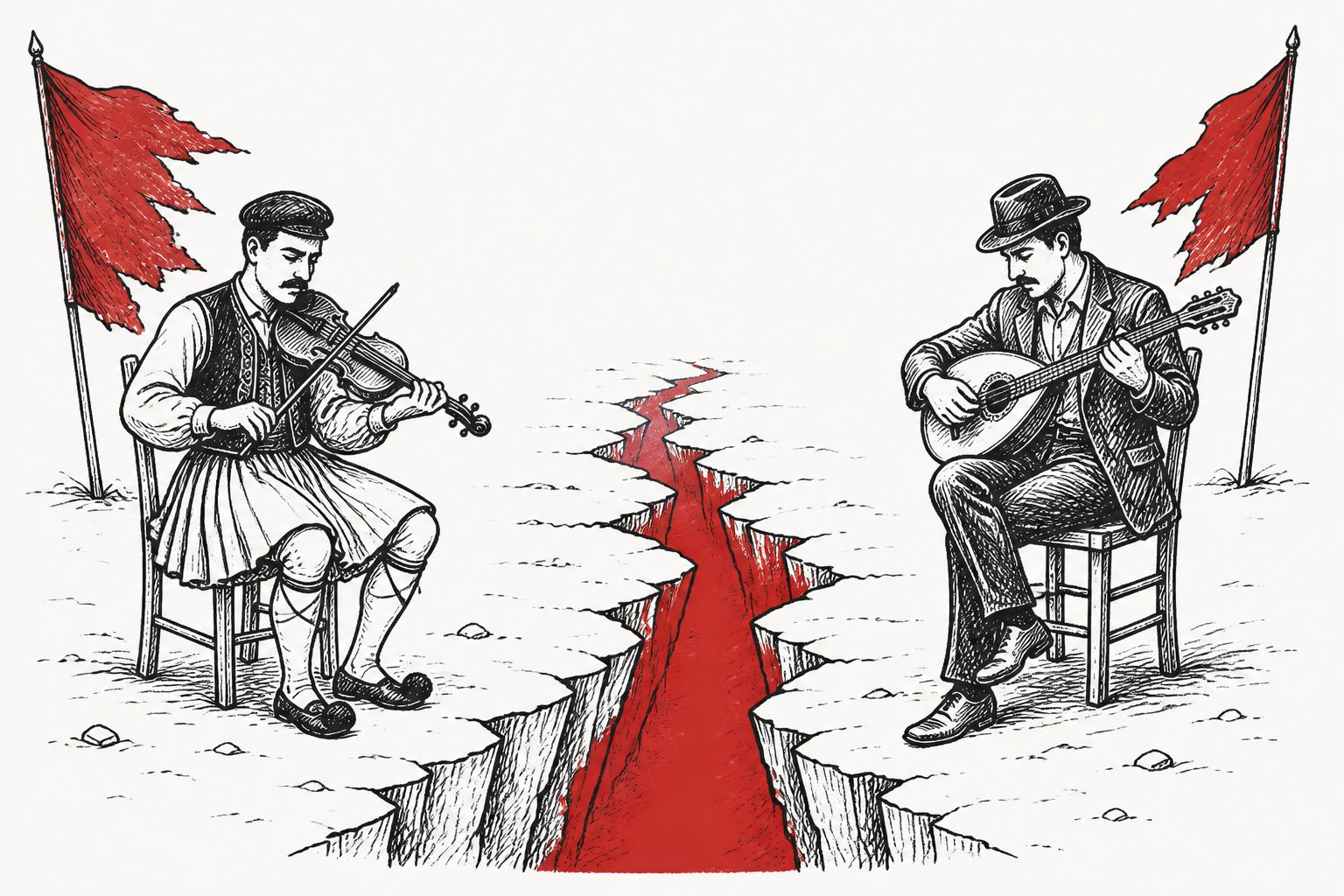
Research on Athens from 1915 to 1922 shows how violence and economic necessity pressured professional musicians to perform for rival political camps.
The study uses reports from Athens’ partisan press to examine the position of professional musicians during Greece’s National Schism. It finds that musicians became trapped between rival political demands, with violence and economic necessity compelling them to perform partisan repertoires rather than remain publicly neutral.
The note also proposes tools for studying sound in nationalist conflict. Its concept of “acoustic coercion” focuses on the gap between formal tolerance and informal terror, while its historical method reconstructs past sound environments from written archival sources.
When music was not neutral
The research note proposes “acoustic coercion” as a way to study the enforcement of political conformity through sound. It defines the concept around informal violence, state complicity through selective non-intervention, and credible impunity.
Drawing on original research into the partisan press in Athens during the Greek National Schism, from 1915 to 1922, the note shows that professional musicians became trapped subjects. Violence and economic necessity compelled them to perform partisan repertoires, making acoustic neutrality difficult or impossible in a polarized environment.
The note also demonstrates how historical acoustemology—the reconstruction of past sound environments from textual sources—can be used to study people’s lived experience of sonic conflict.
Why sonic pressure matters
The study broadens the ways researchers can examine music’s role in nationalist conflict. Propaganda, censorship and resistance do not fully capture situations in which performers face informal terror while authorities formally tolerate, or selectively fail to stop, coercion.
The framework may also help researchers examine other cases in which sound is used to enforce nationalist boundaries, including contemporary cases studied through ethnographic research.
Sources and limits
This is a conceptual and methodological research note supported by original analysis of the partisan press in Athens during 1915–1922. It reconstructs past sound environments from textual and archival sources rather than presenting a survey, experiment or numerical estimate.
The historical analysis reflects the evidence available in those sources, and written records provide an indirect view of past listening experiences. The note presents tools that may be applied to other cases, but the abstract does not establish that the Athens findings represent all nationalist conflicts.
// Source
Nationalities Papers · 2026 · DOI: 10.1017/nps.2026.10200
Authors: Argyrios Kokoris
Institutions: Aristotle University of Thessaloniki