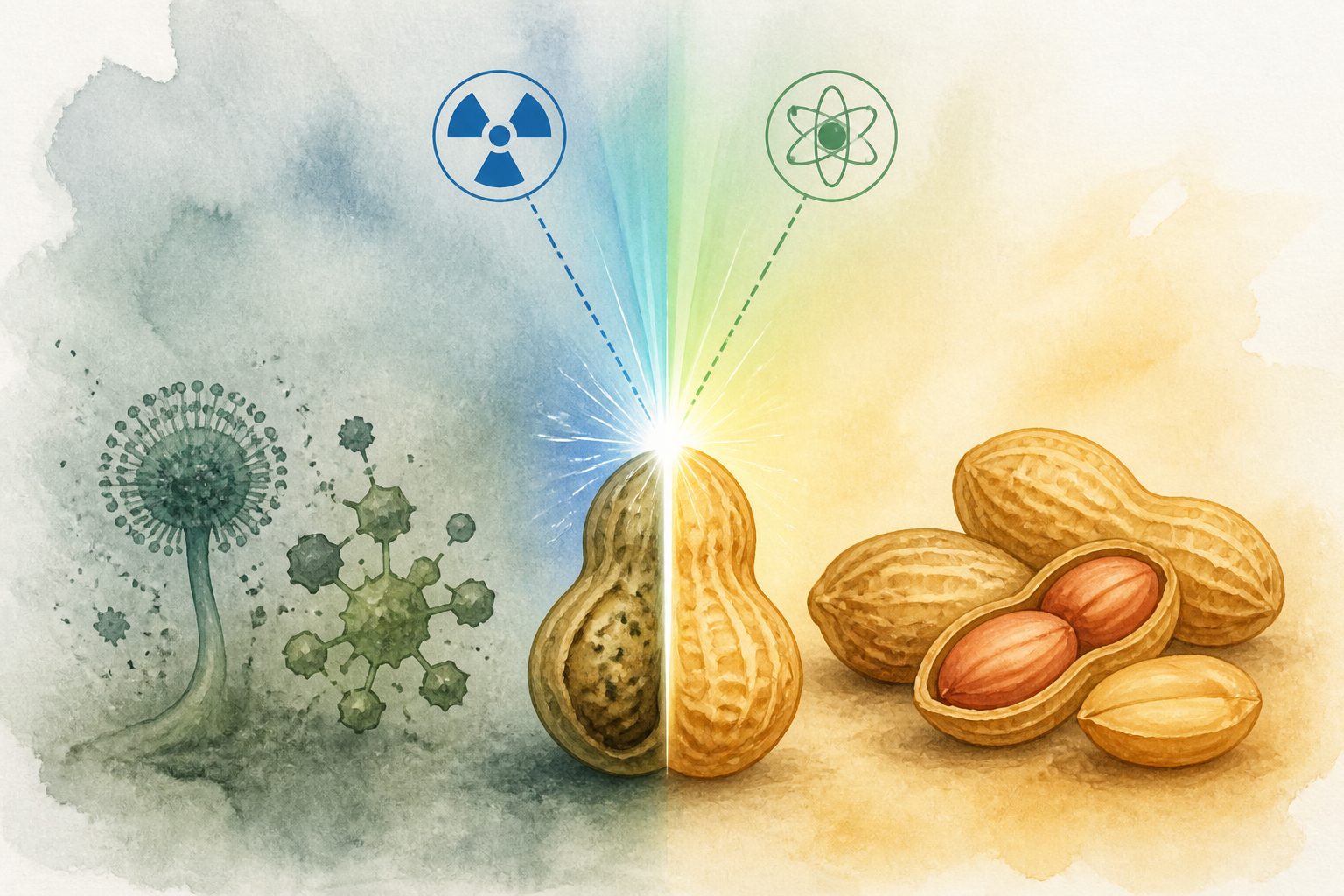
Both radiation types lowered aflatoxin B1 and microbes, but doses above 2 kGy increased signs of peanut lipid oxidation and darkened the nuts.
Researchers tested contaminated peanuts across radiation doses from 0 to 10 kGy using either gamma irradiation or electron-beam irradiation. They measured microbial populations, aflatoxin B1 content, and multiple physicochemical indicators linked to quality, including markers of lipid oxidation and changes in volatile compounds and color.
Both methods reduced aflatoxin B1 and microbes, with gamma irradiation producing larger reductions at lower doses. Still, higher doses increased malondialdehyde levels (a marker consistent with lipid oxidation) and changed color indices, while some protein and compositional features shifted—without a formal sensory panel to confirm how people would rate taste.
What the irradiation changed
• Both gamma and electron-beam irradiation lowered aflatoxin B1 (AFB1) in infected peanuts and reduced microbial contamination.
• Starting level of AFB1 was 529.40 ± 3.40 µg/kg.
• With gamma irradiation, 2 kGy reduced AFB1 by 85.9% to 74.70 ± 2.15 µg/kg, and 4 kGy eliminated AFB1.
• With electron-beam irradiation, reductions were smaller at 2 kGy (58.01%, to 222.30 ± 4.10 µg/kg) and required higher dose for near elimination; at 4 kGy AFB1 fell to 12.73 ± 0.75 µg/kg, and complete elimination required 6 kGy.
• Gamma irradiation also significantly inhibited Aspergillus flavus growth at 2 kGy.
• Doses above 2 kGy—especially 10 kGy—increased malondialdehyde levels, consistent with lipid oxidation that could deteriorate peanut quality; color indices shifted toward a darker appearance.
• Total soluble protein increased, and protein band patterns changed at doses ≥ 4 kGy.
• Volatile compounds and reduced phytosterols changed, which the authors used as indicators of sensory quality; formal sensory analysis was not performed.
• Fatty acid profiling showed total fatty acids were not significantly diminished at 2 kGy, but some unsaturated fatty acids changed as dose increased.
Evidence and study caveats
This is an experimental study on infected peanuts treated with controlled doses of gamma rays or electron-beam irradiation, with measurements of aflatoxin B1, microbial contamination, and multiple physicochemical quality indicators. A key limitation is that formal sensory testing was not done; the study relied on chemical and instrumental proxies (volatile compounds and color indices) for sensory quality. The abstract also does not specify sample size, how many independent repeats were performed, or whether results would hold across different peanut lots or real-world storage conditions.