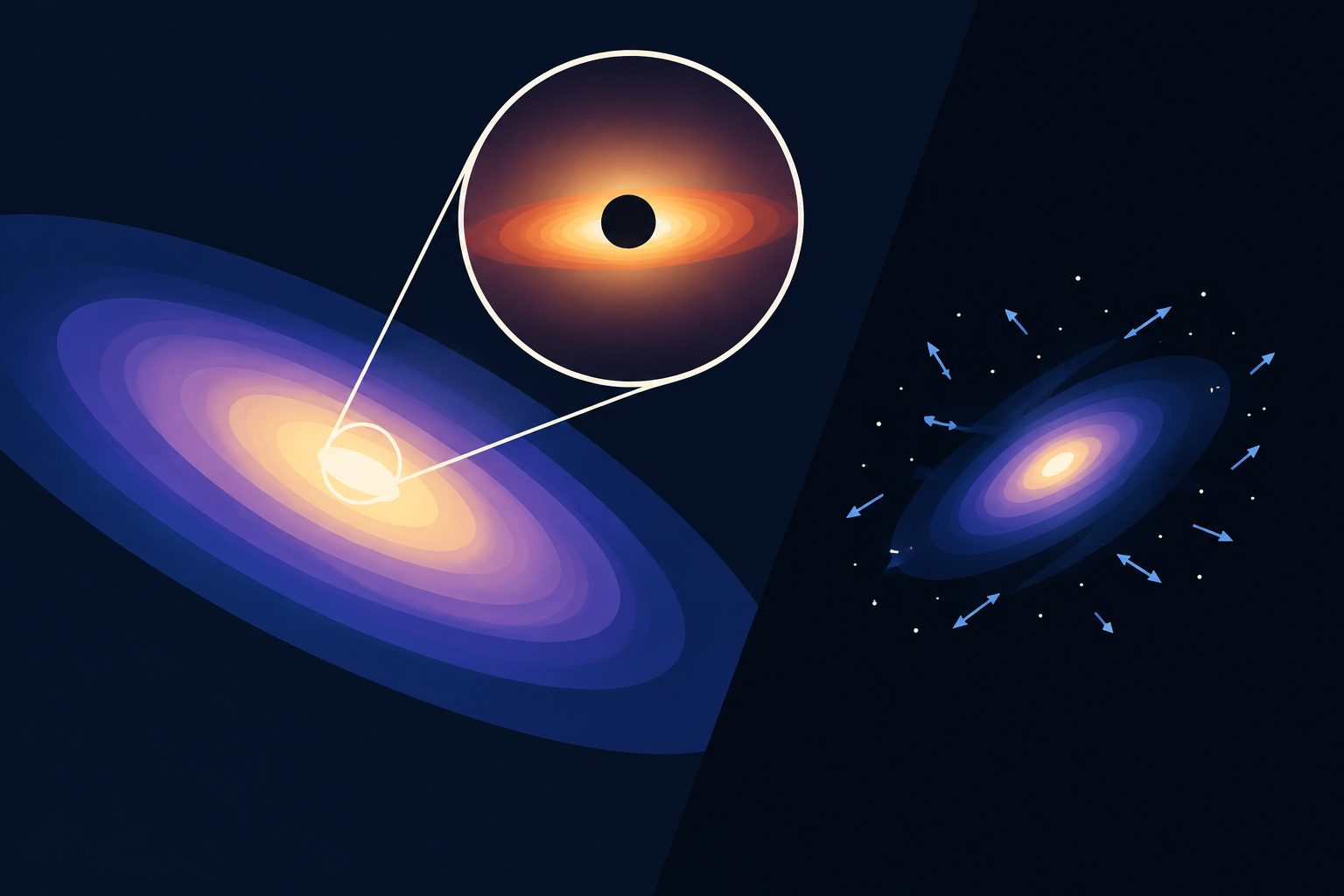
In 16 brightest cluster galaxies, the width of the central light-deficient region was a more reliable guide to black hole mass than the galaxies’ central motion.
Researchers studied 16 brightest cluster galaxies, including eight with newly identified ultramassive black holes—those heavier than 10 billion Suns. They used triaxial dynamical models, which account for stars moving in three dimensions, to measure the black holes and examined how those masses related to the galaxies’ properties.
The galaxies did not follow the usual black hole–stellar speed relation at the high-mass end. Instead, the size of their central light-deficient cores showed a tighter connection with black hole mass, continuing the trend found in earlier studies and supporting a model in which pairs of black holes eject stars from galactic centers during mergers.
Core size beats stellar speed
The study found that brightest cluster galaxies are outliers from the commonly used relation linking black hole mass to central stellar velocity dispersion. For the ultramassive black holes in this sample, the size of the depleted central core had a scatter of 0.22 dex—about half the scatter of the relation based on stellar speed—making it a more accurate predictor of black hole mass.
The researchers’ sample included eight newly identified ultramassive black holes and doubled the number of known objects in that category. Core size also correlated tightly with the black hole’s sphere of influence and with the core’s central density. These relationships, together with the galaxies’ central tangential stellar orbits, support the idea that black hole binaries helped create the cores by ejecting stars. The observed core sizes were inconsistent with predictions based on gravitational-wave recoil alone.
The pattern was not universal: two confirmed galaxies had large cores but relatively small black holes, while some coreless galaxies contained massive or ultramassive black holes. The researchers say these exceptions exist but appear uncommon among the selected systems.
Why the core matters
The result identifies a potentially more useful way to estimate the masses of the largest black holes. Core size can be measured from a galaxy’s light, so it may help researchers find galaxies likely to host very massive black holes even when a direct dynamical mass measurement is not available.
The connections among core size, black hole mass, the sphere of influence and central stellar motions also provide evidence about how the centers of the most massive galaxies formed. In particular, they are consistent with core formation through interactions involving pairs of black holes rather than gravitational-wave recoil alone.
Evidence and caveats
This is an analysis of dynamical black hole mass measurements in 16 brightest cluster galaxies. The new measurements used triaxial Schwarzschild models, which represent stellar orbits and allow the galaxies’ three-dimensional shapes to be considered. The researchers also measured core sizes from high-resolution imaging and fitted models to the galaxies’ surface-brightness profiles.
The sample was selected as a group of candidate ultramassive-black-hole hosts because of their large cores or high masses, so it is not a general sample of all galaxies. The conclusions therefore apply most directly to the high-mass brightest cluster galaxies studied here. The findings show correlations and support a black-hole-binary formation model, but the scaling relations and observed stellar motions do not by themselves provide a complete reconstruction of each galaxy’s merger history. Some large-core galaxies had small black holes, and some massive black holes were found in coreless galaxies.