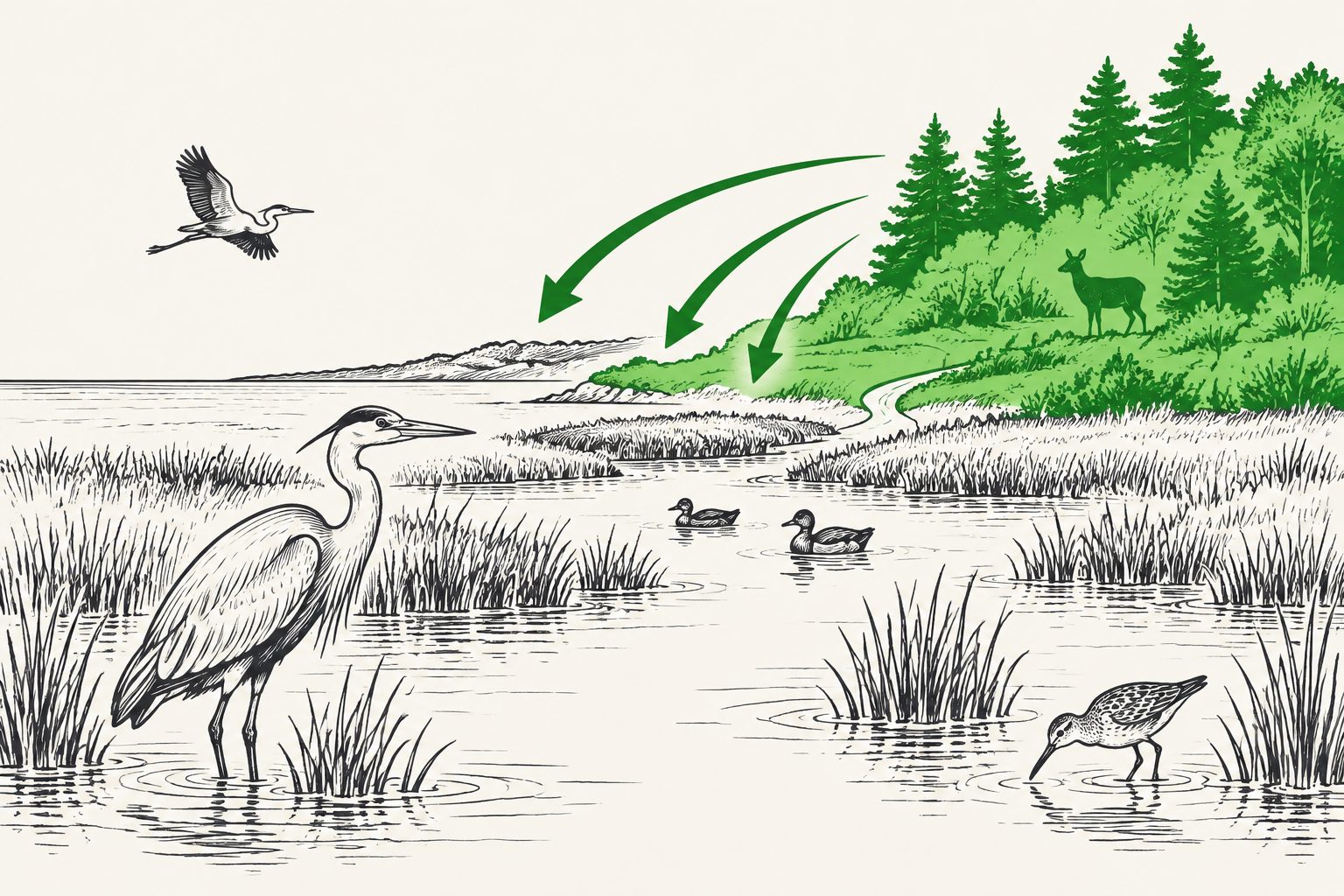
A survey in southeast Queensland found that links to natural habitats shaped vertebrate communities more strongly than most local habitat features.
Researchers used baited camera traps to survey terrestrial vertebrates in 57 mangrove and 58 saltmarsh sites in southeast Queensland, Australia. The sites ranged from estuaries near extensive urbanisation to more natural areas, allowing the researchers to compare local habitat conditions with the surrounding landscape.
Native and introduced species showed different relationships with nearby urban, agricultural, protected and remnant natural land. Landscape patterns generally had stronger effects than local habitat structure, although some local effects were observed.
Wildlife followed the wider landscape
The cameras recorded 45 species in mangroves and 38 species in saltmarshes. Native species in saltmarshes increased with the area of nearby mangroves and remnant natural land, while native species in mangroves peaked at intermediate levels of nearby saltmarsh and remnant land.
Introduced species in mangroves increased as sites became closer to urban land and declined as the amount of protected land increased. Introduced species in saltmarshes increased with urban extent but declined with remnant natural land, protected land and mangrove extent. Several relationships peaked at intermediate amounts of saltmarsh or agricultural land.
The researchers found only minor effects from local habitat structure. These effects were influenced by broader landscape conditions or by general structural features of the habitat.
Survey evidence and limits
This was a field survey using baited camera traps over 48 hours, covering four tidal cycles, at 115 sites across seven estuaries in southeast Queensland. The researchers compared wildlife records with measurements of local habitat and the surrounding landscape.
Because the study observed existing conditions rather than assigning land-use changes, it identifies relationships but does not by itself prove that a particular landscape feature caused a change in species presence or abundance. The survey also covered one region of Australia and a short sampling period, so the findings may not apply in the same way to other coastal wetlands or seasons.