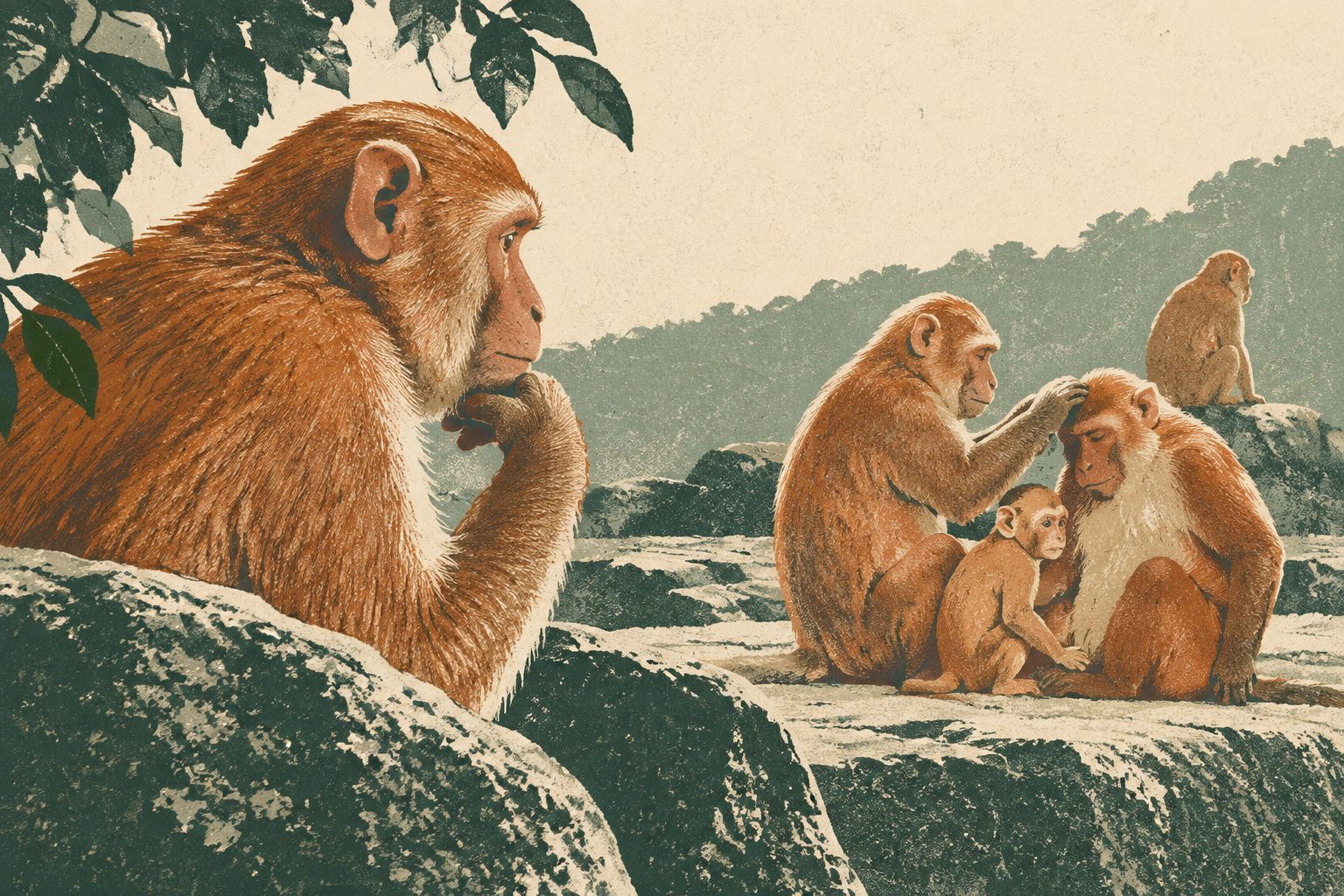
Attention to unfamiliar female faces was associated with a higher chance of reproducing the following year.
Researchers tested female rhesus macaques in a semi-free-ranging population by showing them photographs of unfamiliar monkeys and measuring how long they looked at the images. The study followed reproductive outcomes across three annual birth seasons.
Greater interest in the initial female face was associated with a higher likelihood of reproducing the following year. The monkeys’ current reproductive state also affected their responses: females caring for a newborn showed less interest in unfamiliar conspecifics than pregnant or nonbreeding females.
What the monkeys watched
The study included 103 reproductive-age female rhesus macaques, tested across as many as three years. Females that spent more time attending to the initial unfamiliar female face were more likely to reproduce in the following year. This relationship was tested against future reproduction to separate it from the effects of a female’s current reproductive state.
Nursing females showed less interest in unfamiliar conspecifics than pregnant or nonbreeding females. Interest in the subsequently shown male images was not associated with reproductive success. The findings therefore link attention to unfamiliar female social information—not attention to all of the tested images—to later reproduction.
// Source
Behavioral Ecology and Sociobiology · 2026 · DOI: 10.1007/s00265-026-03801-w
Authors: Raisa Hernández‐Pacheco, Alexis A Diaz, Nalina Aiempichitkijkarn, Natalia Camargo Peña, Sheida Yahyazadehmoghaddam, Jacob Weber, Elizabeth Maldonado, Shripad Tuljapurkar, Alexandra G. Rosati
Institutions: University of Michigan, Stony Brook University, Stanford University, University of Puerto Rico, Medical Sciences Campus, California State University, Long Beach, University of Puerto Rico System, Suranaree University of Technology