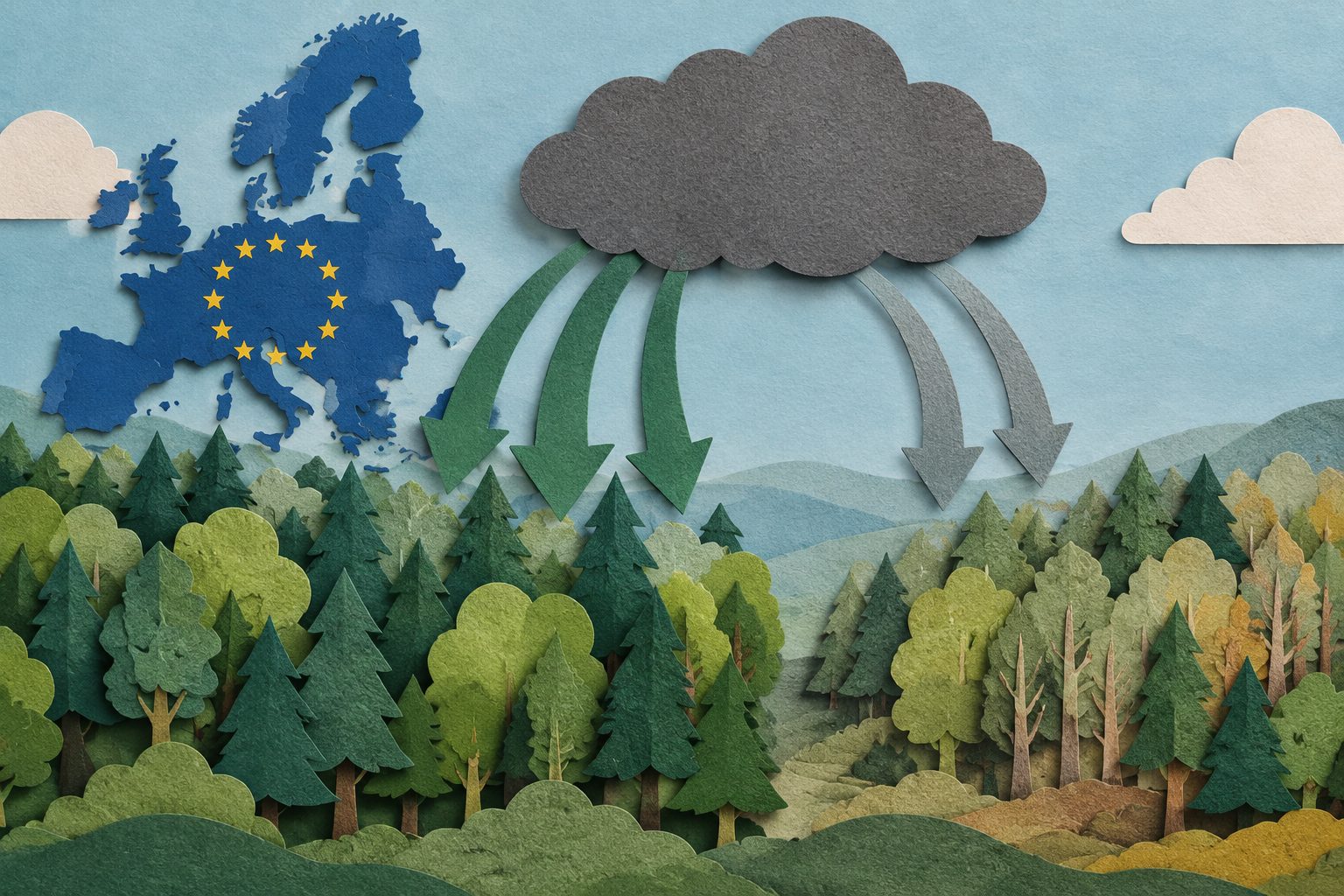
Falling forest growth, harvesting, fires and other pressures are widening the gap to the bloc’s 2030 removal target.
The study synthesises recent assessments of the European Union’s land use, land-use change and forestry carbon balance. The EU-27 land sink was about 231 million tonnes of carbon dioxide equivalent in 2024, compared with a binding 2030 target of 310 million tonnes, and Member State projections indicate a remaining gap of 40–55 million tonnes.
The authors link the weakening sink to declining forest growth, increased harvesting, climate-driven disturbances and rising demand for woody biomass. They also argue that land-removal plans should account for how quickly removals can be delivered, changes in stored carbon, uncertainty in inventories, disturbances and competition for land and biomass.
Where the sink is weakening
The EU-27 land use, land-use change and forestry balance was approximately minus 231 million tonnes of carbon dioxide equivalent in 2024. The latest Member State projections indicate that the bloc may fall 40–55 million tonnes short of its binding minus 310-million-tonne target for 2030.
The study identifies declining forest growth, increased harvesting, climate-driven disturbances and rising biomass demand as factors reducing net carbon uptake. In one 2040 sensitivity analysis using the GLOBIOM model, an additional demand of 20 million tonnes of oil equivalent in woody biomass was associated with an approximately 100-million-tonne reduction in the land sink.
The EU inventory reported uncertainty of 52.7% in the 2022 land-sink level and 29.4% in its trend. The authors also note that important changes in soil carbon are not yet fully represented.
Why the shortfall matters
EU climate policy relies partly on land to remove carbon from the atmosphere and help balance remaining greenhouse-gas emissions. The findings indicate that these removals are dynamic and vulnerable to disturbances, harvesting and competing biomass demand rather than being a fixed resource that can be rapidly expanded.
If land sinks deliver less than expected, the assumptions behind carbon-neutrality plans may not hold. The study therefore calls for removal plans to be assessed using dependable annual removals alongside changes in stored carbon, delivery time, uncertainty, exposure to disturbances and reversals, and competition for land and biomass.
Evidence and uncertainties
This is a synthesis of recent assessments rather than a new field experiment. It draws on EU inventories, Member State projections and modelling, including one 2040 sensitivity analysis of added woody-biomass demand.
The results are subject to substantial measurement and accounting uncertainty: the reported uncertainty was 52.7% for the 2022 land-sink level and 29.4% for its trend. Soil-carbon dynamics are also incompletely represented. The biomass-demand result comes from a sensitivity analysis, so it describes one modelled scenario rather than a prediction of what will necessarily occur.
// Source
Carbon Neutrality · 2026 · DOI: 10.1007/s43979-026-00185-8
Authors: Behrouz Gholamahmadi, Eva Ivits
Institutions: University of Aveiro, European Environment Agency