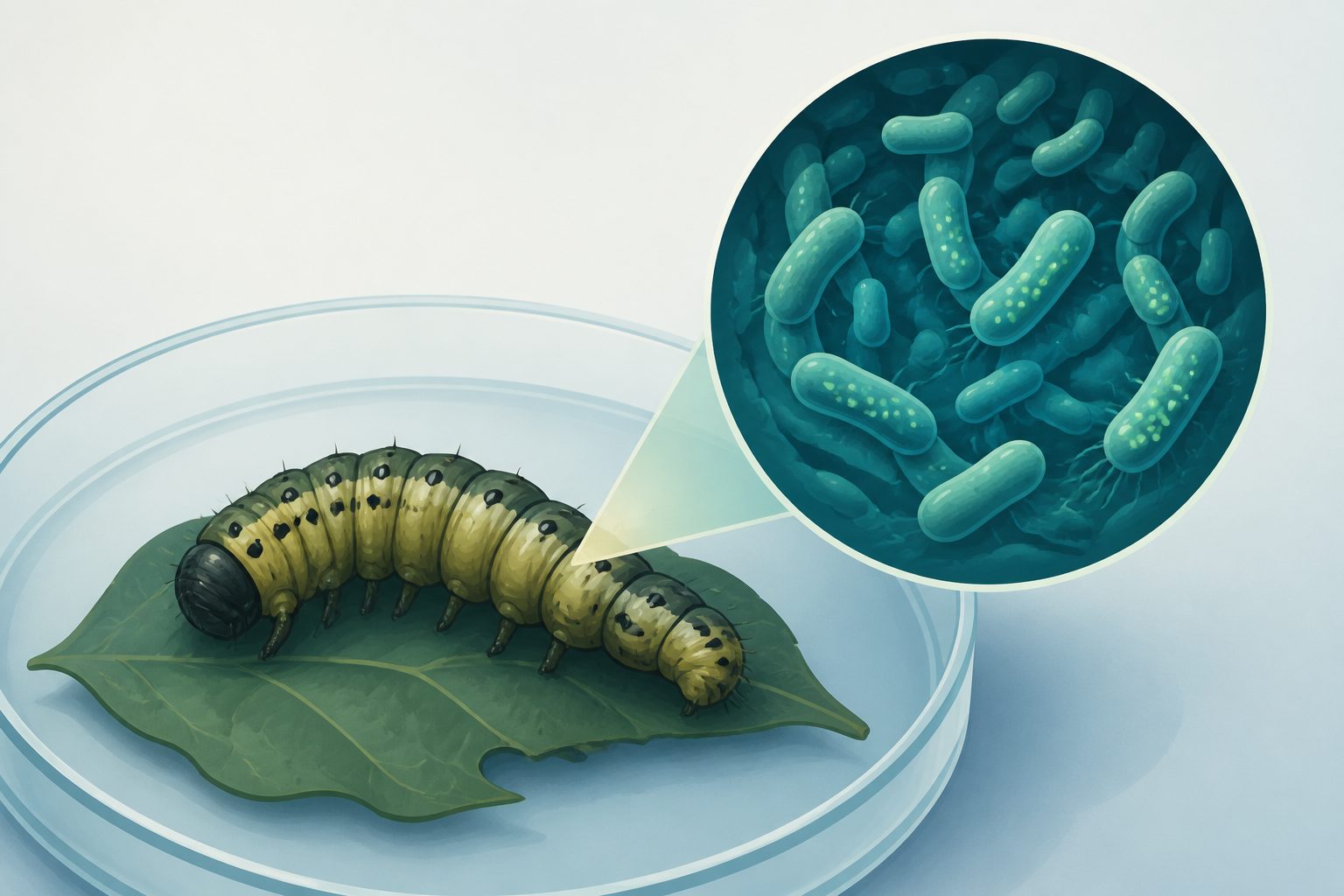
The modified bacterium produced the insect-killing Cry1Ac toxin and colonized both caterpillar guts and tomato leaves in laboratory experiments.
Researchers engineered Enterobacter aerogenes, a bacterium found in the gut of Helicoverpa armigera, to produce Cry1Ac, a toxin made by Bacillus thuringiensis. In laboratory tests, the modified bacterium killed up to 100% of exposed larvae, including all larvae in one leaf-treatment test within eight days.
A related version carrying a fluorescent marker colonized caterpillar guts within 48 hours and tomato leaves within 24 hours. The findings support further study of the bacterium as a possible way to deliver insect-killing molecules, but its behavior and safety outside the laboratory remain unknown.
What the modified bacteria did
The researchers introduced two plasmids into Enterobacter aerogenes: one carrying the gene for the Cry1Ac toxin and another producing green fluorescent protein. The fluorescent version colonized Helicoverpa armigera larvae within 48 hours and tomato leaves within 24 hours.
In feeding tests, diets containing 10⁵ to 10⁹ transformed cells produced mortality of 79% to 100% among larvae exposed to engineered E. aerogenes. A Cry1Ac-producing Escherichia coli strain used for comparison produced mortality of 86% to 100% over the same tested cell range.
When leaves were treated with 1.0 × 10⁸ engineered E. aerogenes cells per leaf, the treatment caused 100% larval mortality within 192 hours, or eight days.
// Source
World Journal of Microbiology and Biotechnology · 2026 · DOI: 10.1007/s11274-026-05175-7
Authors: Abhishek Ojha, Mohd Usman
Institutions: Symbiosis International University, International Centre for Genetic Engineering and Biotechnology