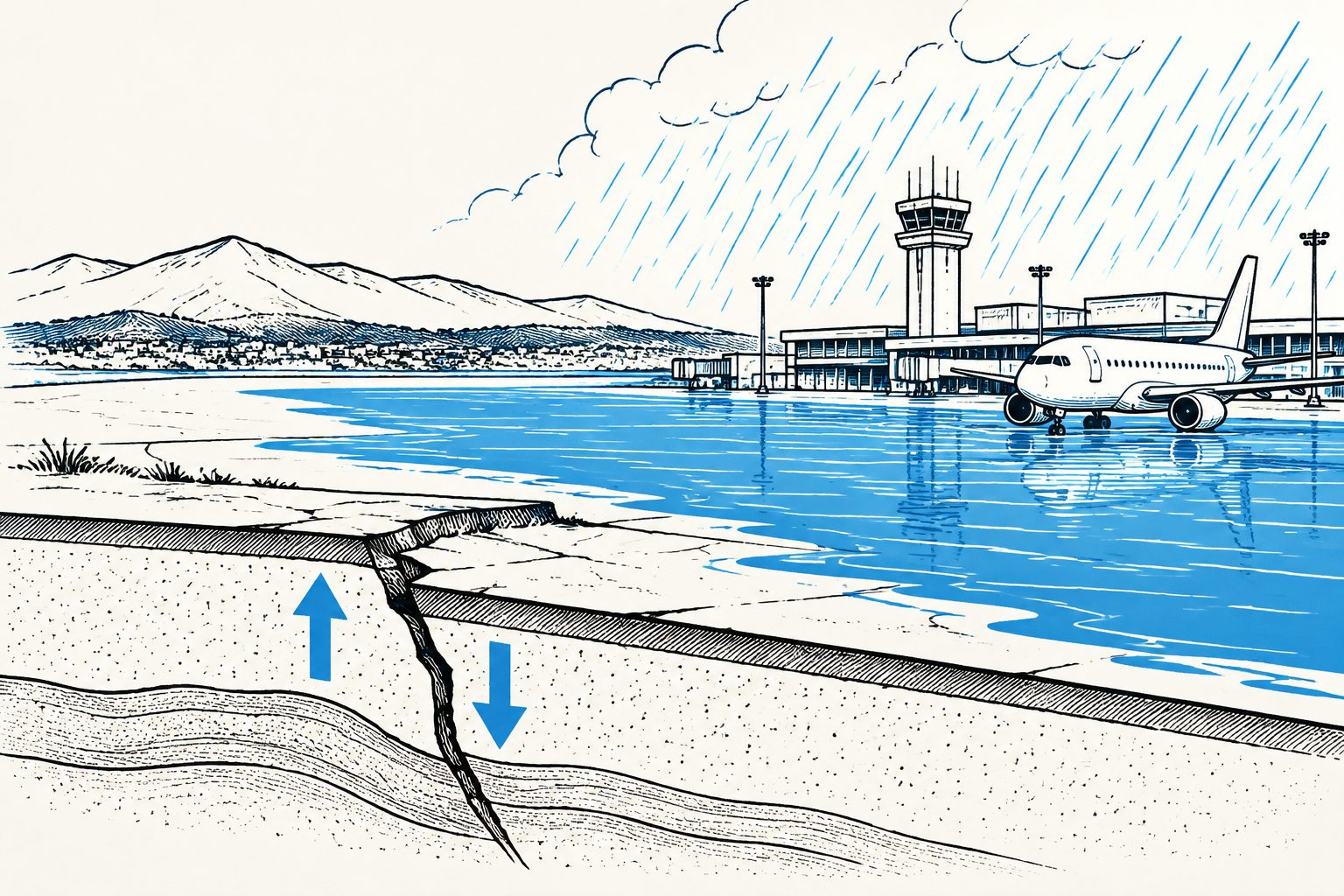
Modelling of a possible Titri fault rupture suggests uplift could block drainage and subsidence could reduce infiltration in the Taieri Basin.
Researchers combined models of earthquake-related ground movement with flood simulations to examine how a Titri fault rupture could affect the Taieri Basin, which is managed by the Lower Taieri Flood Protection Scheme. The approach assessed changes in flood depth, extent and frequency after the ground deformation.
In the modelled scenario, involving 2.6 metres of fault slip and a 45-degree fault dip, Dunedin Airport flooded during events with a 2%–5% annual exceedance probability. The simulations also indicated that fault uplift could obstruct the basin’s drainage outlet, while sinking on the other side of the fault could reduce infiltration and help form a lake after an earthquake.
How the ground could change flooding
The researchers’ paired fault and flood modelling identified areas where an earthquake could increase exposure to flooding in the Taieri Basin. With 2.6 metres of slip on the modelled Titri fault at a 45-degree dip, Dunedin Airport was flooded to depths of 0.3–1.5 metres during flood events with a 2%–5% annual exceedance probability.
The simulations showed that earthquake-related uplift could obstruct the basin’s drainage outlet and undermine flood defenses. Subsidence in the fault’s footwall could reduce how much water enters the ground and may help a lake form during or after the earthquake.