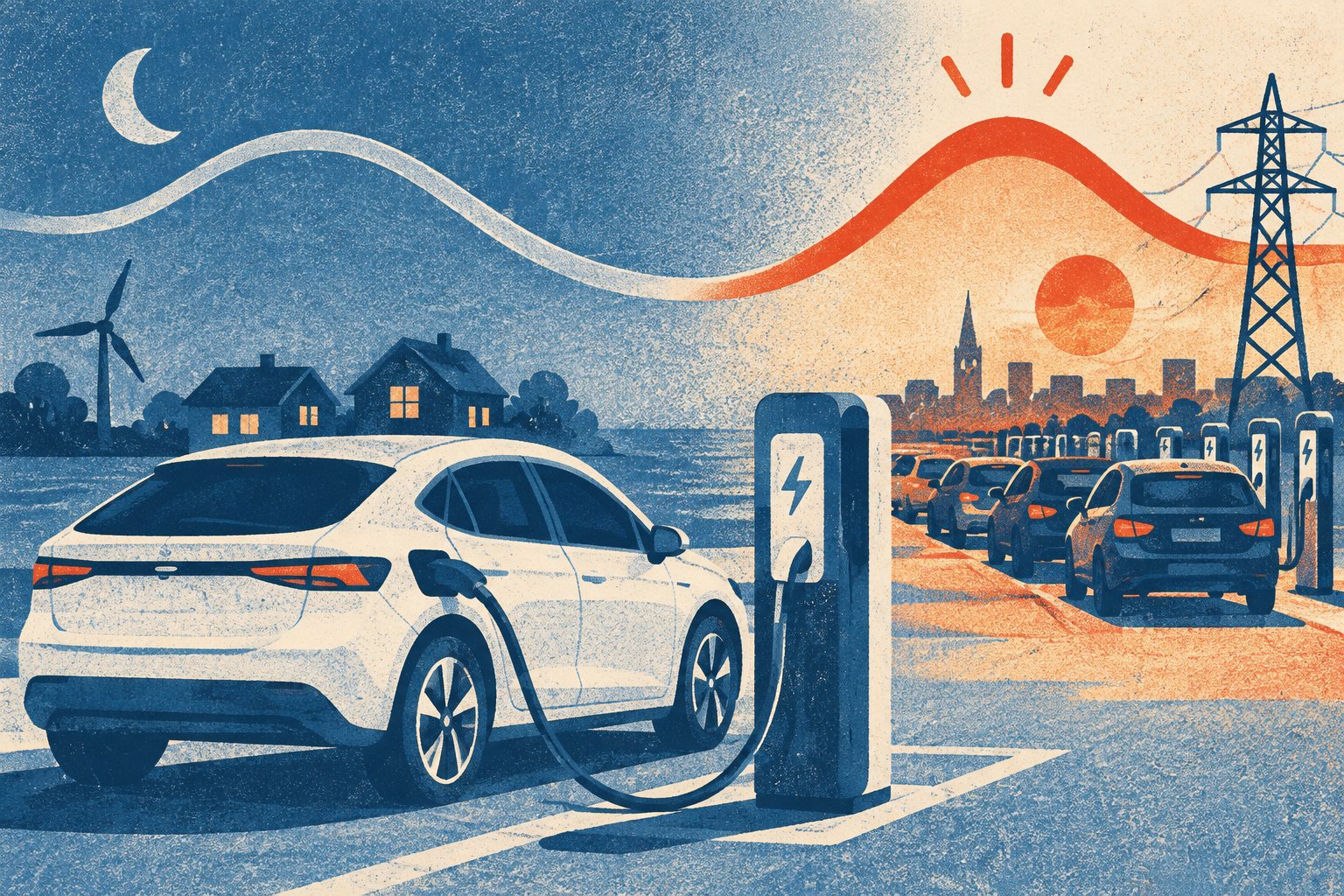
Households moved charging to lower-priced hours, raising the possibility of synchronized demand surges as more electric vehicles join the grid.
Researchers analyzed more than three years of hourly charging-session data from approximately 5,000 residential charging stations in Denmark. They compared the response of electric-vehicle charging with the response of general household electricity consumption, using changes in wind and solar generation to help separate price effects from other influences on demand.
Charging was much more responsive to hourly prices than overall household electricity use. The findings support dynamic pricing—prices that vary over time—as a way to shift charging toward periods when electricity is cheaper, while also pointing to a risk that many households could charge at the same time.
How charging responds to prices
The researchers estimated a short-term price elasticity of demand of –0.756 for residential electric-vehicle charging. In practical terms, charging demand fell as hourly prices rose and shifted toward cheaper hours. The corresponding estimate for general household electricity consumption was –0.062, indicating much less short-term responsiveness.
Households’ tendency to move charging to cheaper hours intensified during the 2022 energy crisis and persisted after electricity prices returned to more stable levels. The study also highlights a risk: if many electric-vehicle owners respond to the same prices, their charging could become synchronized and create new demand peaks.
Why timing matters for the grid
Electric-vehicle charging is a flexible form of electricity demand: unlike many household uses, it can often be moved to another hour. The results suggest that time-varying prices could help make use of this flexibility, including in a power system with substantial variable wind and solar generation.
The same response could create a coordination problem. If large numbers of households move charging into the same low-price periods, the resulting concentration of demand could produce peaks that grid operators need to manage.
Evidence and caveats
The study uses more than three years of hourly charging-session data from approximately 5,000 residential charging stations in Denmark. Its estimates come from an instrumental-variable analysis that uses wind and solar generation as sources of price variation, and the researchers compare electric-vehicle charging with general household electricity consumption.
The evidence concerns short-term responses in Danish households and residential charging stations, so the abstract does not establish whether the same response would occur in other countries, over longer periods, or under different pricing and charging arrangements. The study identifies the potential for synchronized peaks but does not report that such peaks have already occurred.