Cosmic surveys point to stronger gas expulsion around smaller dark matter structures
A joint analysis of galaxy shapes and hot gas suggests active galaxies affect lower-mass halos more strongly than some simulations assume.
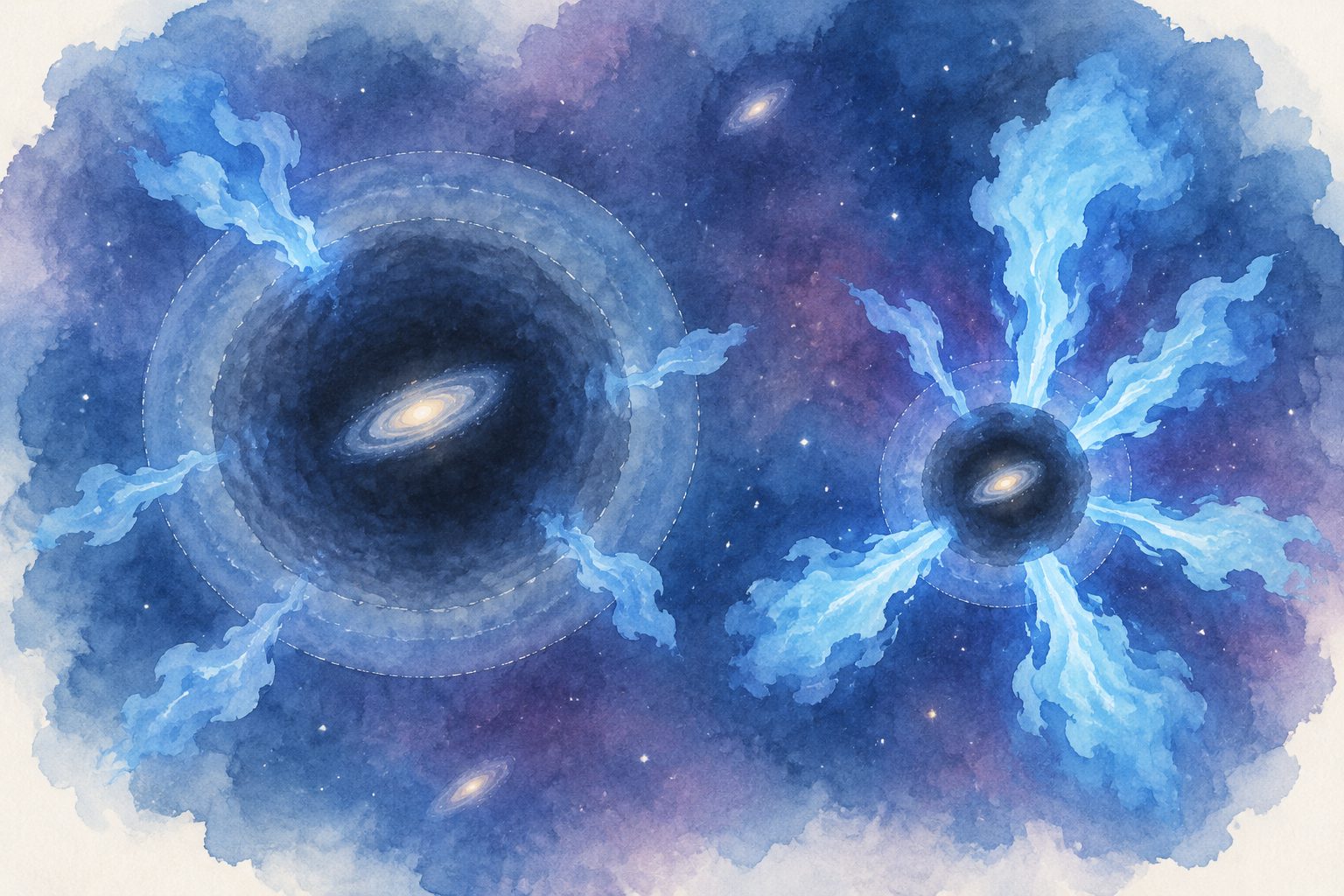
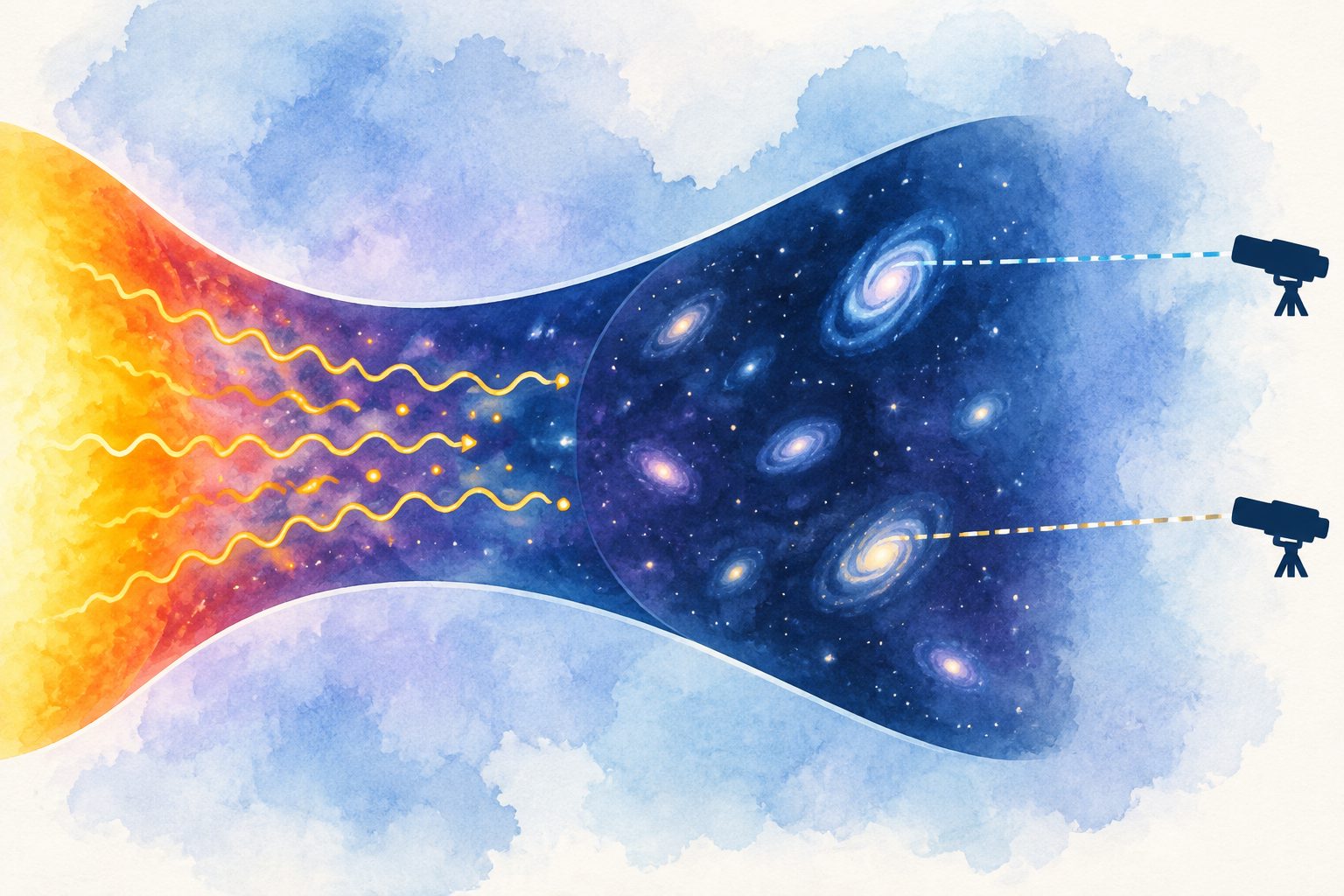
Editorial illustration — not from the study.
Researchers combined measurements of how foreground matter distorts distant galaxy shapes with measurements of pressure from hot gas in large-scale structure. The cross-correlation between the two signals was detected at 21 standard deviations, after reducing contamination from infrared-emitting galaxies in the gas map.
Jointly modeling the two measurements produced tighter constraints on matter density and its late-time clustering than the lensing data alone. The results were consistent with primary cosmic microwave background analyses, while the inferred suppression of matter clustering showed a 2–4 standard-deviation tension with simulations that use mild feedback from active galaxies.
What the surveys found
The researchers detected the correlation between galaxy lensing and the thermal Sunyaev–Zel’dovich signal at 21 standard deviations. Combining that signal with the lensing auto-correlation gave S₈ = 0.811⁺⁰·⁰¹⁵₋₀·₀₁₂ and Ωm = 0.263⁺⁰·⁰²³₋₀·₀₃₀, consistent with primary cosmic microwave background results from Planck and the combined Planck–Atacama Cosmology Telescope analysis.
The data indicated reduced thermal gas pressure in dark matter halos with masses below 10¹⁴ solar masses per unit h. They also favored stronger suppression of matter clustering than hydrodynamic simulations with mild baryonic feedback, with a reported 2–4 standard-deviation tension. The joint analysis tightened the constraints by helping separate effects that are difficult to distinguish with lensing alone.
Why gas feedback matters
Matter-distribution measurements depend on how gas is moved and heated by processes such as activity from galactic centers. By measuring total matter and gas pressure together, this analysis provides a more direct way to constrain those effects and reduces uncertainty in the cosmological interpretation of small-scale lensing data.
The preference for stronger feedback challenges some simulations used to model how matter is distributed. However, the researchers note that simulations with strong feedback have difficulty reproducing other observations, including galaxy colors, galaxy shapes and X-ray measurements of clusters. This leaves open whether the difference reflects the strength of active-galaxy feedback or other processes affecting ionized gas.
Evidence and caveats
The evidence comes from a joint statistical analysis of the first three years of Dark Energy Survey galaxy-shape data and thermal Sunyaev–Zel’dovich maps made from Atacama Cosmology Telescope and Planck observations. The analysis covered halos with masses of roughly 5 × 10¹³ to 5 × 10¹⁴ solar masses per unit h, redshifts of about 0.2 to 0.7, and matter-power-spectrum scales up to approximately 5 h per megaparsec. The researchers modeled possible contamination from the cosmic infrared background and used mitigation methods before drawing their conclusions.
The results depend on the joint model of matter and gas thermodynamics, which was validated using hydrodynamic simulations. The comparison with simulations is therefore model-dependent, and the paper notes that other poorly understood sources—such as cosmic rays—could contribute to the observed patterns. Strong-feedback simulations also do not match every other observable, so the findings do not identify a single confirmed explanation for the inferred suppression.
// Source
Physical review. D/Physical review. D. · 2026 · DOI: 10.1103/zbwq-mjq5
Experiments on KV₂Se₂O found momentum-dependent spin polarization even though the material has no net magnetization. Spin-sensitive tunneling and computer simulations linked the pattern to the crystal’s symmetry and a characteristic four-lobed form.
A new analysis finds that extra, self-interacting radiation in the early universe is more compatible with ACT observations when the pattern of primordial fluctuations is allowed to vary with scale. In the models tested, this reduces the Hubble tension from the standard model’s level to 2.2σ, or below 2σ in a version where the radiation was once coupled to dark matter.
Researchers used a tensor-network calculation to study how force-carrying strings break apart in a simplified model of particle interactions. The work links string breaking with energy transport, particle production, entanglement growth and the spread of correlations.