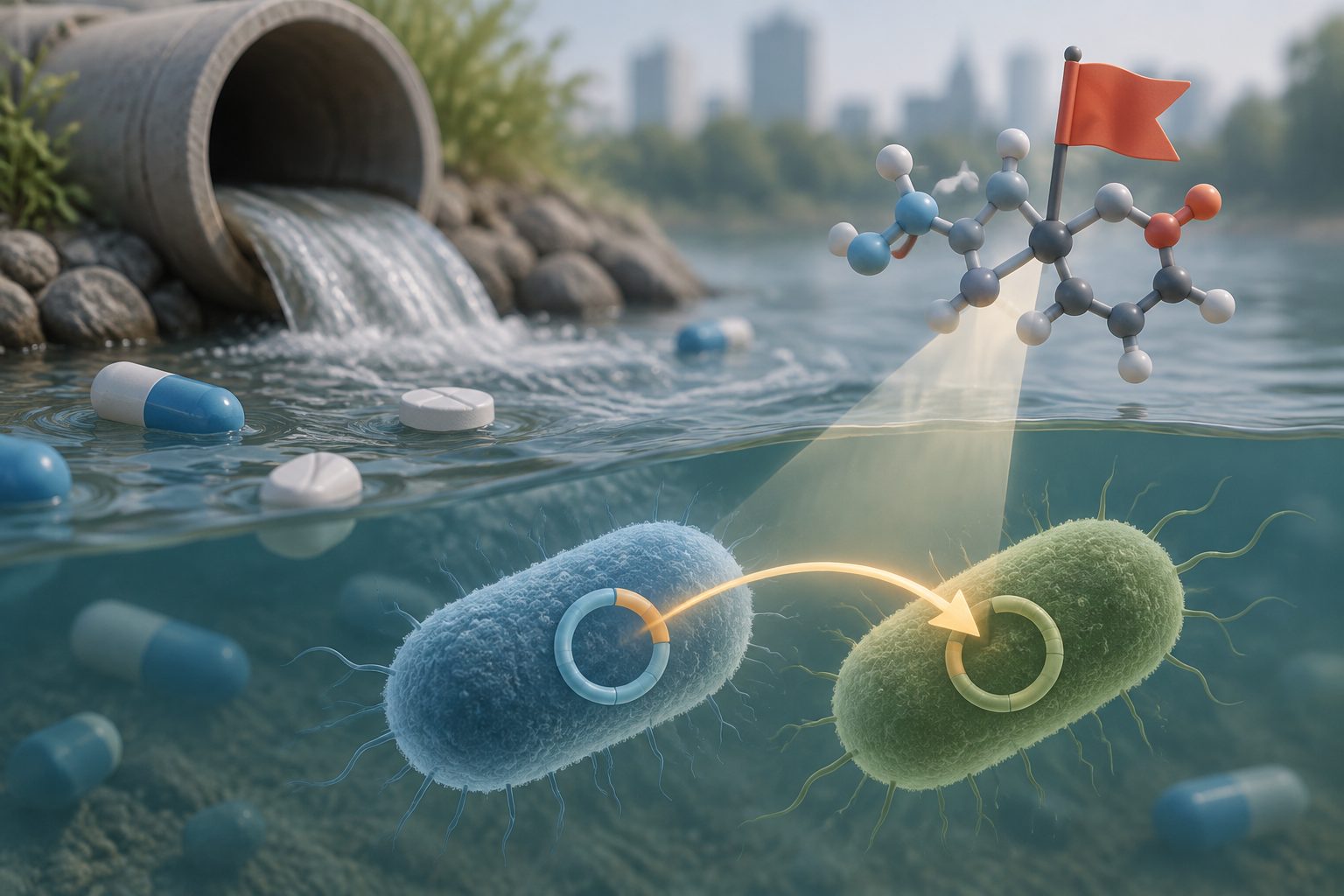
A machine-learning study found that molecular features helped predict whether chemicals were linked to higher or lower transfer of an antibiotic-resistance plasmid.
Researchers assembled data from 73 in vitro studies that tested how individual chemicals affected transfer of the RP4 plasmid, a DNA molecule that can move between bacteria. The data included chemical concentrations, transfer frequencies and experimental conditions, along with several ways of describing each compound’s structure.
Across 3,066 models, concentration by itself did not meaningfully predict transfer. The best model combined concentration, chemical fingerprints and experimental conditions, and performed better on compounds held out from training than models based only on concentration.
What the model linked
Chemical structure was the most influential type of information in the predictions. The best-performing extreme-gradient-boosting model combined concentration, Morgan fingerprints—a computer representation of molecular structure—and experimental conditions. It reported a Q²ext score of 0.373 on a held-out test set in which compounds were kept separate from those used for training; across 20 independent data splits, the median score within the model’s defined applicability domain was 0.319.
A SHAP analysis, which estimates how much each input contributes to a model’s output, attributed 69% of the total predictive weight to Morgan fingerprints. Quaternary ammonium compounds and long-chain alkyl structures were associated with inhibition of plasmid transfer. Sulfonamide- and amine-containing compounds were associated with promotion of transfer. These are model-based associations, not demonstrations that every compound with one of these features will produce the same effect.
Why the screening tool matters
Chemical effects on the transfer of antibiotic-resistance plasmids have been reported for individual compounds, but testing every chemical experimentally is difficult. The study suggests that molecular structure can add useful information beyond concentration when prioritizing chemicals for further assessment.
The researchers describe the approach as a scalable framework for evaluating chemicals that may contribute to antibiotic-resistance dissemination. Its predictions can help organize which compounds warrant closer study, but they do not by themselves establish effects in environmental or clinical settings.
Evidence and caveats
The analysis combined quantitative results from 73 in vitro studies, restricting the modeling data to broth-based experiments involving the RP4 plasmid and individual chemical compounds. Researchers compared 1,022 feature-set combinations across 3,066 models and evaluated the leading approach on a compound-aware held-out test set and across 20 independent splits.
The evidence comes from laboratory assays and one plasmid system, so the findings may not apply to other plasmids, bacteria or exposure settings. Experimental conditions varied among studies, and the available data were too limited to robustly model complex nonlinear interactions among those conditions. The model’s predictive performance was moderate as reported by the study, and the associations identified by feature analysis should not be interpreted as proof of causation.