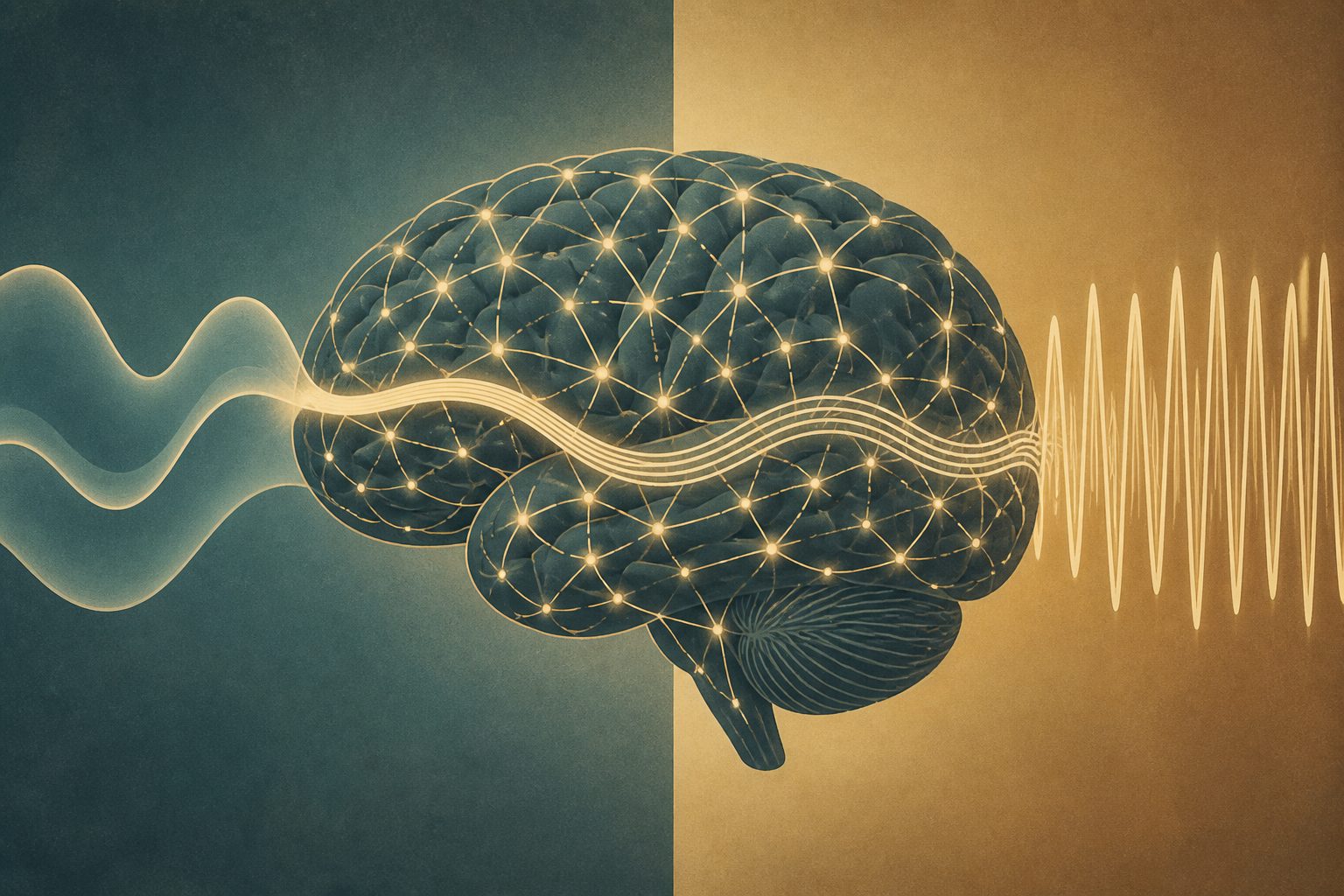
A model of 90 connected brain regions produced gamma activity whose strength varied with slower rhythms, shaped by anatomical connections.
The study examined how complex activity patterns emerge in a large-scale brain model built from 90 interconnected regions. Each region used a neural model designed to represent gamma activity arising from interactions between excitatory and inhibitory populations, while the connections between regions were based on anatomical data.
The researchers analyzed stable resting and oscillating states, then tested how uniform and region-specific disturbances changed over time. Their results indicated that this model produced a broader range of dynamics than earlier models and that anatomical connectivity played an important role in cross-frequency coupling—the interaction between rhythms at different speeds.
How the model behaved
The model had resting and oscillating homogeneous states, as well as heterogeneous spatiotemporal patterns in which activity differed across regions and changed over time. Stability analysis linked the directions in which these states became unstable to the emergence of these patterns.
Compared with earlier studies using classical neural mass models, the next-generation model showed a broader range of dynamics in both uniform states and spatially varied activity. The researchers also identified a role for anatomical connectivity in cross-frequency coupling, including gamma oscillations whose amplitude was modulated by slower rhythms.
// Source
UPCommons institutional repository (Universitat Politècnica de Catalunya) · 2026 · DOI: 10.1016/j.physd.2026.135232
Authors: Rosa Maria Delicado Moll, Gemma Huguet, Pau Clusella Coberó
Institutions: Universitat de les Illes Balears