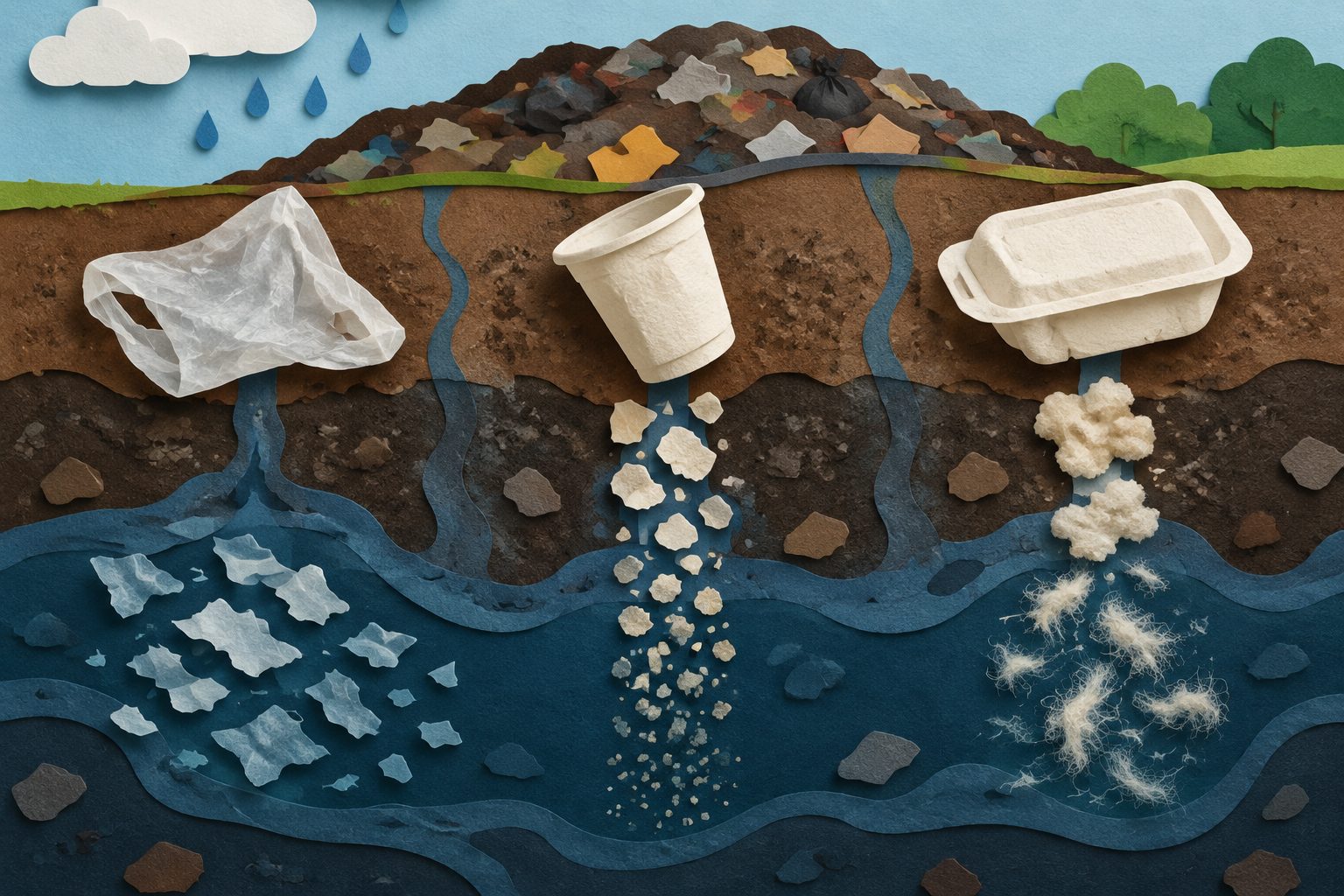
One plastic broke down completely in 17 days, another took 320 days, while a third remained largely intact.
Researchers tested polyhydroxybutyrate (PHB), poly(lactic acid) (PLA) and poly(butylene adipate-co-terephthalate) (PBAT) under oxygen-free, moderate-temperature conditions using landfill leachate. They tracked how much of each material’s carbon was converted into biogas.
The plastics followed different trajectories. PHB mineralized completely within 17 days, while PLA underwent substantial mineralization over 320 days—more than expected from its established reputation for limited breakdown under these conditions. PBAT remained largely recalcitrant, meaning resistant to degradation. Analyses of genes and their activity linked the breakdown of PHB and PLA to microbes living at the contact surface between biofilms and the plastics.
How the plastics broke down
PHB mineralized completely within 17 days. PLA reached 83.6% mineralization over 320 days, showing substantial anaerobic breakdown under mesophilic landfill-leachate conditions. PBAT remained largely resistant to degradation.
Multi-omics analyses connected PHB and PLA breakdown with the biofilm–polymer interface, where microbes attach to the plastic. Transcription of genes for depolymerases—enzymes that break polymers into smaller molecules—tracked the different phases of degradation. Although potential depolymerase genes were widespread in the recovered bacterial genomes, only a subset were actively transcribed. Some of these active organisms belonged to poorly characterized lineages outside the groups containing experimentally confirmed plastic degraders.
Why landfill conditions matter
The results show that the label “biodegradable” does not by itself predict what a plastic will do in landfill leachate. The three materials tested had sharply different outcomes, from complete breakdown in days to substantial breakdown over months to little breakdown.
The findings also indicate that microbial genetic potential alone is not enough to predict degradation. Polymer-specific barriers and the activity of microbes at the biofilm–plastic interface help determine whether breakdown occurs under the tested conditions.
Evidence and limits
This was a controlled study of three plastics in landfill leachate under anaerobic, mesophilic conditions. The researchers measured conversion of polymer carbon into biogas and combined those measurements with genome-resolved multi-omics, including evidence of depolymerase gene activity.
The abstract describes results for these three materials and these tested conditions; it does not establish that all products sold as biodegradable will behave similarly or that the same rates will occur in every landfill. It also does not report the study’s sample sizes or details needed to assess how variable the results were.
// Source
Nature Communications · 2026 · DOI: 10.1038/s41467-026-78850-w
Authors: Shinhyeong Choe, Hyungmin Choi, Hoseong Moon, Woohyuk Shin, Sunho Park, 박희주, Ju Yong Lee, Sukhwan Yoon, Konstantinos T. Konstantinidis, Changsoo Lee, Jaewook Myung
Institutions: Korea Advanced Institute of Science and Technology, Georgia Institute of Technology, Ulsan National Institute of Science and Technology