Lensing measurements from three observatories place tight limits on ultralight axions, while leaving a weak signal at one mass.
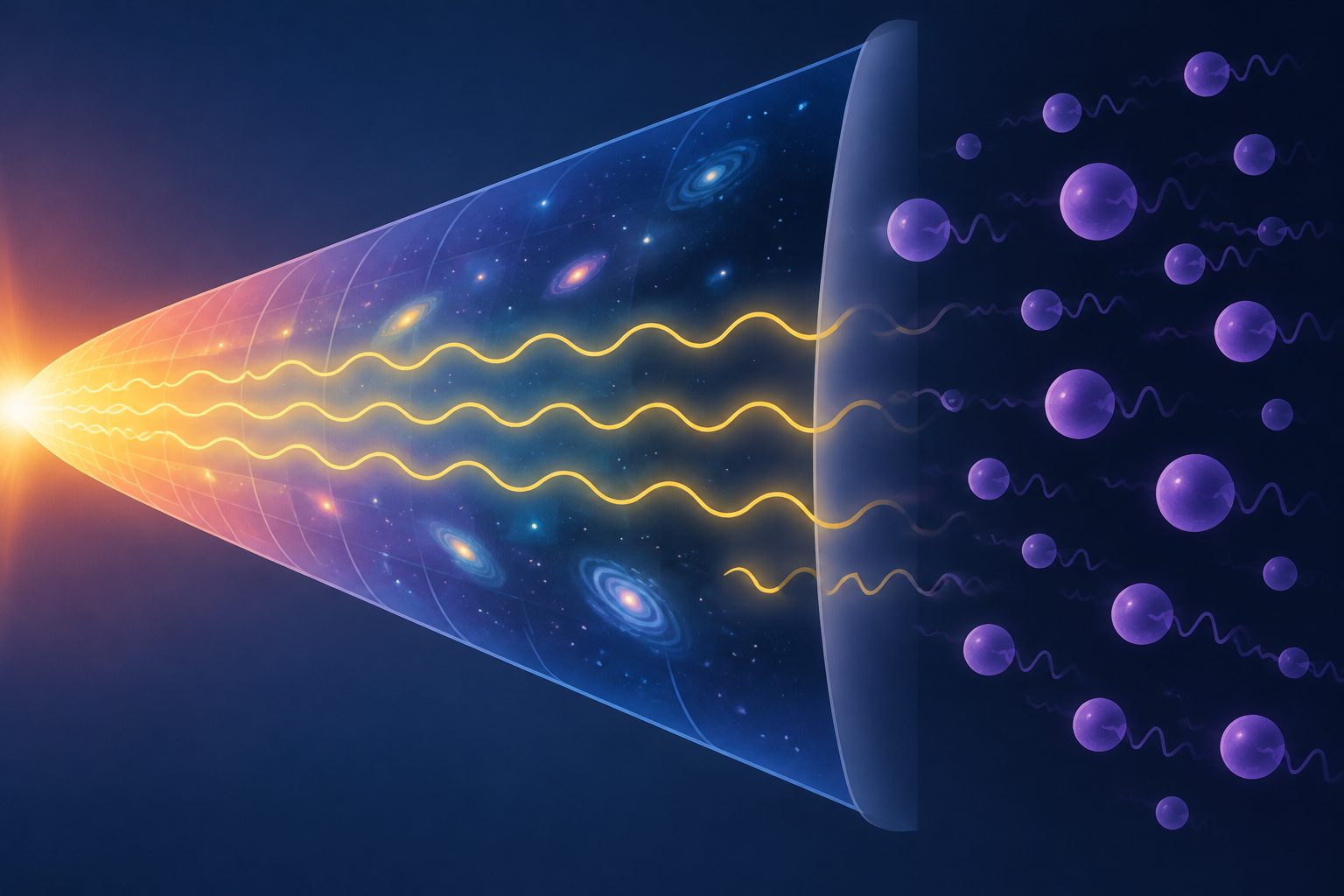
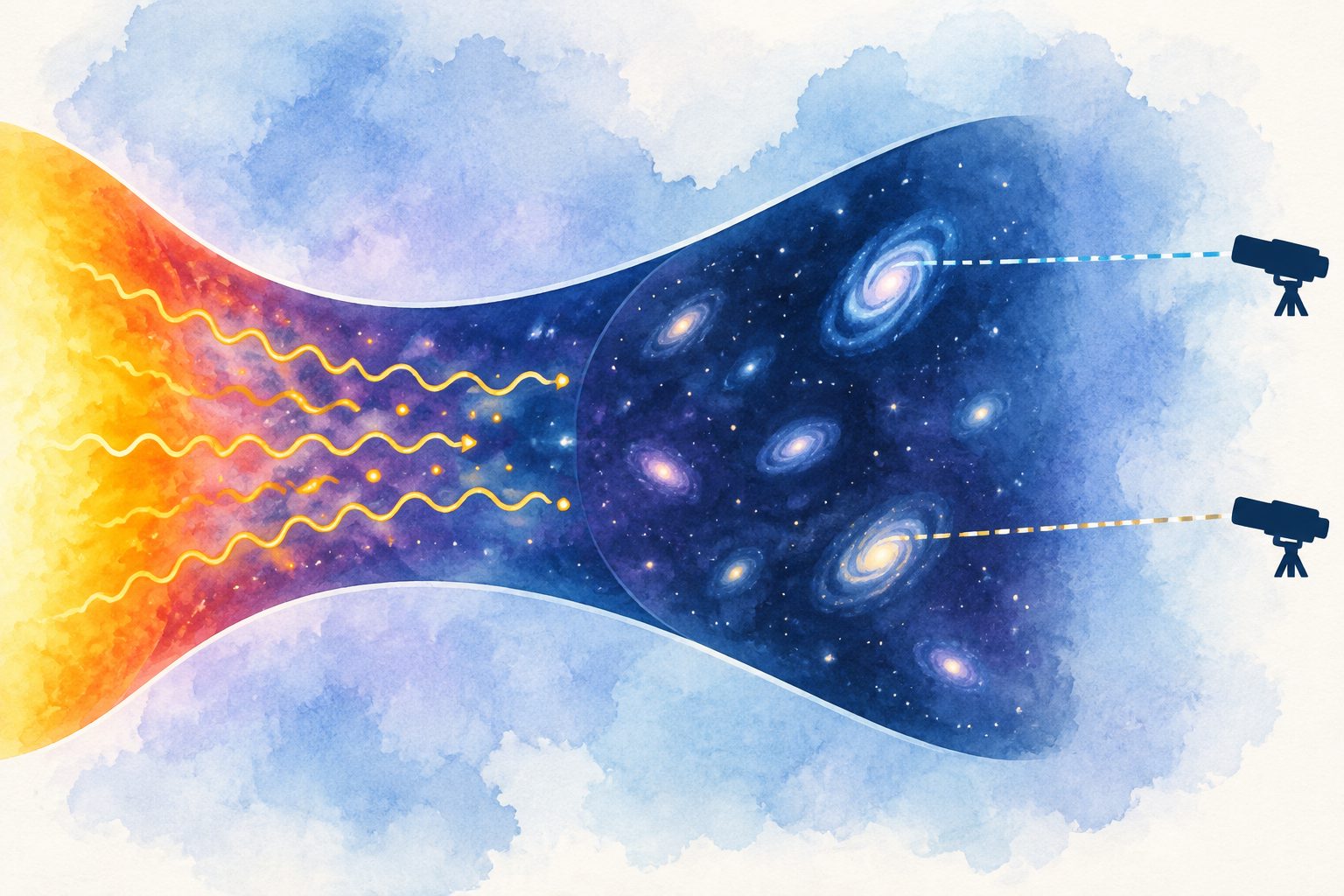
Researchers analyzed measurements of gravitational lensing—the bending of light by intervening matter—in the cosmic microwave background, the faint leftover light from the early universe. They combined data from the Planck, Atacama Cosmology Telescope and South Pole Telescope observatories with a model designed to account for the complex behavior of ultralight axions as cosmic structure forms.
The analysis produced its strongest limits for axions with masses between 10^-26 and 10^-24.5 electronvolts. At the highest mass tested, the data showed a 2.1-sigma preference for a nonzero axion contribution, but the researchers caution that this possible signal is driven by only a few data points.
The limits and possible signal
For axions with a mass of 10^-26 electronvolts, the study finds they make up less than 1.5% of all dark matter at the 95% confidence level. For axions with a mass of 10^-25 electronvolts, the corresponding limit is less than 9%.
The researchers report their strongest constraints in the mass range from 10^-26 to 10^-24.5 electronvolts. At 10^-24.5 electronvolts, they find a slight preference for a nonzero axion density at 2.1 sigma. The preference is associated with measurements showing slightly more lensing than expected from the standard cosmological model around a particular angular scale, but the researchers say the result is not yet established.
Why the limits matter
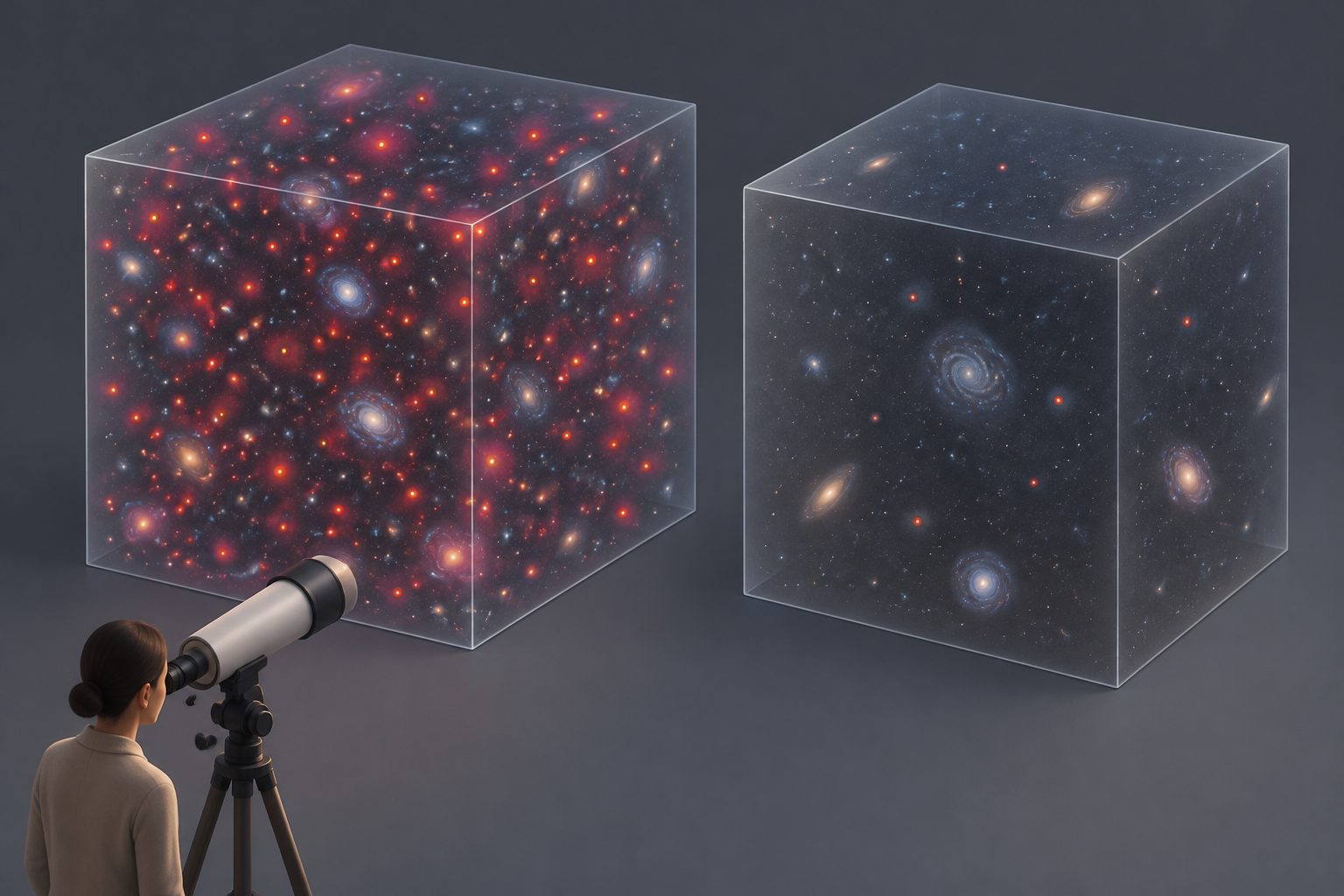
Ultralight axions are proposed particles that could account for some or all of dark matter. Axions in this mass range have also been studied as a possible way to ease differences between measurements of how strongly matter is clustered in the universe.
The new limits indicate that axions at two tested masses cannot account for more than small fractions of dark matter. The tentative signal at a higher mass points to a possible feature worth checking with future cosmic microwave background lensing measurements, rather than establishing that axions are present.
Evidence and caveats
The study fits gravitational-lensing measurements of the cosmic microwave background from Planck, the Atacama Cosmology Telescope and the South Pole Telescope. Its calculations include nonlinear structure formation using a model calibrated against simulations of mixtures of axions and ordinary cold dark matter.
The possible preference for axions is largely driven by a few data points, and the analysis effectively tests several axion masses, raising the possibility of a look-elsewhere effect. The simulation calibration covers redshifts above 1 and was run at one mass value, 10^-24.5 electronvolts. The model also does not include the effects of ordinary matter, such as gas, on the matter distribution. The researchers say more work on nonlinear axion physics is needed to confirm or rule out the possible signal.
// Source
Physical review. D/Physical review. D. · 2026 · DOI: 10.1103/h8rs-slt2
Authors: Alex Laguë, Keir K. Rogers, Mathew S. Madhavacheril, J. Richard Bond, Erminia Calabrese, Mark Devlin, Jo Dunkley, Vera Gluscevic, Renée Hložek, Hidde T. Jense, Thibaut Louis, Frank J. Qu, Bernardita Ried Guachalla, Neelima Sehgal, Blake D. Sherwin, Suzanne T. Staggs, Alexander van Engelen