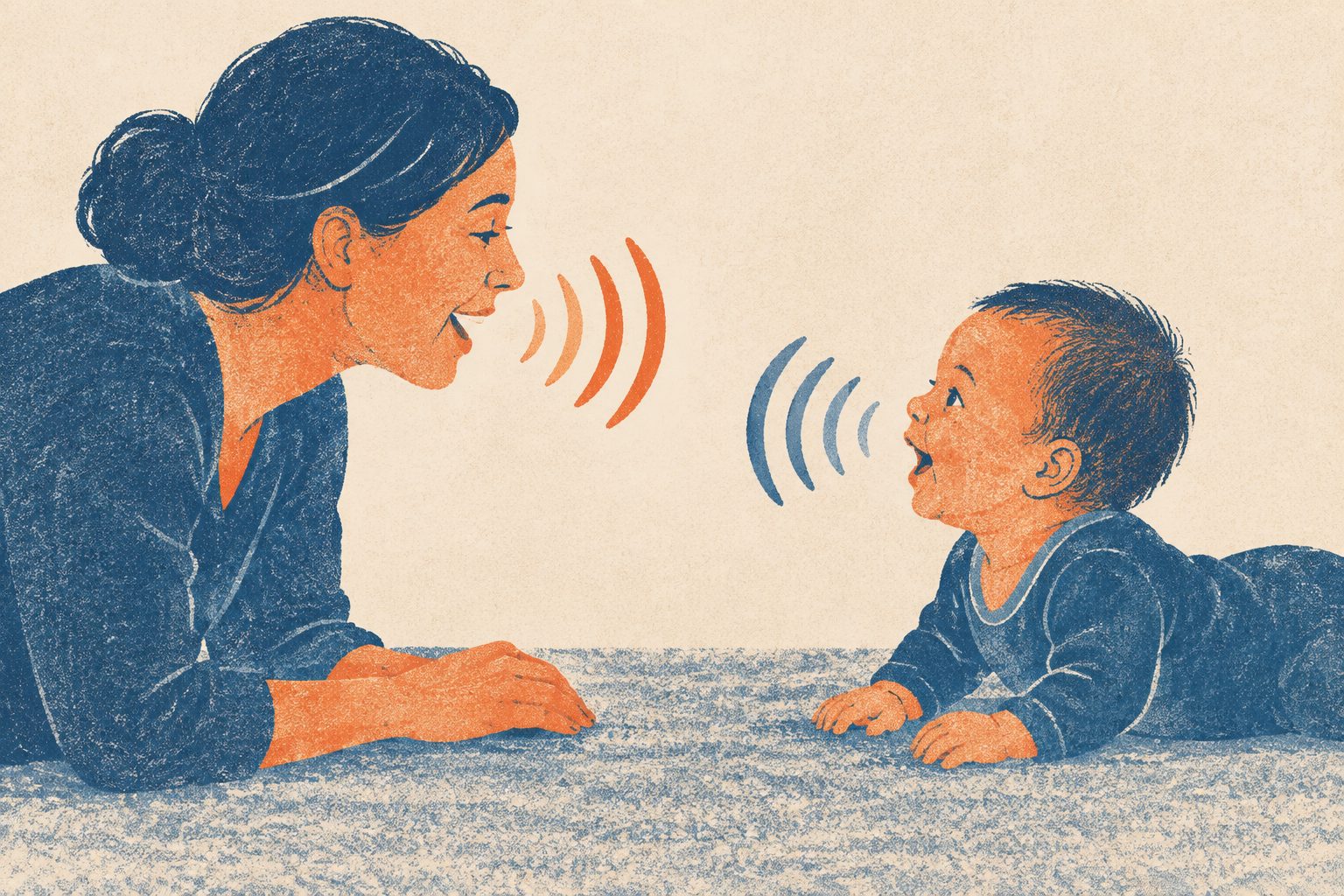
Vocal back-and-forth was strongest when mothers and infants were about 40 centimeters apart.
Researchers recorded mothers and infants aged 5 to 14 months in their homes using wearable audio and proximity sensors. Automated analysis covered 737 hours of indoor audio from long recording sessions, averaging 7.2 hours per pair.
Across all distances and ages, mothers responded vocally to their infants more contingently than expected by chance, while infants did not show this pattern overall. But proximity mattered: coordination increased as pairs moved closer, peaked at about 0.4 meters, and then declined when they were closer still. This pattern was similar across ages, and infants showed vocal contingency specifically at distances of about 0.3 to 0.5 meters.
Vocal coordination at arm’s reach
The study included 61 mother–infant pairs, with infants aged 5–14 months. Researchers analyzed 737 hours of indoor audio recorded during home visits, alongside measurements of the distance between each mother and infant.
When all ages and distances were combined, mothers vocalized contingently to their infants, but infants did not show above-chance contingency overall. Vocal coordination varied with distance in a curved pattern: it became stronger as the pairs moved closer, reached its highest level at approximately 0.4 meters, and decreased at shorter distances. This pattern did not change with age. Infants showed above-chance vocal contingency at distances between 0.3 and 0.5 meters.
Evidence and caveats
This was an observational study of natural interactions in the homes of 61 mother–infant pairs. Wearable audio and proximity sensors provided long recordings, and machine-learning systems were used to classify vocalizations. The study found associations between distance and vocal contingency, not evidence that changing distance causes more coordination.
The sample included mothers and infants aged 5–14 months, so the findings may not apply to other caregivers, ages, settings or forms of interaction. The abstract also does not specify how the pairs’ distances were distributed or whether factors other than proximity contributed to the vocal patterns.
// Source
Infant Behavior and Development · 2026 · DOI: 10.1016/j.infbeh.2026.102257
Authors: Narain K. Viswanathan, Giovanni Esposito, Pierre Labendzki, Marta Perapoch Amadó, James Ives, Emily Greenwood, Tom Northrop, Katie Lancaster, Sam V. Wass, Louise Goupil
Institutions: Université Grenoble Alpes, Centre National de la Recherche Scientifique, University of East London, Birkbeck, University of London, Laboratoire de Psychologie et NeuroCognition