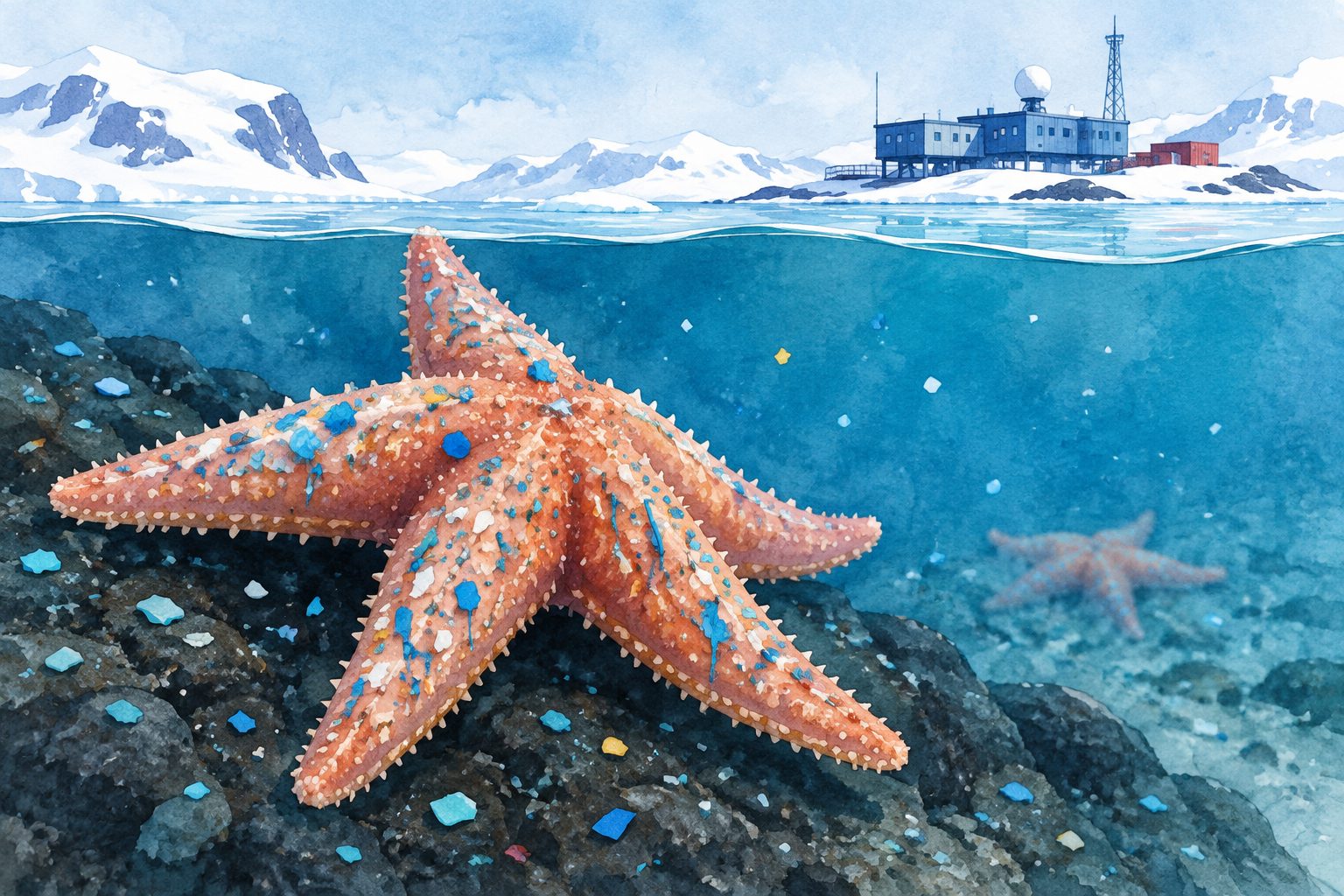
A study at Deception Island found fibers in about 63% of the sea stars examined, with higher levels near a research base.
The study examined 41 Odontaster validus sea stars collected at four locations and at depths of 5 and 15 metres in 2023. About 63% contained at least one micro-litter item, and every detected item was a fiber. The average was 1.10 items per animal and 0.77 items per gram of wet weight.
At 15 metres, sea stars collected at the station nearest to research facilities had significantly more micro-litter by weight than those collected near the bay entrance. The researchers found no significant differences between sampling stations at 5 metres or between the two depths, although some variation was present.
Fibers in Antarctic sea stars
Micro-litter was detected in approximately 63% of the 41 sea stars examined. All of the items were fibers. Across the specimens, the mean abundance was 1.10 items per individual and 0.77 items per gram of wet weight.
The clearest spatial difference occurred at 15 metres. At the sampling station nearest to research stations, abundance reached 3.15 ± 2.46 items per gram of wet weight, significantly higher than at stations near the bay entrance. The researchers say this pattern is consistent with research stations acting as local sources of micro-litter, but the study did not directly trace the fibers to those facilities.
Evidence and caveats
This was a field study of 41 sea stars collected at Deception Island, followed by laboratory analysis of their soft tissues. Researchers used filtered reagents, contamination controls and a conservative correction that removed items matching fibers found in laboratory blanks. That correction removed 57% of the initially detected items, from 105 to 45.
The correction may have underestimated true environmental contamination because matching color and polymer type cannot distinguish laboratory contamination from fibers the animals acquired in the environment. The sample was limited to one island and a small number of animals. Sampling at the research-base station was possible only at 15 metres, and the authors say the influence of depth needs further study across a broader depth range. The spatial pattern therefore suggests, rather than proves, that research stations are a source.
// Source
Marine Pollution Bulletin · 2026 · DOI: 10.1016/j.marpolbul.2026.120412
Authors: Marina Aldana-Martínez, Conxita Ávila, Tomás Azcárate-García
Institutions: Institut de Biologia Evolutiva