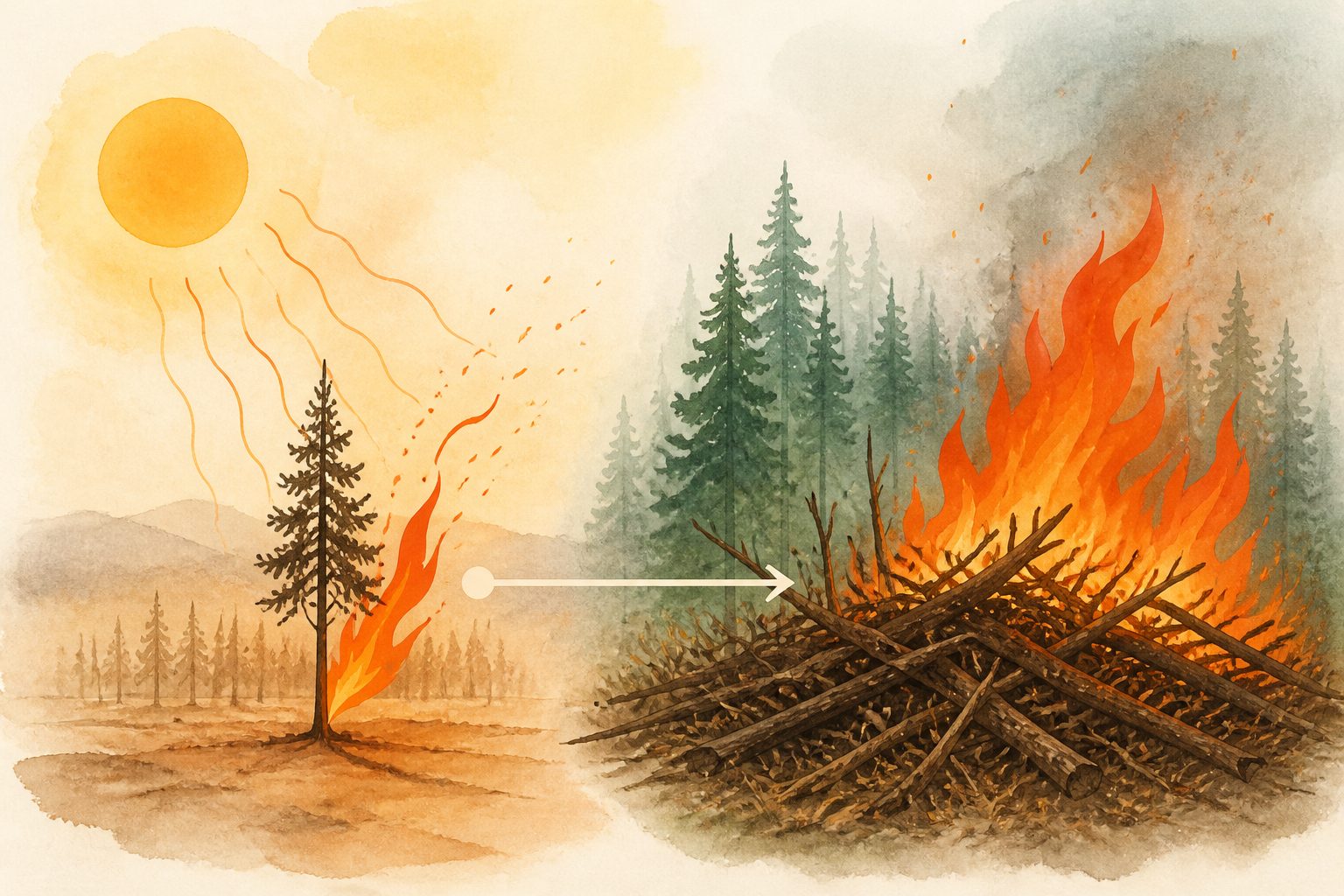
Fossil charcoal from a lake record suggests that early warming increased fire as landscapes became drier, while later fire escalation continued as climate recovered.
Researchers used Raman spectroscopy to study fossil charcoal preserved in the Boltysh 42/11 lake record. The record spans a Danian, or Early Palaeocene, period of unusual carbon-cycle change and provides evidence of several phases of increasing fire activity.
The first phase occurred alongside repeated, progressive drying and the spread of flowering plants. Fire activity increased again as the climate recovered, but this later escalation was not closely tied to continued warming. Instead, the researchers link it to the characteristics of the available plant fuel.
Evidence and caveats
The study is based on Raman spectroscopy of fossil charcoal preserved in a single lacustrine record, Boltysh 42/11. It provides evidence from an ancient ecosystem rather than a modern experiment, and the abstract does not give quantitative estimates of fire intensity, the age range represented, or how widely the pattern applies beyond this record. The observed timing supports links between fire, climate and vegetation, but cannot by itself establish that the same processes will occur in every modern ecosystem.
// Source
Scientific Reports · 2026 · DOI: 10.1038/s41598-026-72676-8
Authors: Thomas Theurer, David Jolley, David K. Muirhead, Dmitri Mauquoy
Institutions: University of Aberdeen