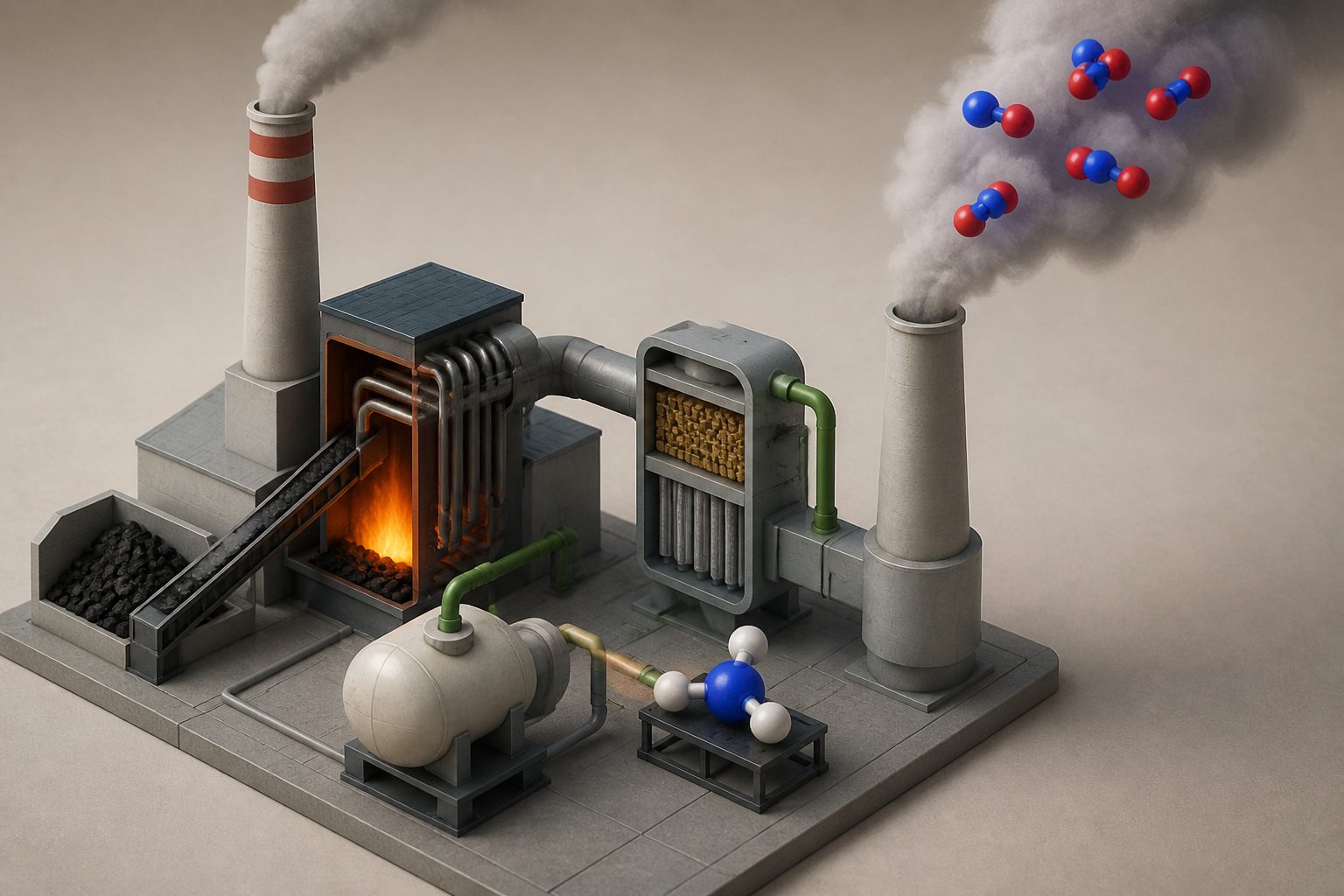
A review finds that blending 20%–30% ammonia with coal may work in existing boilers, while higher shares can increase nitrogen-oxide pollution and reduce efficiency.
The review examines ammonia and coal co-combustion as a way to reduce carbon dioxide emissions from coal-fired power generation without relying on direct ammonia combustion alone. Direct ammonia burning is hindered by low flame temperature, slow flame speed and low reactivity, as well as the potential for higher nitrogen-oxide emissions.
Across the studies reviewed, ammonia shares of 20%–30% were considered feasible in existing coal boilers, with nitrogen-oxide emissions potentially matching or falling below those from coal alone. Above that range, the review reports risks of higher nitrogen-oxide emissions and lower boiler efficiency. Injection location, air staging and low-oxygen combustion were among the approaches examined to control emissions.
What the review found
The authors systematically reviewed simulation and experimental research, including laboratory tests and industrial-scale applications. They conclude that co-firing 20%–30% ammonia in existing coal-fired boilers is feasible and that nitrogen-oxide emissions may be equal to or lower than those from burning coal alone. Increasing the ammonia share further can increase nitrogen-oxide emissions and reduce boiler efficiency.
The review identifies ammonia-injection location as an important control. The studies it discusses found that injecting ammonia into a reducing or higher-temperature zone could lower nitrogen-oxide release compared with injecting it with the coal. Air staging and moderate-to-intense low-oxygen combustion were also highlighted as ways to reduce emissions. The review says dedicated ammonia-injection systems, chemical-reaction models and efficient industrial numerical methods still need further development.
Evidence and remaining limits
This is a review of previously reported simulation and experimental studies, rather than a new combustion experiment. The evidence spans laboratory facilities and industrial-scale applications, but the abstract does not provide a single pooled estimate of emissions or efficiency effects.
The review identifies unresolved practical and technical issues. Ammonia production, storage, transport and use are described as more costly than for coal and other fossil fuels, which limits industrial-scale application. The authors also say that dedicated injection technologies, chemical-reaction models and industrially efficient numerical approaches remain to be established.
// Source
International Journal of Coal Science & Technology · 2026 · DOI: 10.1007/s40789-026-00931-4
Authors: Abu Hurera, Yujie Hou, Chang’an Wang, Liangxu Dai, Defu Che
Institutions: Xi'an Jiaotong University