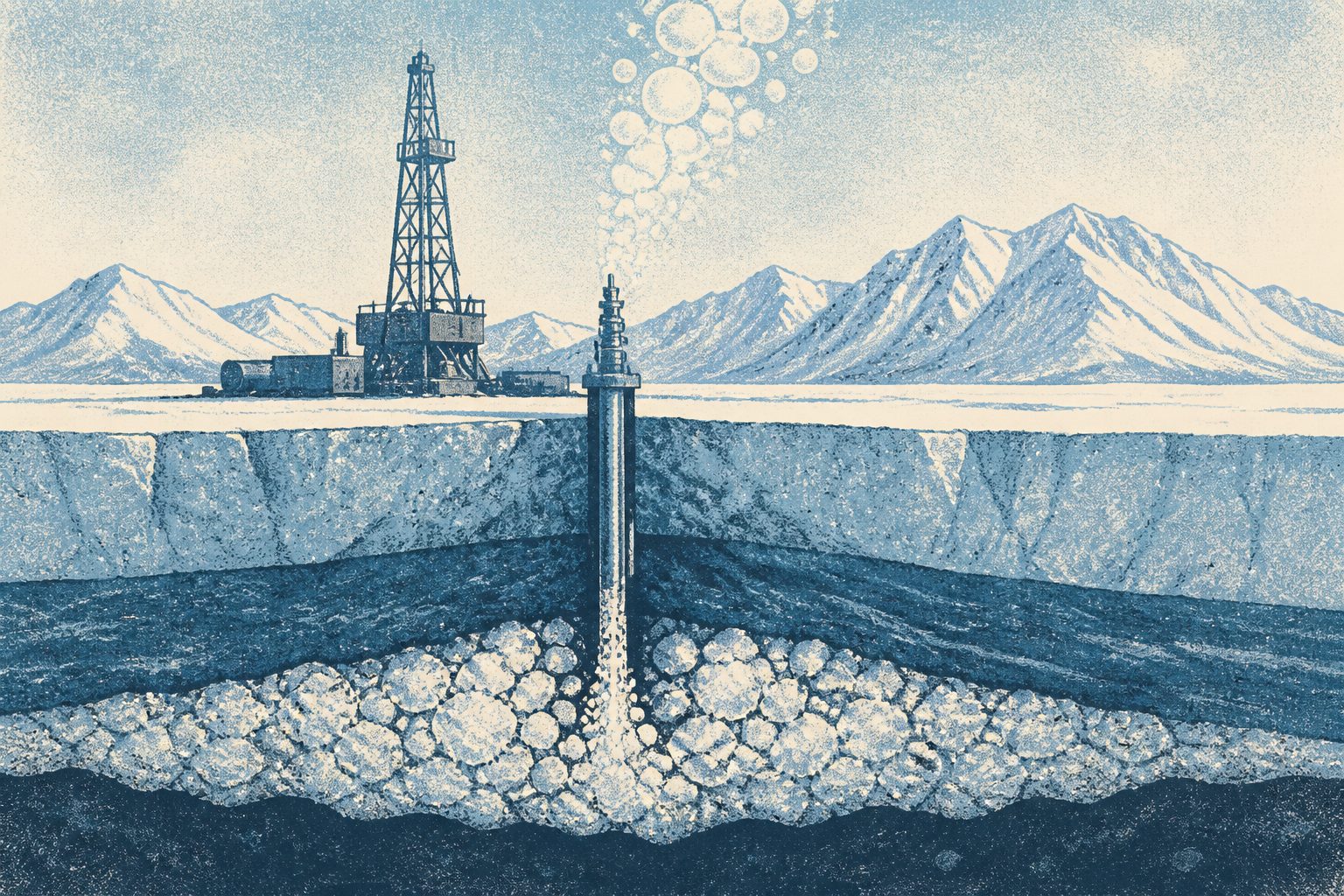
A 151-day well test found that gas released from the reservoir was mostly secondary microbial methane and came with unexpectedly little water.
Researchers tested the B1 sand reservoir, a layer beneath permafrost where methane is trapped in gas hydrate, at a site in the Prudhoe Bay Unit on Alaska’s North Slope. They used gas composition and stable-isotope measurements from well cuttings, pressure cores and production samples to distinguish microbial and thermogenic methane sources.
The test first used an electrical submersible pump and later a jet pump to lower pressure and release methane from the hydrate. Gas from the reservoir was generally different from gas dissolved in the clay-rich layers above and below it, suggesting those layers limited gas and water movement into the reservoir during production.
What the well produced
Gas composition changed with depth. Near the surface and down to 1133 feet (345.3 meters), the well contained predominantly primary microbial methane. From there to the base of ice-bearing permafrost at 1968 feet (599.8 meters), the gas was a mixture that was mostly primary and secondary microbial methane.
At depths reaching 3558 feet (1084.5 meters), including the D1 and B1 sand units, the gas was more than 98% secondary microbial methane. The remainder was oil-associated thermogenic gas that had migrated from the deeper Sadlerochit Formation.
The production well targeted the B1 sand and successfully extracted methane released from gas hydrate for 151 days. Gas from the well generally matched the composition measured through the B1 sand and differed from gas dissolved in the surrounding clay-rich layers. This separation coincided with an unexpectedly high ratio of produced gas to water.
Evidence and limits
The study combines gas composition and stable-isotope measurements from well cuttings, pressure cores and gas produced during a single extended test well. The agreement between the production gas and the B1 sand’s measured gas profile supports the interpretation that the well mainly produced gas from the hydrate-bearing reservoir rather than from the surrounding clay-rich sediments.
The abstract describes one test at one Alaskan North Slope site. It does not provide a broader estimate of production across the region, a total gas volume, or an economic assessment. The reported methane categories are based on geochemical measurements and source interpretation rather than a direct census of all methane in the reservoir.
// Source
Energy & Fuels · 2026 · DOI: 10.1021/acs.energyfuels.5c06364
Authors: J. Pohlman, Michael A. Casso, Lee-Gray Boze, William F. Waite, Stephen C. Phillips, Carolyn D. Ruppel, Melanie Holland, Jun Yoneda, Motoi Oshima, Akihiro Hiruta, Timothy S. Collett
Institutions: National Institute of Advanced Industrial Science and Technology, United States Geological Survey, Pacific Science Center