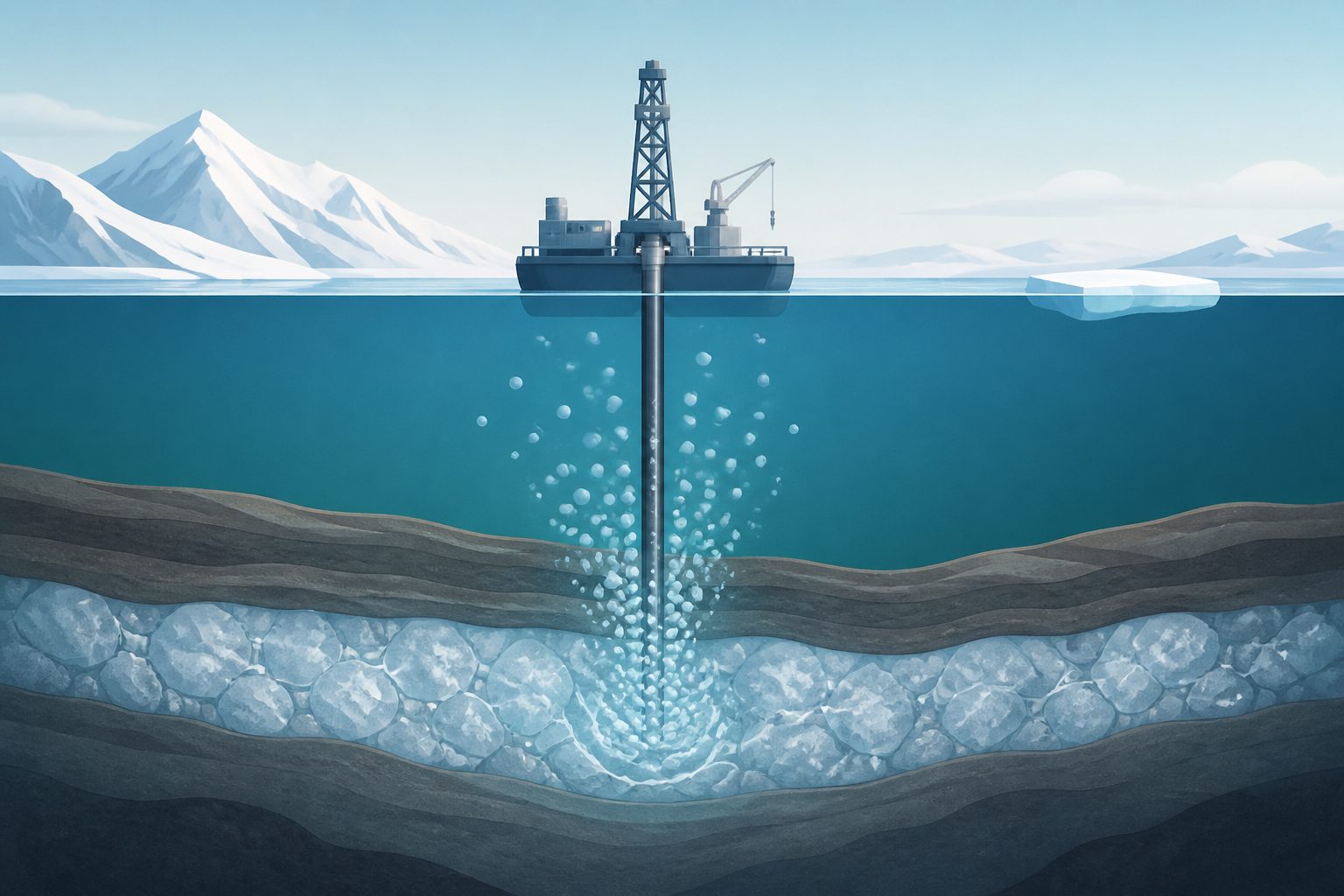
Alaska gas-hydrate test showed high gas output with no clear decline
During a 2023–24 field test, the reservoir produced gas at a higher-than-expected ratio to water, while its gas rate showed no clear rise or fall during about two months of steady production.
Editorial illustration — not from the study.
Researchers conducted an extended gas production test in the Prudhoe Bay Unit during 2023–2024 by lowering pressure in a gas-hydrate-bearing reservoir. The operational period lasted 315 days, although equipment problems, troubleshooting and shutdowns left 216 days of net gas production time.
For about two months, production continued at a bottomhole pressure of about 850 pounds per square inch, with gas production of roughly 60 thousand standard cubic feet per day and water production of about 17 barrels per day. Sensors in three observation wells tracked changes in pressure, temperature and strain as the gas hydrates broke down.
What the test found
The test showed several notable reservoir responses. During about two months of continuous production at a steady bottomhole pressure, the reservoir’s permeability increased as gas hydrates dissociated, or broke down, and the zone affected by dissociation expanded. However, the gas production rate showed no clear increase or decrease during that period.
The produced fluids had a higher gas-to-water ratio than reported in previous gas-hydrate production tests. The gas production rate was approximately 60 thousand standard cubic feet per day, equivalent to about 1,700 cubic metres per day, while water production was about 17 barrels per day, or 2.7 cubic metres per day.
Frequent gas-locking events in the electric submersible pump, caused by the higher-than-expected gas-to-water ratio, made stable pumping difficult. Later, pressure communication through the sand-control device decreased substantially. Replacing the electric submersible pump with a jet pump lowered the target bottomhole pressure, but it did not produce a sufficient reduction in reservoir pressure.
Why the results matter
The findings provide field data on how a gas-hydrate reservoir responds to extended production rather than a short test. The high gas-to-water ratio affected pump operation, while the lack of a clear production-rate trend during sustained operation adds information about how gas output may behave as hydrates dissociate.
Measurements from observation wells also showed that pressure, temperature and strain changes can be tracked at different distances from a production well. The authors say these results can help identify issues for future geological, reservoir and geomechanical modeling and simulation aimed at assessing gas-hydrate production.
Evidence and limits
This is an analysis of data from a field production test conducted in one gas-hydrate-bearing reservoir on Alaska’s North Slope. The test ran for 315 days, but the net gas production period was 216 days because of surface-facility and downhole-equipment issues, troubleshooting and pump replacement.
The clearest production observations came from about two months of continuous operation at a roughly constant pressure. The test was also affected by pump gas-locking, reduced pressure communication through the sand-control device and the inability of the replacement jet pump to achieve a sufficient pressure reduction. The abstract reports reservoir behavior and comparisons with earlier tests, but it does not establish how the results would apply to other reservoirs or whether commercial production is feasible.
// Source
Energy & Fuels · 2026 · DOI: 10.1021/acs.energyfuels.6c01456
High-resolution drone maps detected early crop water stress before changes appeared in other plant measurements. The approach tracked evapotranspiration—the movement of water from soil and plants into the air—across sugar beet, potato and winter wheat fields.
A pilot-scale system removed long-chain PFAS, including PFOS and PFOA, from municipal wastewater and concentrated the compounds in a small volume of foam. Under the best-performing conditions, a subsequent treatment destroyed and removed more than 99% of measured PFAS in that concentrated foam.
Humpback whales in Monterey Bay fed more frequently when California sea lions were present. The whales appeared to spend less time searching and approaching prey, while the effort and movement of individual lunges showed no detectable increase.