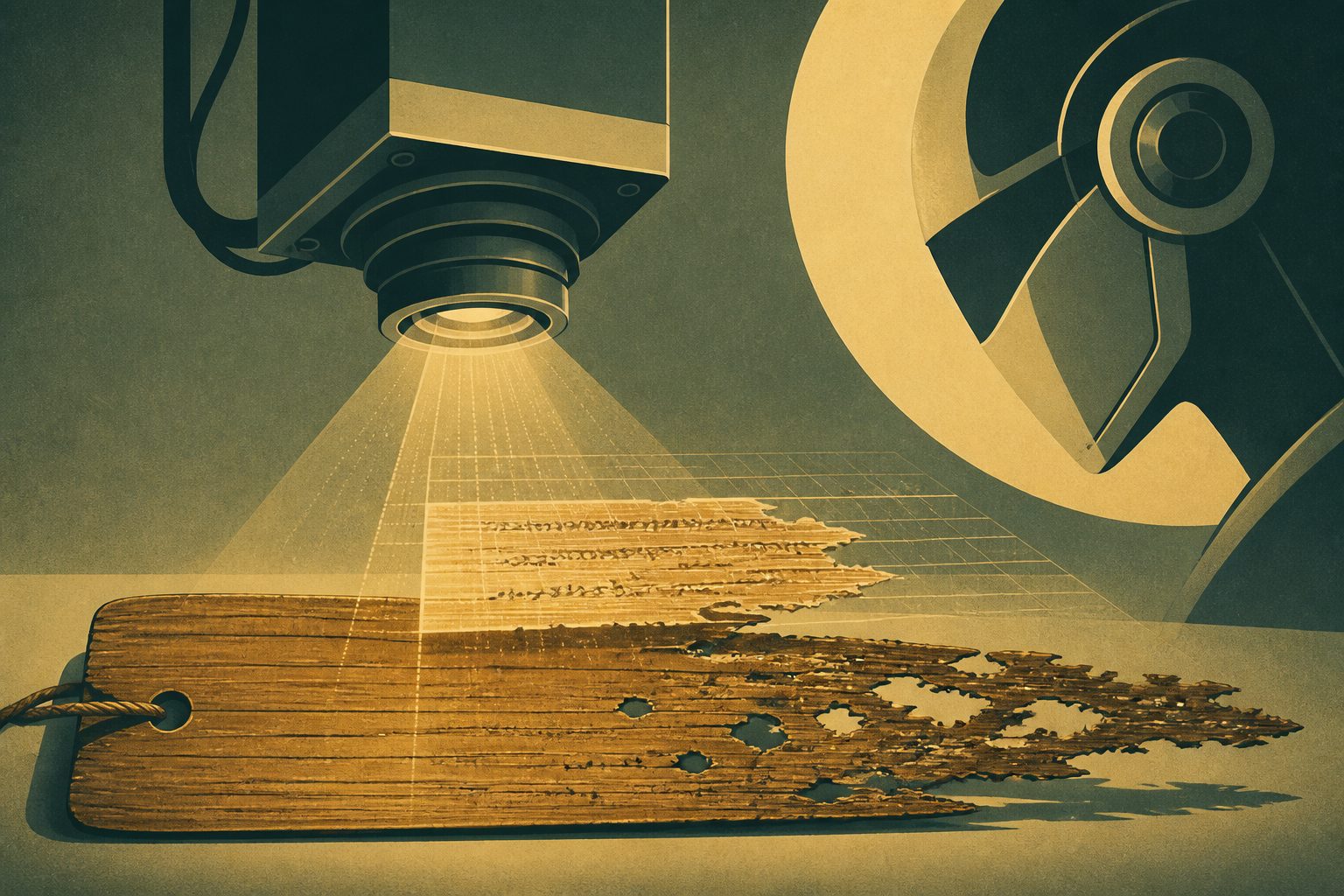
EpigraphiX-AI combines image processing, character recognition and manuscript authentication tools for historical palm leaves written with incised styluses. The system is designed to distinguish shallow incisions from fiber patterns, decay and uneven surfaces, including in complex Grantha writing.
AI & Computing1 month ago
AI recognizes writing on severely damaged South Indian palm leaves
A system tested on 1,250 historical folios reported high accuracy while identifying authentic manuscripts and separating writing from wood fibers.
How well the system read
In tests on 1,250 historical palm-leaf folios, the system reported a Word Accuracy Rate of 97.4% and Character Accuracy of 98.6%. Its reported Character Error Rate was 1.4%, with precision of 98.6%, recall of 98.4% and specificity of 99.4%. The manuscript-authentication component reported 99.4% accuracy. The system was also described as rejecting non-manuscript images, including portraits, indoor and outdoor scenes, and digital interfaces.
Why damaged folios matter
South Indian palm-leaf manuscripts preserve texts in Sanskrit, Grantha and Old Malayalam on material that can be difficult for conventional optical character recognition systems to interpret. A tool that can identify authentic folios and recognize writing despite decay, wood fibers and uneven incisions could support the digitization and study of these historical records.
Evidence and open questions
The findings come from an experimental evaluation reported in a journal article using an archival corpus of 1,250 historical folios. The abstract does not give details about the corpus's source, language distribution, annotation process, train-test separation or the exact state-of-the-art systems used for comparison. It also does not report how well the system performs on manuscripts outside this corpus, or provide separate results for its translation and grammar components.
// Source
International Journal for Research in Applied Science and Engineering Technology · 2026 · DOI: 10.22214/ijraset.2026.84707
Authors: Adarsh S