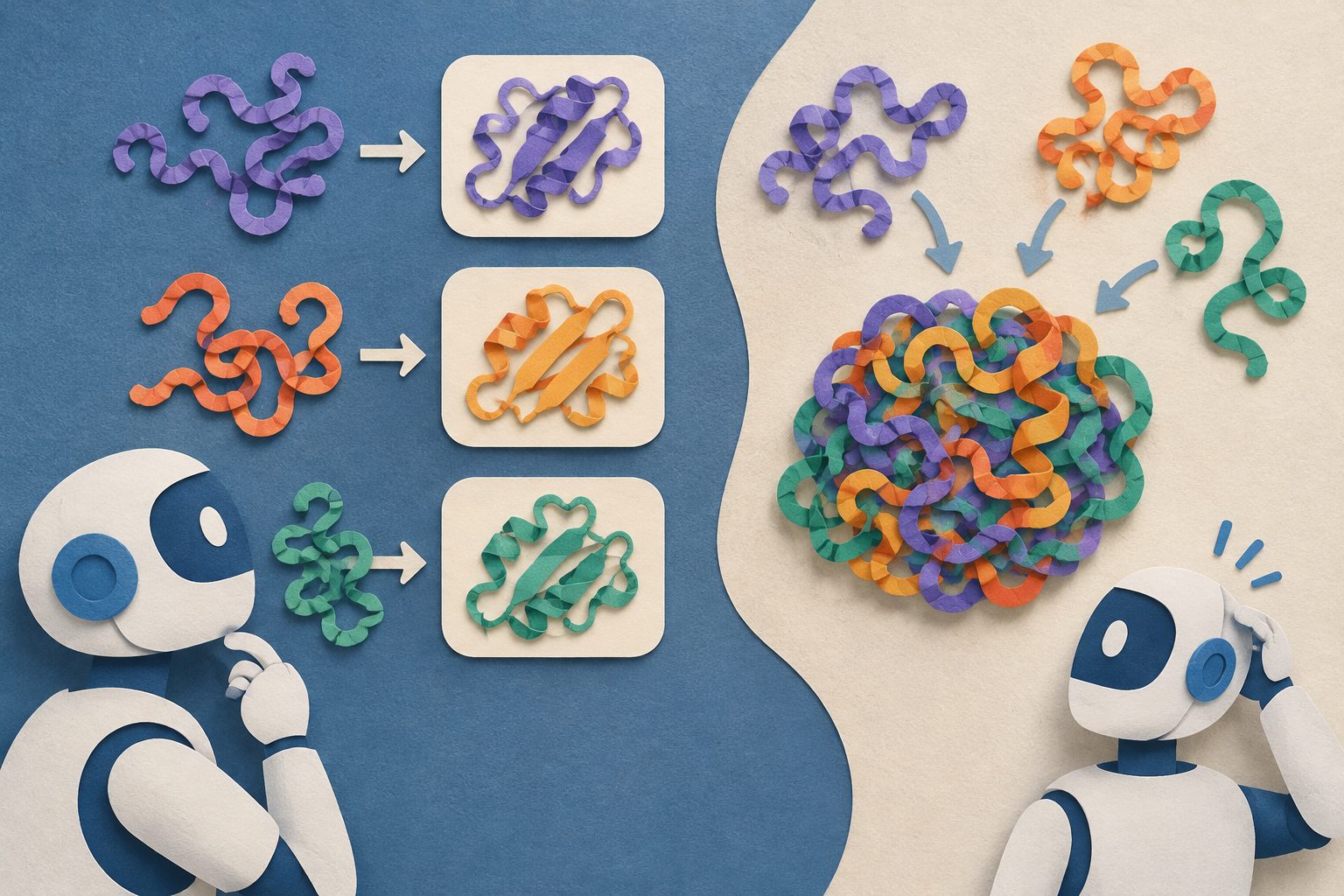
A study of AlphaFold3 finds consistent predictions for individual disordered proteins but uneven results for protein assemblies.
Researchers systematically evaluated AlphaFold3 on proteins that lack a single stable shape, both individually and in assemblies. For individual proteins, AlphaFold3’s confidence scores were a reliable guide to disorder and performed similarly to AlphaFold2 and dedicated disorder predictors.
For assemblies, AlphaFold3 had aggregate docking performance similar to AlphaFold2, but the two systems appeared to achieve those results differently. AlphaFold3 also often produced substantially different results from independent runs, with occasional strong predictions among otherwise weaker ones. Both systems performed equally well on cases where disordered proteins fold when they interact, predicting the final folded states.
Where predictions hold up
For individual proteins, AlphaFold3’s pLDDT confidence scores predicted disorder with a Matthews correlation coefficient of 0.693, matching AlphaFold2 and approaching the performance of specialized predictors. The authors say this consistency across different system designs suggests that the ability to recognize disorder comes from the training data rather than from a particular model architecture.
For protein assemblies, AlphaFold3 and AlphaFold2 had similar average DockQ scores: 0.563 for AlphaFold3 and 0.571 for AlphaFold2. However, conventional features of the contact area explained 42% of the variation in AlphaFold3’s results, compared with 58% for AlphaFold2. This means interface properties alone did not show when AlphaFold3 would succeed or fail.
On the MFIB benchmark, which includes cases where proteins become ordered when they interact, both systems predicted the final folded states equally well. Results from repeated AlphaFold3 runs often varied substantially. In many cases, an occasional high-scoring run appeared within a broader set of lower-scoring results, suggesting that the system can sometimes find a correct structure without finding it consistently.
Why the distinction matters
The findings distinguish two uses of AlphaFold3. Its confidence scores can help identify disorder in individual proteins, but its predictions for assemblies of disordered proteins are less predictable. Researchers using it for these assemblies may therefore need to examine multiple independent predictions rather than rely on a single result or on interface features alone.
The study also points to a data problem: changing the model architecture by itself may not resolve these difficulties. The authors argue that progress will require more training data focused on disordered proteins and methods that combine results from multiple prediction runs.
Evidence and limits
This is a systematic evaluation published in the journal Proteins: Structure, Function, and Bioinformatics. It compares AlphaFold3 with AlphaFold2 on monomer and multimer cases, including the MFIB benchmark, and analyzes variation across independent runs.
The abstract does not report the number of proteins or assemblies tested, so the breadth of the evaluation cannot be assessed from the available information. The reported aggregate docking scores also do not show that either system is consistently accurate for every assembly. The results specifically concern the tested disordered-protein systems and do not establish performance for all protein-prediction tasks.
// Source
Proteins Structure Function and Bioinformatics · 2026 · DOI: 10.1002/prot.70189
Institutions: University of South Florida