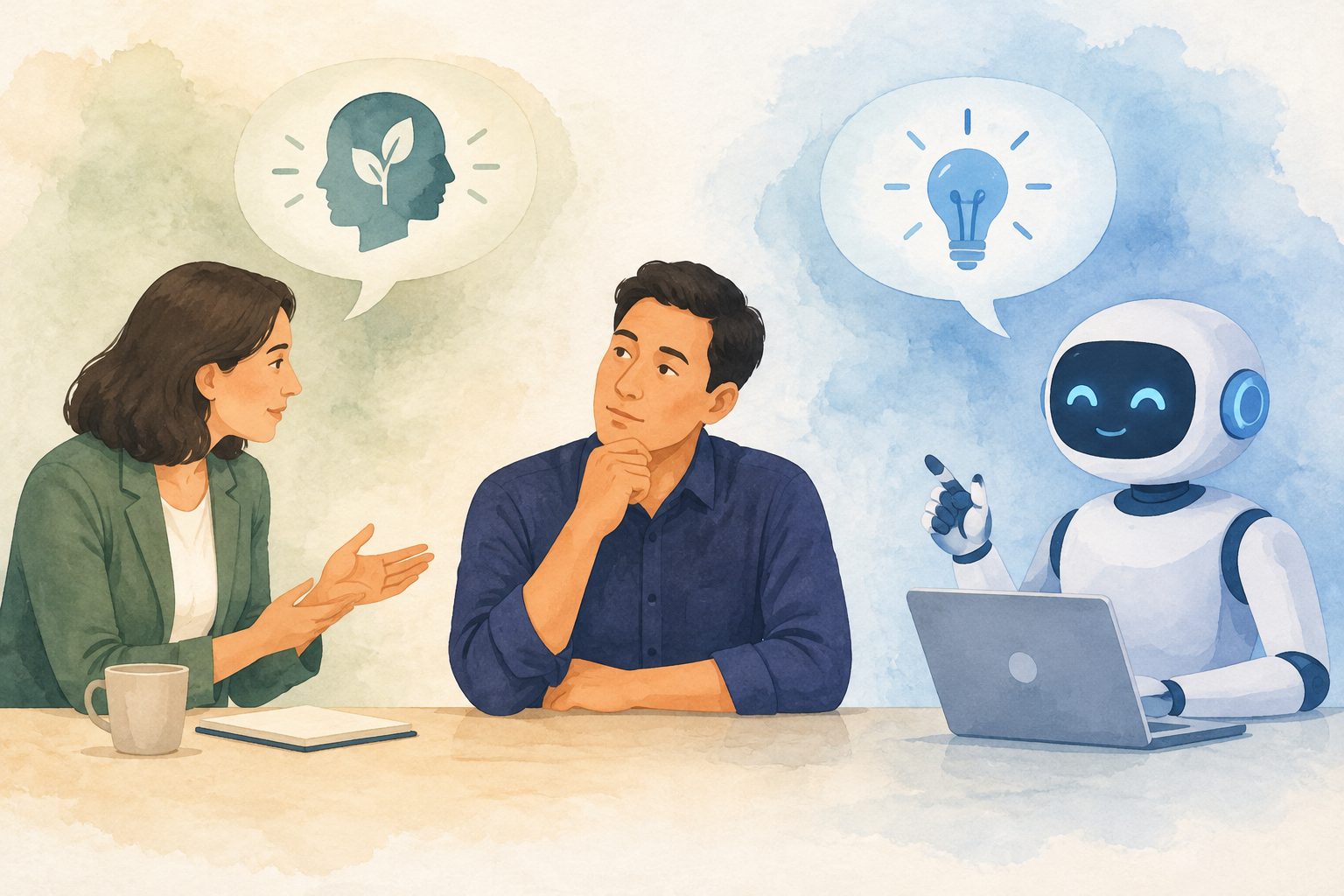
A review finds that AI tools may improve access and provide ongoing support while raising concerns about privacy, bias and safety.
The article analyzes recent research on generative AI in mental-health care, including AI chatbots, virtual assistants, emotion-recognition systems and personalized digital support platforms. The studies reviewed suggest these tools may improve access to support, encourage self-awareness and reduce loneliness through personalized interactions.
The review also identifies unresolved concerns. People may become emotionally reliant on AI companions, while inaccurate information, data-security risks, biased systems and limited clinical testing could undermine care. The authors say generative AI should support—not replace—mental-health professionals, and call for ethical guidelines, transparency and stronger oversight.
What the review found
The reviewed studies suggest that generative AI tools can expand access to mental-health support, provide assistance at any time, increase self-awareness and reduce loneliness through personalized interactions. The review covers chatbots, virtual assistants, emotion-recognition systems and other digital support platforms.
It also identifies several risks: emotional reliance on AI companions, misinformation, privacy and security problems, algorithmic bias and a lack of clinical validation. The authors conclude that these tools cannot directly substitute for mental-health professionals.
Why oversight matters
Generative AI could offer another way for people to access mental-health support, particularly through personalized digital interactions that are available around the clock. But the review indicates that wider use needs to be accompanied by safeguards addressing privacy, accuracy, bias and emotional dependence.
The authors argue that responsible implementation, transparency, ethical guidance and robust regulation are needed to keep AI-based mental-health services safe and reliable. Their conclusions support using AI as a supplement to professional care rather than as a replacement for it.
// Source
International Journal of Technology & Emerging Research · 2026 · DOI: 10.64823/ijter.2621030
Authors: Sivanjali.V Sivanjali.V, Aryananda Ms, Abhirami Anilkumar, Nimisha Prakash
Institutions: Little Flower Hospital & Research Centre