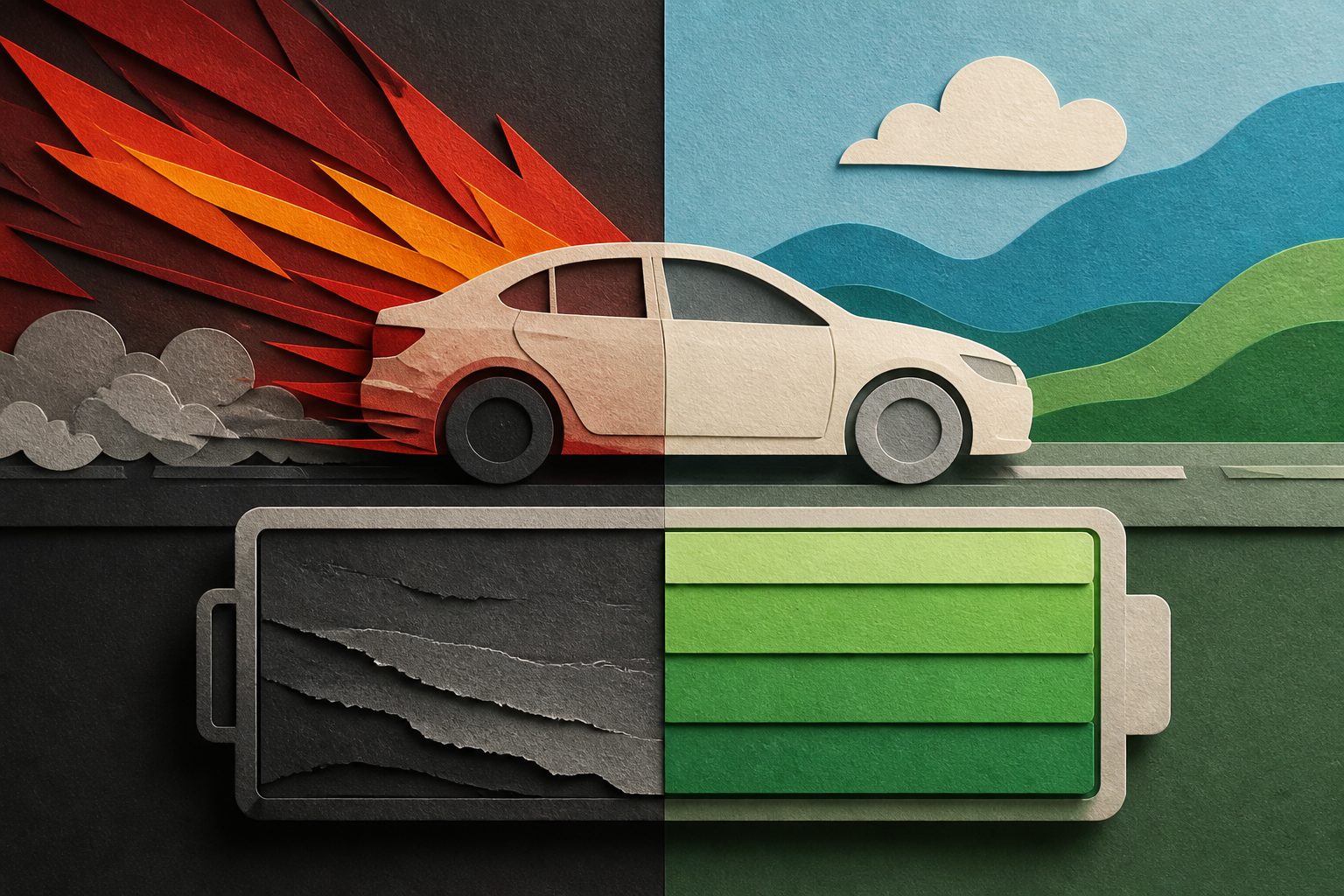
A model combining battery physics with real-world driving data estimated a substantially greater capacity loss for aggressive driving than for eco-driving.
A study of real-world electric-vehicle operation data found that aggressive driving was associated with more than 2.5 times the model-predicted battery capacity fade seen with eco-driving. The researchers used a battery model alongside causal-inference methods to account for other factors that could influence aging.
The framework was designed to connect driving behavior with battery wear without relying only on correlations or an unconstrained data model. Its predictions may help inform strategies for extending battery life and tailoring guidance to drivers, although the reported aging differences come from the model rather than direct long-term battery measurements described in the abstract.
Driving style and battery fade
The researchers developed a framework that combines a second-order Thevenin equivalent-circuit model—a physics-based representation of a battery’s electrical behavior—with a generative model and causal-inference techniques. The framework separates potential confounding factors, or other influences that could affect both driving behavior and battery aging, and estimates what battery aging might look like under different driving styles.
Applied to real-world electric-vehicle operation data, the method reconstructed terminal voltage with a 0.55% mean absolute percentage error. Under the framework’s estimated causal association, aggressive driving was linked to more than 2.5 times the model-predicted battery capacity fade of eco-driving.
// Source
Scientific Reports · 2026 · DOI: 10.1038/s41598-026-66428-x
Authors: Hao Cheng, Zhongwei Gu, Wangqiang Gao
Institutions: Shanghai Dianji University