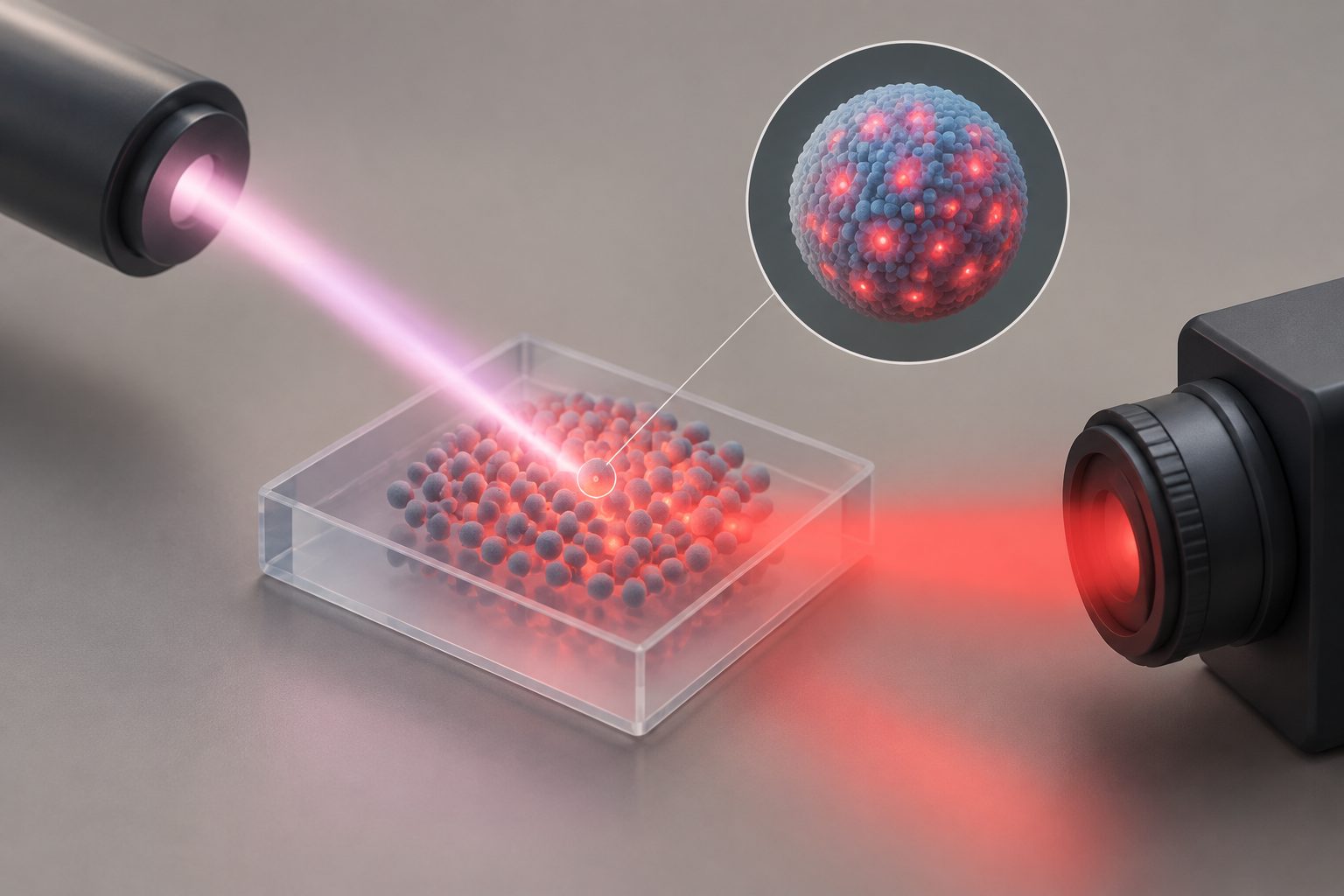
The printed codes appeared under near-infrared light and were decoded from camera images using a smartphone.
The ink uses lithium yttrium fluoride nanoparticles doped with ytterbium and erbium and coated with polyacrylic acid. The coating helped make the particles suitable for water-based printing, while a protective particle shell increased green light emission by about 2.7 times.
The researchers tested four formulations and selected one made with a 65:35 volume ratio of 10% aqueous ethanol to glycerol. They printed covert text with a standard Canon printer and used a near-infrared camera to capture QR codes, which were then displayed on a computer screen and decoded with a smartphone.
What the hidden ink did
The treated nanoparticles retained their tetragonal crystal structure and overall particle shape, according to X-ray diffraction and transmission electron microscopy. Infrared spectroscopy indicated changes to the particles’ surface chemistry after the polyacrylic acid treatment.
Adding a lithium yttrium fluoride shell increased the green emission intensity by about 2.7 times. For inks containing core–shell particles coated with polyacrylic acid at concentrations from 1 to 20 milligrams per milliliter, the background-corrected green peak intensity increased by about 28 times across that concentration range.
QR-code decoding succeeded in 5% of 20 attempts at 1 milligram per milliliter, 25% at 2.5 milligrams per milliliter, and 85% at 5 milligrams per milliliter. The success rate was 100% for inks containing 7.5, 10 and 20 milligrams per milliliter.
Evidence and caveats
This is a materials and printing study supported by structural imaging, spectroscopy, light-emission measurements and QR-decoding tests. The decoding results are based on 20 attempts for each tested concentration and on one selected ink formulation, a Canon PIXMA MG5320 printer, a near-infrared camera and a smartphone-based decoding process. The abstract does not report tests of long-term durability, different printers or surfaces, resistance to copying, or performance outside these conditions; the proposed applications therefore remain potential uses rather than demonstrated real-world deployments.