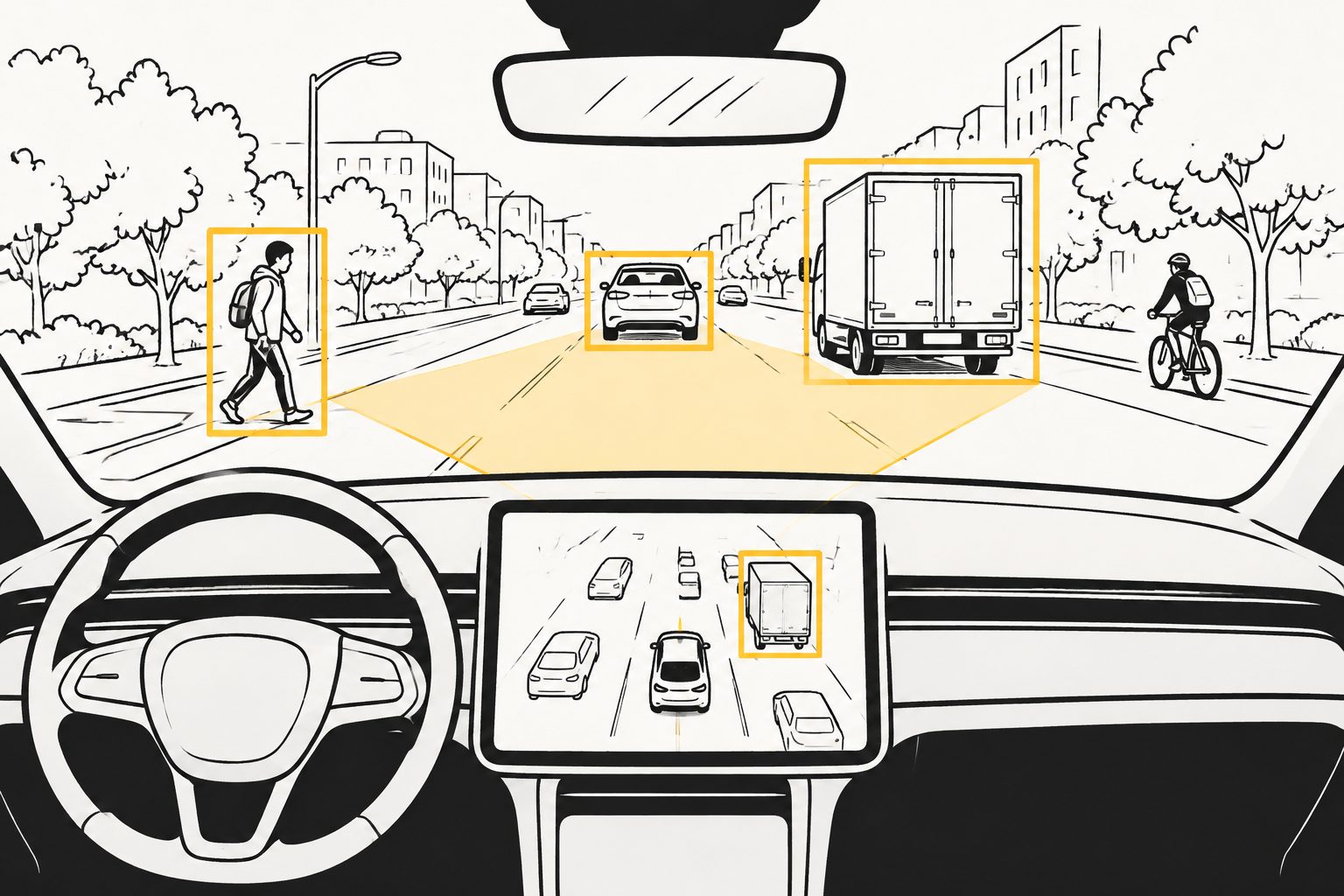
New data from roads in 63 countries finds that AI handles broad scene meaning better than road geometry and driving plans.
Researchers introduced ScenePilot-4K, a first-person driving-video dataset with descriptions of road scenes, risk labels, key road users, vehicle paths and camera information. They also created ScenePilot-Bench, which tests AI systems on scene understanding, spatial perception, motion planning and agreement with human-language descriptions.
Results from representative open-source and proprietary systems showed that current models remain competitive at describing overall scenes but have substantial limitations in understanding geometry and reasoning about driving plans. The benchmark also tests performance when systems face traffic and regions different from those represented in their training conditions.
Where driving AI struggles
ScenePilot-4K contains 3,847 hours of video and 27.7 million front-view frames covering 63 countries or regions and 1,210 cities. Its annotations include natural-language scene descriptions, risk assessments, key participants, the vehicle’s path and camera parameters.
On ScenePilot-Bench, current vision-language models performed relatively well on high-level scene semantics. They showed substantial limitations in geometry-aware perception—understanding spatial relationships and road layout—and in planning-oriented reasoning. The benchmark’s cross-region and cross-traffic tests are designed to reveal how models cope with changes in driving environments.
Why the benchmark matters
Autonomous driving systems need more than a broad description of what is happening around a vehicle: they must understand spatial relationships and use that information to plan movement. By evaluating these abilities separately, ScenePilot-Bench provides a way to identify weaknesses that may be missed by tests focused mainly on scene descriptions.
The dataset also covers many regions and traffic settings, allowing researchers to examine geographic and traffic-related shifts. The annotation process described in the study could be reused to build similar datasets from public driving videos.
Evidence and caveats
The study presents a newly assembled dataset and benchmark, along with baseline results from representative open-source and proprietary vision-language models. The videos come from public online driving footage, and the dataset relies on a multi-stage annotation pipeline rather than direct testing of autonomous vehicles on roads.
The abstract does not give detailed model scores, explain how the online videos were selected, or report how well the annotations match real-world driving outcomes. The benchmark therefore documents model performance on its defined tasks; it does not by itself establish that any system is safe for deployment in autonomous cars.
// Source
Communications in Transportation Research · 2026 · DOI: 10.26599/commtr.2026.9640069
Authors: Yujin Wang, Yutong Zheng, Wenxian Fan, Tianyi Wang, Hongqing Chu, Li Zhang, Bingzhao Gao, Daxin Tian, Jianqiang Wang, Hong Chen
Institutions: Fudan University, The University of Texas at Austin, Tongji University, Tsinghua University, Beihang University