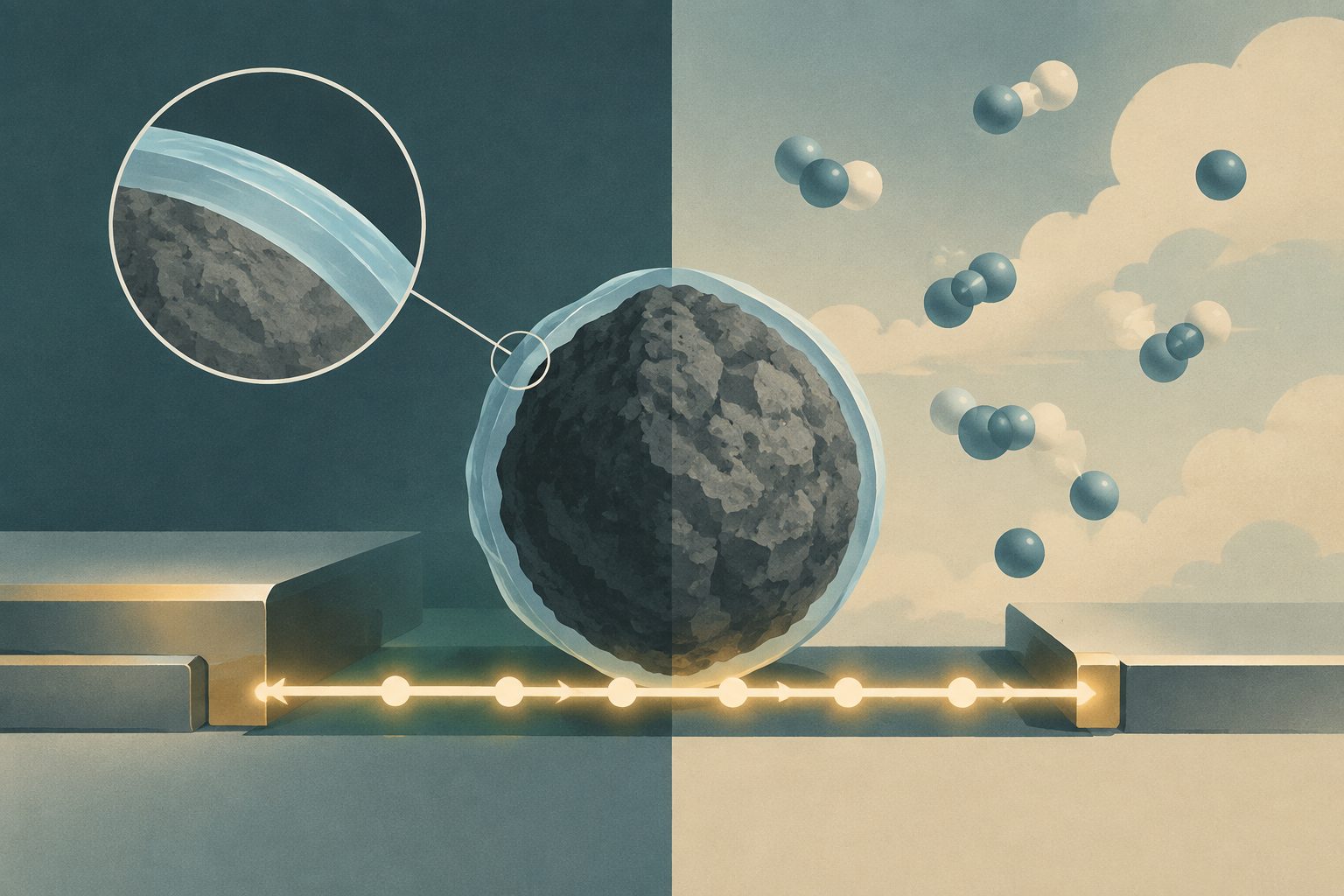
The coated sulfide electrolyte released less toxic gas in humid air and helped a battery retain 84.6% of its capacity after 1,000 cycles.
Sulfide solid electrolytes can conduct lithium ions well, but moisture can quickly damage them and release toxic hydrogen sulfide gas. The researchers coated one such electrolyte, Li₅.₅PS₄.₅Cl₀.₈Br₀.₇, with (3-mercaptopropyl)trimethoxysilane, or MPTMS.
The roughly 10-nanometer coating reduced hydrogen sulfide emission by 93.0% after 35 minutes at 30% relative humidity. The material retained 83.1% of its initial ionic conductivity under that test and stayed above 5.7 mS cm⁻¹ after 10 hours of air exposure. In all-solid-state cells with a nickel-rich lithium cathode, it retained 84.6% of its capacity after 1,000 cycles.
What the coating does
The MPTMS coating formed a water-repelling barrier around the sulfide electrolyte. After 35 minutes at 30% relative humidity, the coated material released 93.0% less hydrogen sulfide than the unprotected material, while retaining 83.1% of its initial ionic conductivity of 10.8 mS cm⁻¹. After 10 hours of air exposure, its ionic conductivity remained above 5.7 mS cm⁻¹.
When used in all-solid-state cells with LiNi₀.₈₃Co₀.₁₁Mn₀.₀₆O₂ cathodes, the coated electrolyte supported 84.6% capacity retention after 1,000 cycles.
Evidence and caveats
The findings come from materials tests and cycling experiments in laboratory all-solid-state cells. The abstract reports results for one coated sulfide electrolyte, specified humidity and exposure times, and cells using one cathode composition. It does not provide details about the comparison methods, capacity fade during intermediate cycles, longer-term performance beyond 1,000 cycles, or how the coating would perform in large-scale manufacturing.