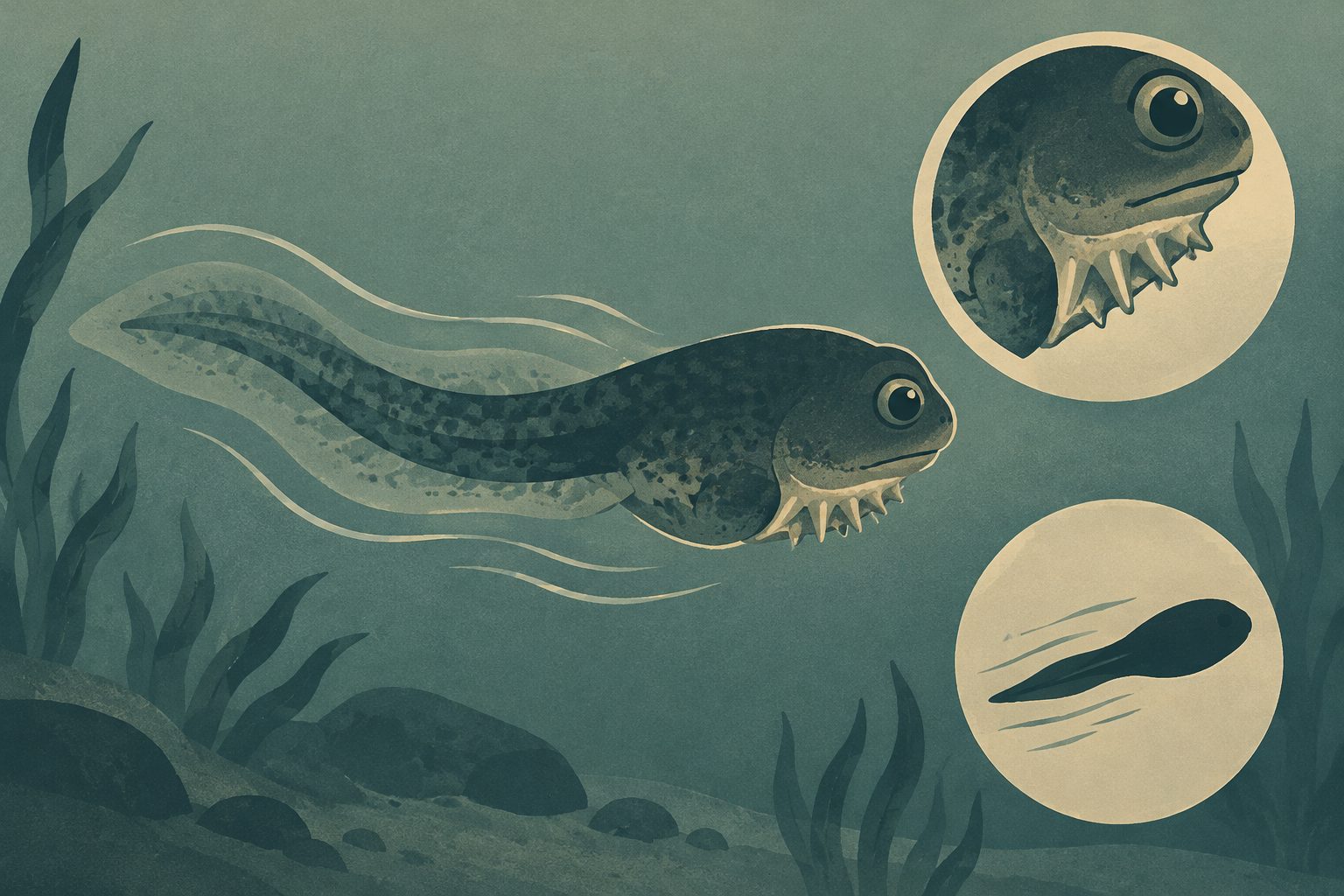
A swollen body helps Rana pirica tadpoles avoid salamander larvae, but makes their escapes less efficient than those of tadpoles with a deeper tail alone.
Researchers compared three forms of Rana pirica tadpoles: a non-induced form, a dragonfly-induced form with a deeper tail, and a salamander-induced form with both a deeper tail and a swollen body. The dragonfly-induced tadpoles had the fastest rapid-start swimming, followed by the salamander-induced tadpoles and then the non-induced tadpoles.
The researchers also separated the effects of body shape from the amount of body movement. Both predator-induced forms converted movement into swimming speed more efficiently than the non-induced form. The deeper tail helped most, while the swollen body of the salamander-induced tadpoles added water resistance that partly reduced this benefit.
How body shape changed escape
Fast-start swimming speed was highest in the dragonfly-induced phenotype, intermediate in the salamander-induced phenotype and lowest in the non-induced phenotype. Both predator-induced forms had higher motion–speed efficiency than the non-induced form, even though the amount of tail movement was similar among the groups.
The results suggest that a deeper tail helps tadpoles turn body movement into forward speed more effectively. In salamander-induced tadpoles, the swollen body adds drag, partly offsetting the deeper tail’s benefit. That swollen shape protects tadpoles from being swallowed by salamander larvae that cannot open their mouths wide enough to consume them.
Evidence and caveats
This was a comparative study of predator-induced forms in Rana pirica tadpoles. The researchers measured rapid-start swimming speed and motion–speed efficiency, using similar tail-motion amounts to assess how morphology affected performance.
The abstract does not report the sample size, the experimental conditions or whether the results extend to other amphibian species or natural settings. It supports a functional trade-off among the tested tadpole forms, but does not establish how these differences affect survival in the wild.