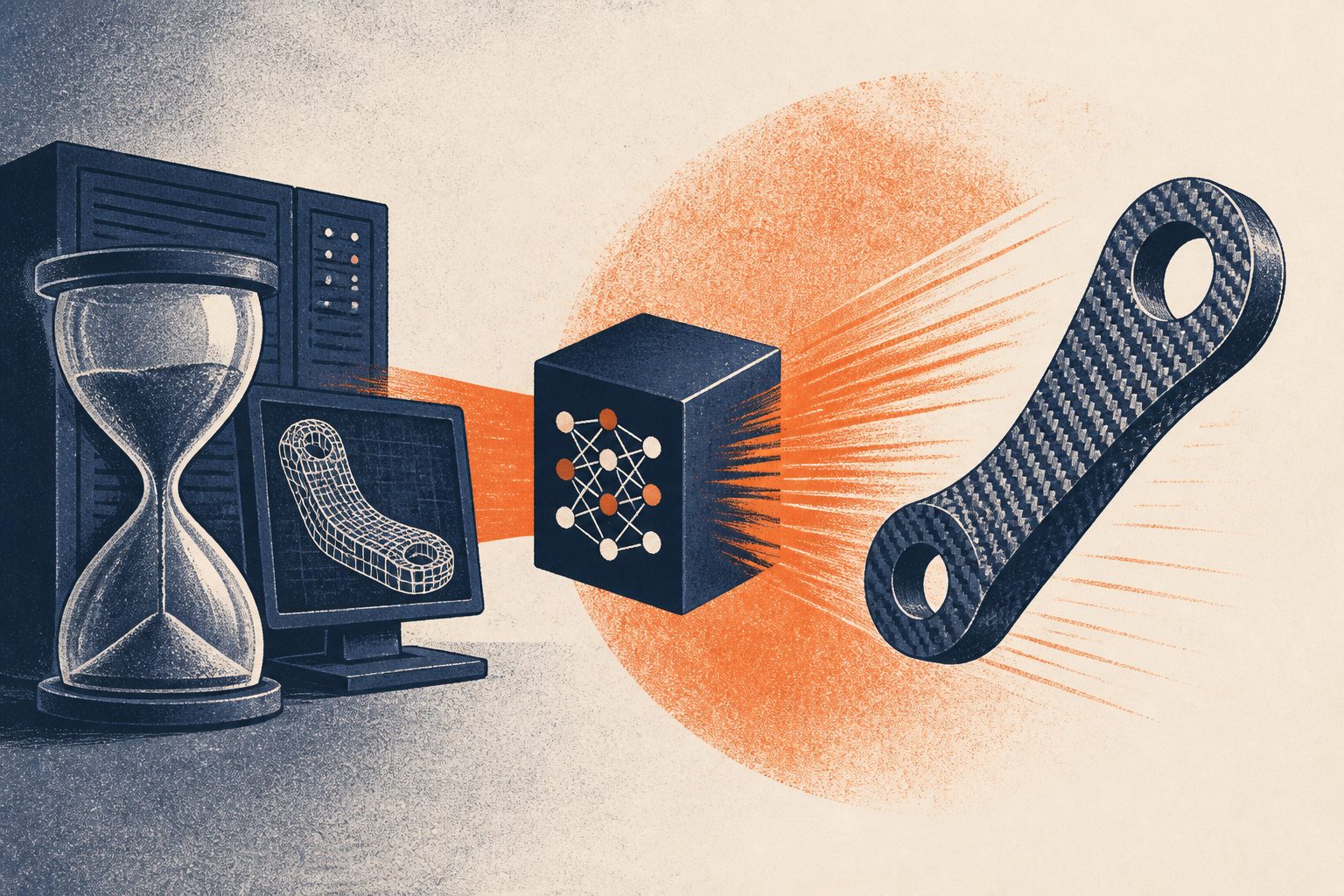
The lightweight system reproduced reference results for a two-dimensional model while reducing calculation time by up to 30,000-fold.
The study presents a practical workflow for building a lightweight neural-network surrogate for the part of a multiscale materials simulation that calculates plastic deformation. The system was trained on data from incremental homogenization analyses, designed to reflect material symmetry, and deployed in a standard finite-element solver as a user-defined material routine.
For the two-dimensional plane-stress setting studied, the surrogate matched the reference response while avoiding repeated fine-scale calculations. The authors also examined how its performance changed with training-data density, increment size and mesh refinement, and identified conditions under which the surrogate no longer held up.
What the AI system matched
The feed-forward neural network reproduced the reference response for a macroscopically isotropic, two-dimensional plane-stress material model. It reduced the cost of each analysis from hours to seconds, with reported speed-ups of up to 30,000 compared with the standard multiscale approach based on fast Fourier transform homogenization. Because the surrogate did not need to store and update extensive microscale state variables, it also substantially reduced memory requirements and allowed finer finite-element discretizations than the conventional approach. Its performance depended on the training data, increment size and mesh refinement, and the paper describes both the conditions where it worked and where it broke down.
Evidence and limits
This is a computational modeling study, not an experiment on a physical material. The reported results apply directly to a macroscopically isotropic, two-dimensional plane-stress setting and to the reference simulations used for training and comparison. The sensitivity analysis shows that accuracy depends on data density, increment size and mesh refinement, with identifiable regimes where the surrogate breaks down. Extensions to three dimensions and weaker material symmetries are presented as possible with appropriate sampling and datasets, rather than as results demonstrated in this paper.