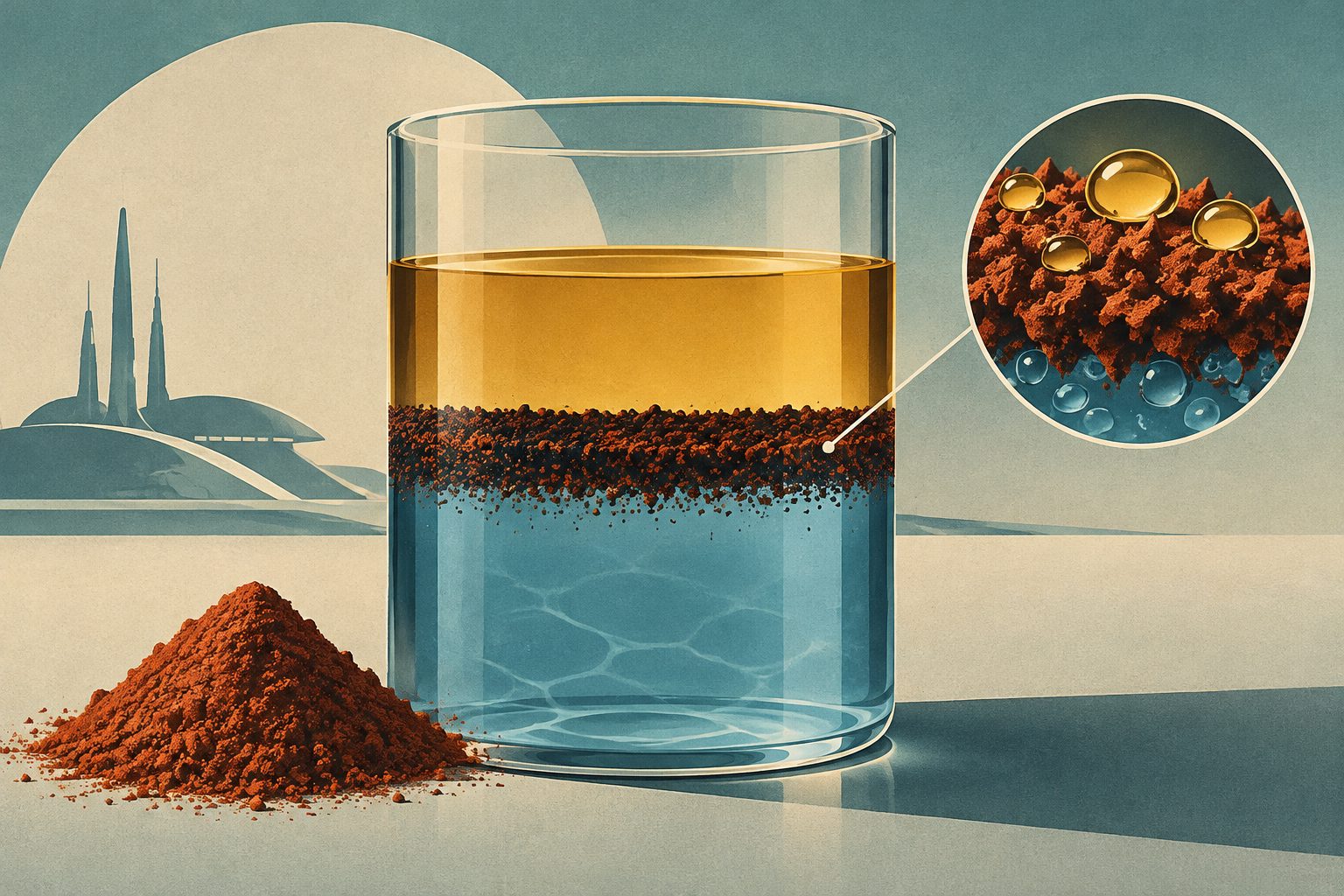
A magnesium-cobalt catalyst changes its active sites during the reaction, helping break down hard-to-remove organic pollutants while limiting cobalt loss.
The catalyst contains neighboring magnesium and cobalt atoms that perform different steps in the purification process. Under light, magnesium converts oxygen into hydrogen peroxide, whose products then adjust the nearby cobalt site and help it activate another oxidant used to break down pollutants.
This step-by-step rearrangement lowers reaction barriers and helps keep cobalt attached to the catalyst. The researchers report that the system maintained its performance through more than 30 regeneration cycles, addressing the common tension between catalytic activity and long-term stability.
How the catalyst changes
Experiments and theoretical calculations showed that the magnesium site selectively converted oxygen into hydrogen peroxide under light. Hydrogen peroxide and related surface hydroxyl groups then progressively changed the electronic structure of the neighboring cobalt site, helping it activate peroxymonosulfate and release reactive radicals that degrade pollutants.
The spatially ordered sequence reduced competition between molecules binding to the catalyst and helped stabilize the cobalt center against leaching. Across various hard-to-break-down contaminants, the system showed a normalized rate constant of 595.3 min⁻¹ M⁻¹ and retained its reported performance through 30 regeneration cycles. The authors describe this as the highest normalized rate constant among the catalytic systems they compared.
Why the design matters
Advanced oxidation processes can remove persistent organic pollutants, but catalysts that react efficiently may lose activity or release metals over time. This catalyst’s self-adjusting reaction sequence is designed to address both problems at once: it improves the steps that degrade pollutants while helping retain cobalt.
The findings suggest a possible route toward more durable water-purification catalysts. The abstract does not establish how the system would perform in full-scale treatment or in all types of contaminated water.
Evidence and open questions
The study combines laboratory experiments with theoretical calculations to explain how the magnesium and cobalt sites change during the reaction and how pollutants are degraded. The reported durability comes from tests covering 30 regeneration cycles.
The abstract does not identify the specific contaminants tested, describe the water conditions or treatment scale, or report the products formed during pollutant breakdown. It therefore does not by itself show how the catalyst would perform in real-world water-treatment systems or over longer operating periods.
// Source
Nature Communications · 2026 · DOI: 10.1038/s41467-026-78263-9
Authors: Jingjing Jiang, Chang He, Shengda Liu, Tongze Sun, Bowen Zhao, Ruixin Wang, Yanan Zhang, Zhenhao Zhao, Xuesong Ye, Hao Yu, Yifang Fu, Yanan Liu, Di Wu, Mingxin Huo, Dandan Zhou, Shuangshi Dong
Institutions: Northeast Normal University, Ghent University, Jilin University, Changchun University of Science and Technology, Centre for Advanced Process Technology for Urban Resource Recovery, Ghent University Global Campus