The review brings together geological data, case studies of significant events, coupled fluid-and-rock simulations and machine-learning-based rankings of influencing factors. It finds that slow, non-earthquake fault movement often precedes moderate events, while stress changes in the rock can matter more than direct fluid-pressure spread beyond 1 kilometre from a well.
Engineering & Technology1 month ago
A review outlines ways to limit fracking earthquakes in the Duvernay shale
The proposed plan combines basement mapping, smaller injections in high-risk areas and real-time stress calculations.
How Duvernay earthquakes start
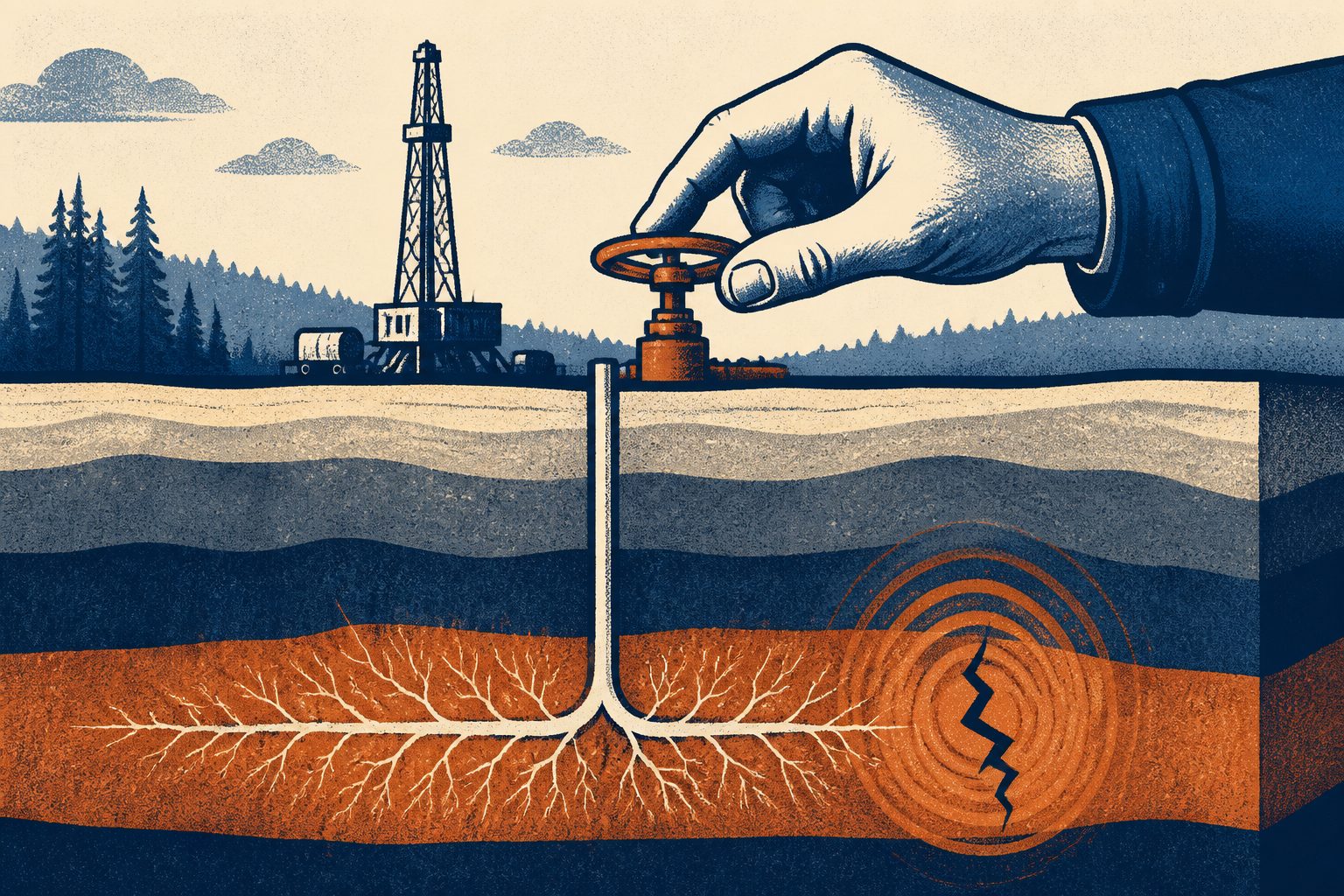
The review describes three established ways hydraulic fracturing can trigger earthquakes: increased fluid pressure, stress changes caused by deformation of the rock, and aseismic slip—fault movement that does not produce an earthquake. In the Duvernay, aseismic slip is frequently reported as a precursor to moderate-sized events. Beyond 1 kilometre from an injection well, changes in rock stress often have a larger effect than direct pore-pressure diffusion.
Using seismic moment released per unit of injected fluid as a measure of induced-seismicity potential, the review reports the strongest correlations with being less than 250 metres from the Precambrian basement and with formation overpressure above 15 kPa per metre. Duvernay events occur mainly within the sedimentary cover, are spatially associated with Devonian reef margins and have lower maximum magnitudes for a given injected volume than events in the comparison considered by the review.
The authors propose four parts of a mitigation framework: detailed mapping of faults and the basement before drilling; operational limits such as keeping single-stage injection below 15,000 cubic metres in high-risk zones; a traffic-light system that uses real-time Coulomb stress calculations; and practical risk tools such as nomograms and scoring cards.
Why the proposals matter
The proposed framework is intended to help operators identify higher-risk areas before drilling and adjust injection practices as conditions change. Its regional focus reflects the review’s conclusion that risk management in the Duvernay should account for local geology, including the depth of the Precambrian basement and the location of reef margins, rather than rely on a single basin-wide rule.
Evidence and open limits
This is a review, not a new field experiment. It synthesizes geological datasets, case studies, simulations and machine-learning-based factor ranking. The review says the relative contributions of the three triggering mechanisms, as well as their quantitative thresholds, have not yet been systematically constrained for the Duvernay. The injection limits and other tools are proposed mitigation strategies; the abstract does not report tests showing how much they reduce earthquake frequency or size.
// Source
International Journal of Coal Science & Technology · 2026 · DOI: 10.1007/s40789-026-00926-1
Authors: Gang Hui, Zhiyang Pi, Chenqi Ge, Ye Li, Zhangxin Chen, Di Wu, Yunli Lu, Feng Ni, Xing Yang, Yujie Zhang, Fei Gu
Institutions: Research Institute of Petroleum Exploration and Development, Ningbo Institute of Industrial Technology, Chengdu University of Technology, State Key Laboratory of Oil and Gas Reservoir Geology and Exploitation, China University of Petroleum, Beijing