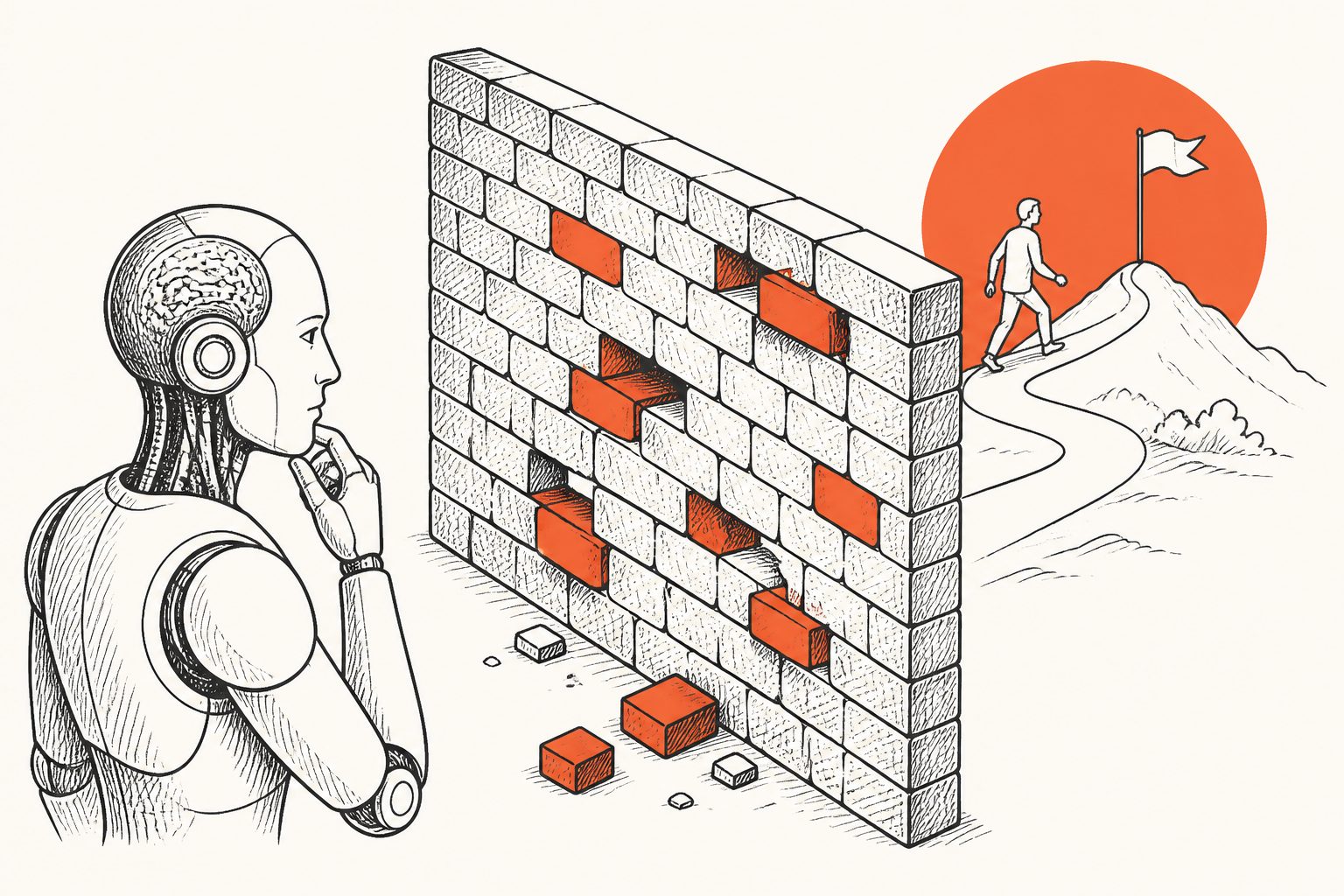
Researchers identify problems with generalization, reasoning, safety and the computing power needed for more adaptable AI systems.
Artificial general intelligence is intended to handle many kinds of intellectual tasks with human-like adaptability, rather than being built for one narrow function. This review examines existing research on why that goal remains difficult, highlighting weaknesses in common sense, reasoning, planning, memory and lifelong learning.
The authors also identify broader engineering challenges: systems may struggle with rare or unexpected situations, produce inaccurate information and require large amounts of computation as their abilities expand. The review suggests that hybrid AI systems, approaches that connect intelligence with interaction in the physical world, and improved reasoning mechanisms could help guide future work.
The barriers researchers found
The review identifies several unresolved barriers to artificial general intelligence. These include limited common sense reasoning; difficulty responding to rare, unexpected or unfamiliar situations; generating inaccurate information; constrained memory; and weaknesses in reasoning, planning and lifelong learning.
It also highlights the need to improve systems' ability to generalize across tasks, operate at a manageable computational scale, remain robust, provide understandable explanations, be verified, and operate safely. The analysis suggests hybrid models, embodied cognitive approaches and improved reasoning mechanisms as possible directions for progress, but it does not establish that any of these approaches solves the identified problems.
Review evidence and limits
This is a systematic literature review, so its conclusions summarize and organize findings and arguments from existing research rather than report results from a new experiment or a direct test of an artificial general intelligence system. The abstract does not provide quantitative estimates, details of the search and selection process, or an assessment of the strength of evidence behind each proposed solution. The review identifies research directions and open barriers, but it does not show that hybrid models, embodied approaches or improved reasoning mechanisms overcome them.
// Source
International Journal of Technology & Emerging Research · 2026 · DOI: 10.64823/ijter.2621026
Authors: Vaishnavy KU, Sajitha Sana P, Devika Pradhan P, Nandhana Pradeep, Niranjana CS
Institutions: Flower Hospital