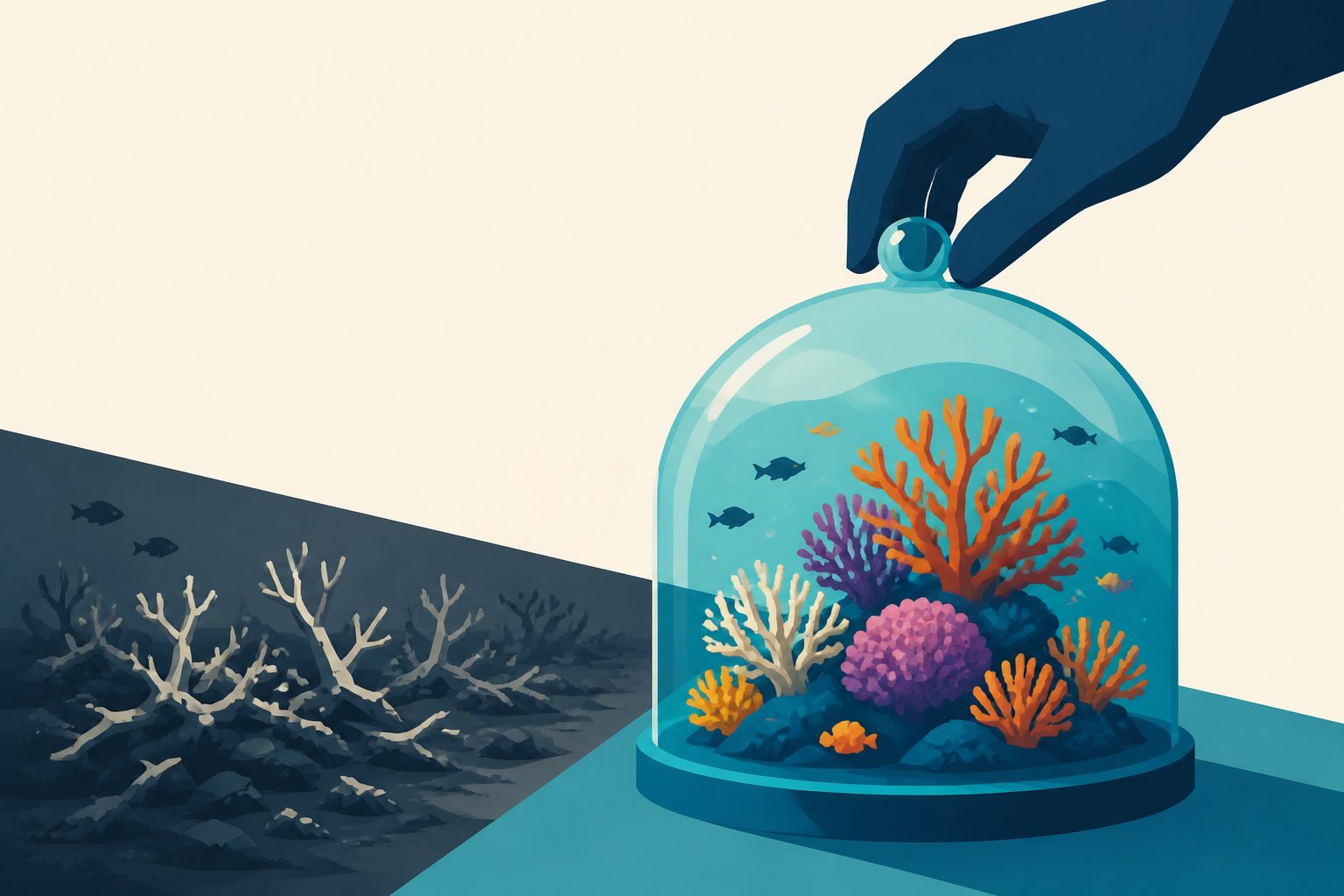
The framework sets out five goals and 12 principles for protecting coral reefs and other tropical marine ecosystems.
The framework is built around five objectives: limit direct habitat destruction; protect a substantial share of marine areas from damaging or extractive activities; manage fishing and hunting outside protected areas; reduce pollution, especially runoff from land; and cut carbon dioxide emissions while strengthening ecosystems’ ability to cope with climate change.
It also outlines 12 principles for putting those objectives into practice. These include community stewardship, place-specific management, ecosystem-based planning, attention to cumulative impacts, precautionary and adaptive decisions, effective enforcement, good governance, and sustained funding and capacity. The article argues that more active interventions are needed in addition to existing approaches, not instead of them.
Five goals, 12 principles
The article outlines five overall conservation objectives and 12 principles of good management for coral reefs and other tropical marine ecosystems. The objectives cover habitat destruction, protected areas, fishing and hunting, water pollution, and climate change. The principles emphasize benefits for both people and biodiversity, community engagement, management suited to local conditions, ecosystem-based and spatial planning, cumulative impacts, uncertainty, resilience, available science, compliance, governance, and finance.
The author also argues that the accelerating scale of pressures requires conservation to be carried out with greater urgency and at a larger scale, including more active and intervention-focused solutions.
Why broader action matters
Coral reefs and related tropical ecosystems are under pressure from multiple human activities, while conservation results have not kept pace with their decline, according to the article. The framework brings these pressures together and presents protection, fishing management, pollution reduction, climate action, governance and funding as connected parts of the response.
Its emphasis on community involvement and local context also treats conservation as a social and economic task, not only an ecological one. The framework’s central message is that additional interventions should strengthen, rather than replace, established management approaches.
What the article shows
This is a framework article that organizes conservation objectives and management principles; the abstract does not report a new experiment, monitoring study or statistical test. It therefore sets out guidance and priorities rather than measuring whether a particular intervention improves reef conditions.
The framework also does not provide evidence in the abstract for how each recommendation performs in specific places or how much funding and protection would be sufficient. Management would need to be adapted and evaluated in local ecological, social and governance contexts.
// Source
Coral Reefs · 2026 · DOI: 10.1007/s00338-026-02946-4
Authors: Laurence J. McCook
Institutions: James Cook University, Hasanuddin University