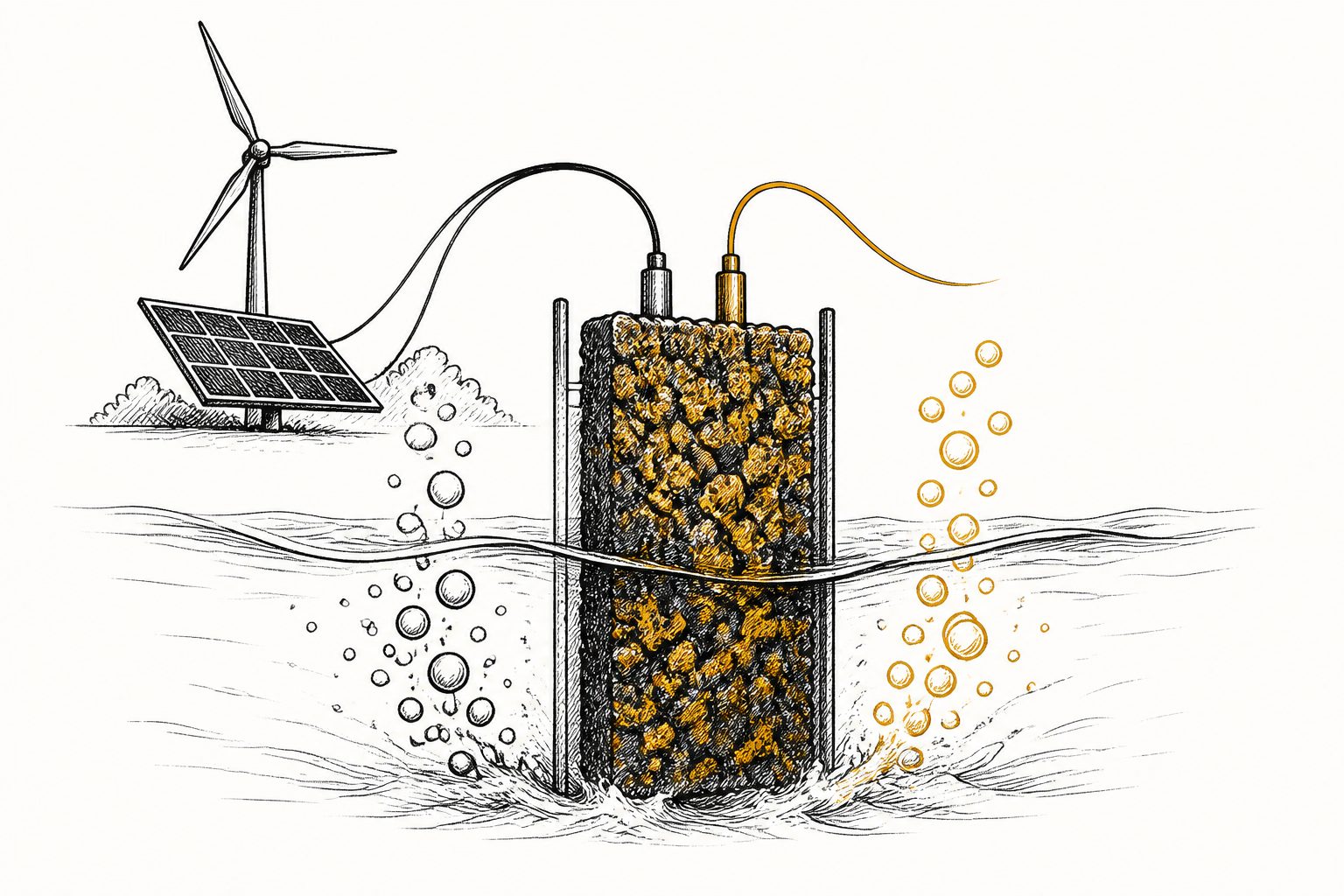
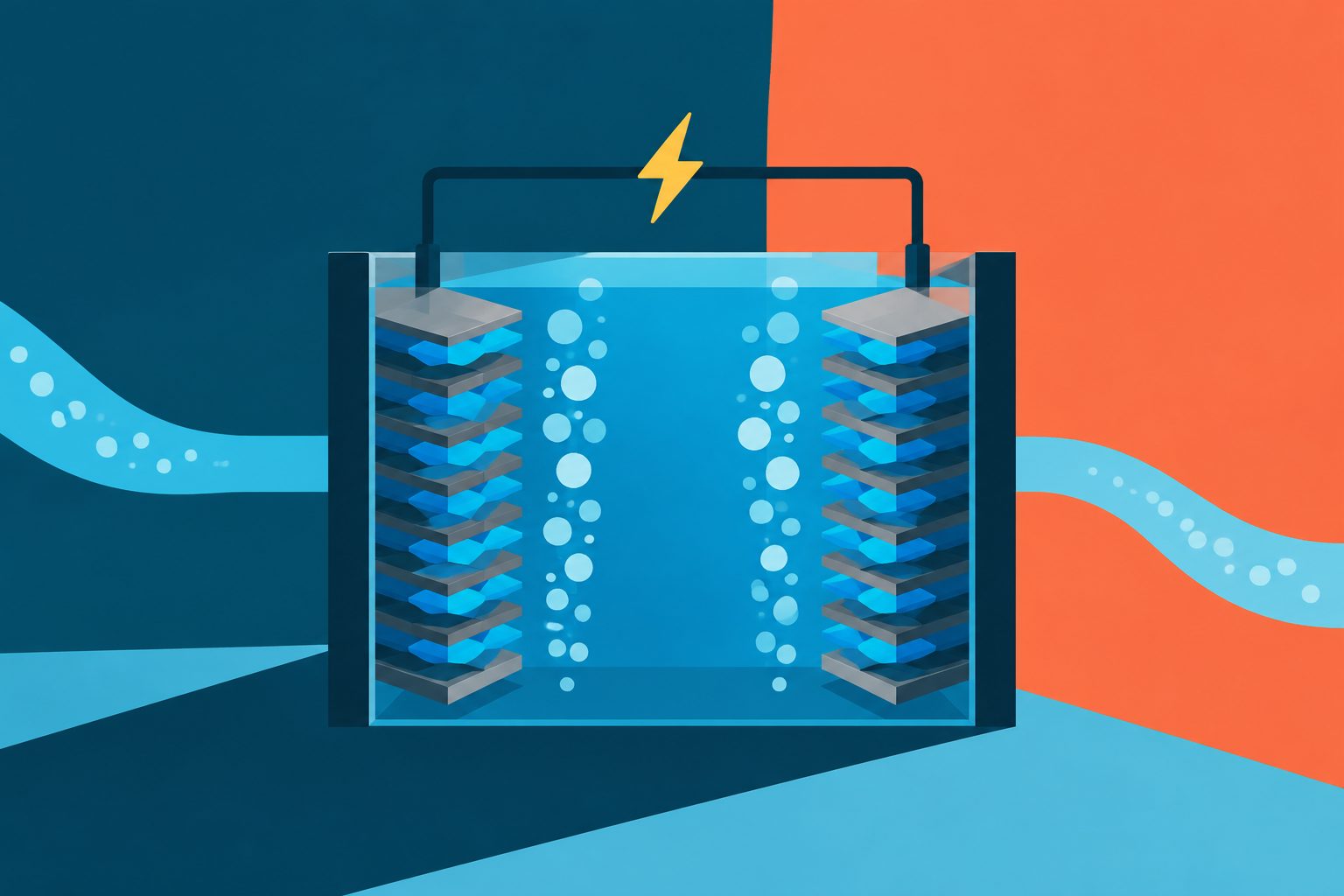
The nonprecious catalyst operated at an industrial current density in a test for making hydrogen from water.
The catalyst combines selenium doping with a surface treatment based on borate ions. The researchers say this creates a network of hydrogen bonds that helps protons move and stabilizes reaction intermediates, while also supporting the movement of hydroxide ions through the catalyst.
Used at the oxygen-producing electrode of an anion exchange membrane water electrolyzer, the catalyst operated for more than 3,400 hours at 1 ampere per square centimeter and 70 °C. It reached an overpotential of 177 millivolts at 10 milliamperes per square centimeter, and the authors report a hydrogen production cost of $2.28 per kilogram.
How the catalyst works
The researchers made a nickel-iron oxyhydroxide catalyst modified in two ways: selenium was added within the material, and borate ions were placed on its surface. They report that selenium adjusts the electronic structure and increases the role of oxygen in the catalyst’s crystal lattice, while surface borate creates hydrogen bonds that help move protons and stabilize reaction intermediates.
According to the study, this combination enables a hydrogen-bond-mediated oxidation process. Faster hydroxide-ion movement replenishes lattice oxygen and limits the buildup of oxygen vacancies, which the researchers link to improved stability. The catalyst produced an overpotential of 177 millivolts at 10 milliamperes per square centimeter and ran for more than 3,400 hours as the anode in an anion exchange membrane electrolyzer at 1 ampere per square centimeter and 70 °C.
Why durable electrolysis matters
Anion exchange membrane electrolysis is being developed to make hydrogen without relying on precious-metal catalysts. A nonprecious catalyst that remains operational for more than 3,400 hours at 1 ampere per square centimeter addresses both the durability and operating-rate requirements highlighted in the study.
The authors calculate a hydrogen production cost of $2.28 per kilogram, which they say is below the European Commission’s 2030 target. This supports the catalyst’s potential for lower-cost hydrogen production, although the result comes from the reported test system rather than a demonstration of commercial deployment.
Evidence and caveats
This is a journal article reporting catalyst measurements and a long-duration water-electrolysis test. The abstract reports stable operation for more than 3,400 hours under the stated conditions, along with electrochemical performance and a cost calculation.
The abstract does not describe independent replication, performance under other operating conditions, or operation at commercial plant scale. The reported cost is an estimate based on the study’s electrolysis system and assumptions; the abstract does not provide those assumptions or a comparison with competing systems.