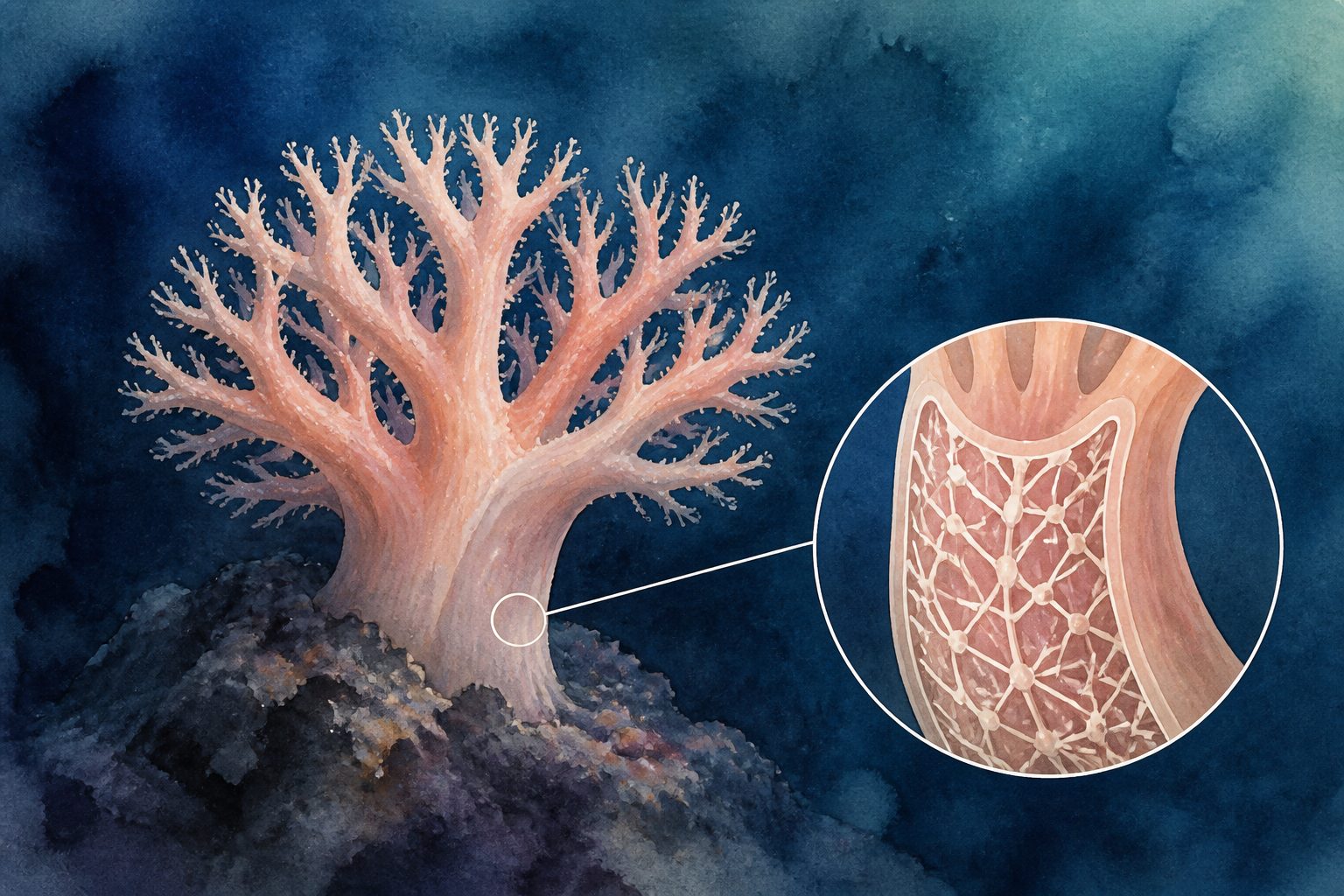
The finding may help explain how bubblegum corals form large, flexible colonies without a conventional skeleton.
The new species, Paragorgia quitinosa, was collected at a depth of 670 meters on the Nazca Ridge in the southeastern Pacific. Analyses identified chitin in the perforating and boundary canals of its coenenchyme, the tissue that makes up much of the colony, as well as in a second Paragorgia species.
The researchers also found that the specimen was a reproductively active female carrying several groups of developing eggs. Genetic analyses placed the new species within Paragorgia and showed that Sibogagorgia is not a single evolutionary group.
Chitin inside the coral
The researchers described Paragorgia quitinosa from a specimen collected 670 meters deep during an expedition on the Nazca Ridge. The species has distinctive rounded mounds bearing retracted feeding and water-pumping structures, along with large radiate mineral structures called sclerites that averaged 0.095 millimeters.
Several methods, including electron microscopy and chemical analyses, detected chitin in the perforating and boundary canals of the coenenchyme. The canal walls resisted digestion with dilute hypochlorite, consistent with the presence of a resistant polysaccharide. The same study found chitin in a second Paragorgia species. Imaging showed that the holotype was a reproductively active female with multiple groups of eggs located in the water-pumping structures.
Why the support network matters
Bubblegum corals can form some of the largest branching colonies in deep-sea environments even though they lack a conventional axial skeleton. The finding that chitin forms a structural canal network offers a possible explanation for how their tissues maintain cohesion while remaining flexible.
It also expands the known occurrence of chitin in Anthozoa, the group that includes corals and sea anemones. Before this work, chitin had been reported in anthozoans only from sea anemones and black corals, according to the abstract.
Evidence and caveats
The evidence comes from structural imaging, spectroscopy, chemical analysis and genetic comparisons of the new species and a second Paragorgia specimen. Together, these methods support the presence of chitin in the coral tissue canals and the species' placement within the Paragorgia lineage.
The study suggests that chitin has a biomechanical role, but the abstract does not report a direct test of how chitin affects colony strength, size or flexibility. The findings are also based on the newly described species and a second Paragorgia species, so their relevance to all skeleton-less octocorals remains uncertain.