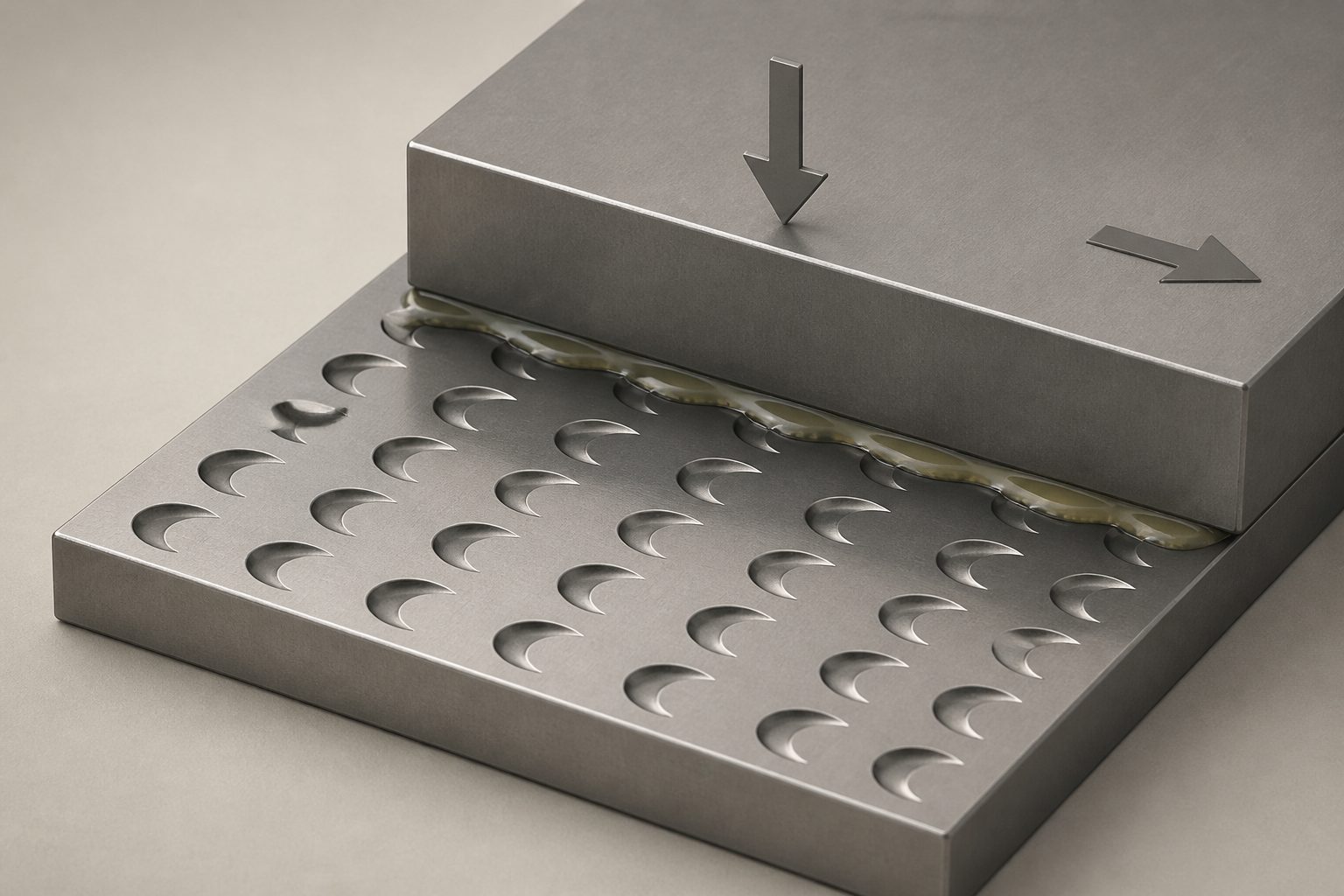
Tests found that the laser-made texture also reduced wear by up to 83.9% compared with untextured steel.
Researchers used computer simulations to optimize a moon-shaped surface texture for lubrication, identifying a design with a 100-micrometer inner radius, an outer-to-inner radius ratio of 1.5, and a centered contact point. They then made the texture in AISI 5115 steel with femtosecond laser processing.
In pin-on-disk tests at 100, 400 and 700 revolutions per minute, the optimized texture, cut to a depth of 10 micrometers, outperformed an untextured surface. The researchers attribute the result to the crescent-shaped cavity’s ability to increase oil-film pressure and trap wear debris.
What the steel texture did
Computational fluid dynamics simulations identified the most effective geometry as an inner radius of 100 μm, an outer-to-inner radius ratio of 1.5, and a contact point at the center of the inner circle. Compared with circular, elliptical, square and triangular textures, the moon-shaped design showed better simulated hydrodynamic lubrication performance. Its wide inlet and narrow outlet increased oil-film pressure.
The optimized texture was fabricated on AISI 5115 steel at a depth of 10 μm. In pin-on-disk friction tests at rotational speeds of 100, 400 and 700 rpm, it reduced friction by up to 52% and wear by up to 83.9% relative to an untextured surface. The researchers say the cavity both supports oil-film pressure and traps wear debris, reducing abrasion caused by loose particles.
Tests and open questions
The study combined computational fluid dynamics simulations with laboratory pin-on-disk tests on femtosecond-laser-textured AISI 5115 steel. The comparisons were made with several texture shapes and with an untextured surface at rotational speeds of 100, 400 and 700 rpm. The abstract does not report the number of test samples, test duration, loads, lubricant details or uncertainty estimates. It also does not show whether the findings apply to other steels, larger components or conditions beyond those tested.
// Source
Nanomanufacturing and Metrology · 2026 · DOI: 10.1007/s41871-026-00308-w
Authors: Zhiyuan Hou, Xiaopeng Ma
Institutions: Shandong University