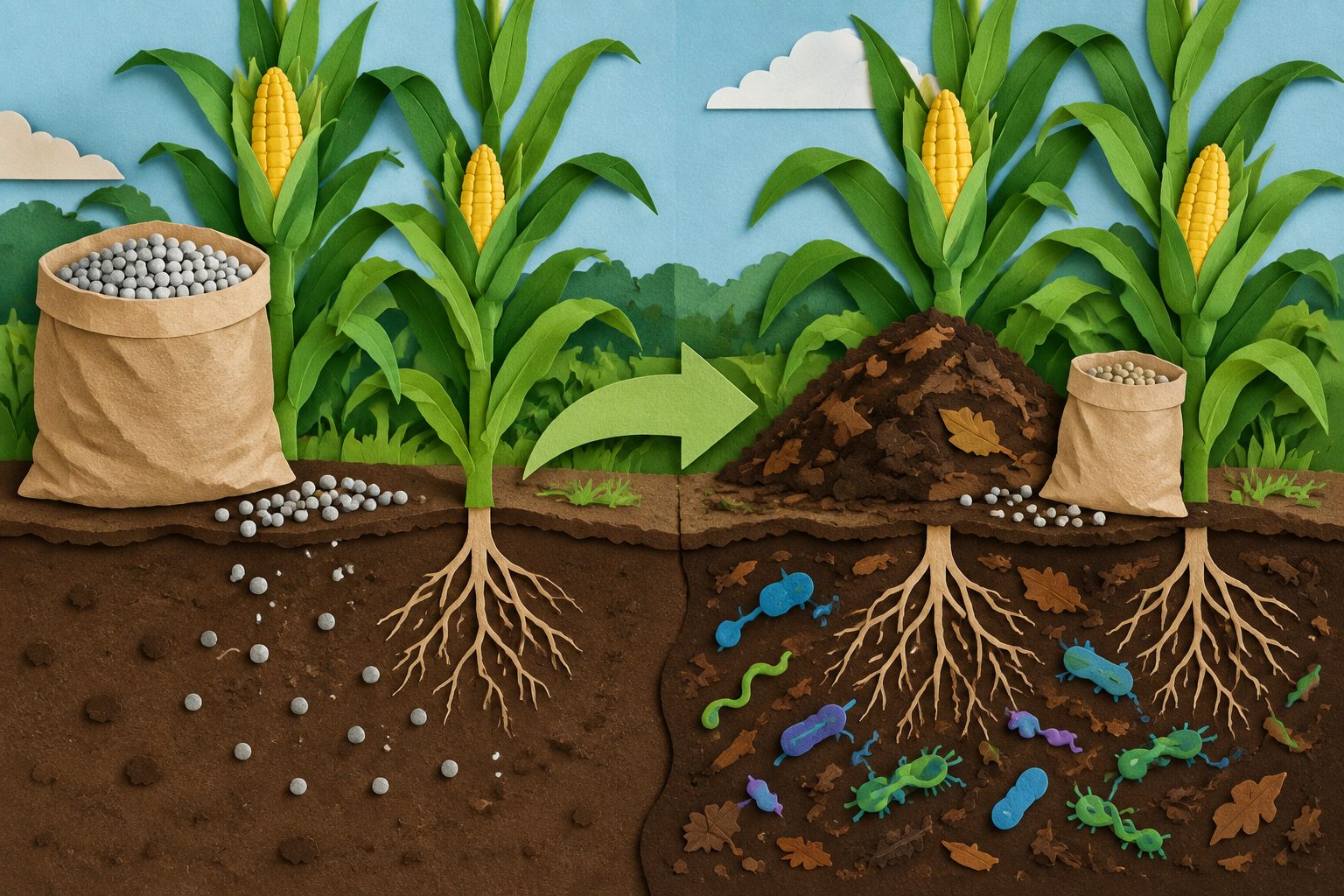
A maize field trial used 25% less mineral fertilizer with compost and bacteria
Using 75% of the usual mineral fertilizer with vermicompost and Azotobacter–Bacillus inoculation maintained maize productivity under the tested conditions.
Editorial illustration — not from the study.
Researchers tested nine combinations of mineral NPK, farmyard manure, vermicompost and Azotobacter–Bacillus inoculation in a randomized field experiment with three replications in Palampur, India. The strongest overall results came from treatments using 75% NPK alongside an organic amendment and the bacterial inoculation.
The treatment combining 75% NPK, 5 tonnes of vermicompost per hectare and Azotobacter–Bacillus produced the highest observed grain and stover yields and the greatest uptake of nitrogen, phosphorus and potassium. It also had the highest microbial biomass carbon and dehydrogenase activity, indicators of soil biological activity, while most measures were statistically similar to a comparable farmyard-manure treatment.
What changed in the maize
The 75% NPK plus vermicompost and Azotobacter–Bacillus treatment produced 40.8 quintals of maize grain and 62.5 quintals of stover per hectare. Total uptake was 121.0 kilograms of nitrogen, 31.3 kilograms of phosphorus and 92.2 kilograms of potassium per hectare.
Microbial biomass carbon reached 112 milligrams per kilogram of soil, and dehydrogenase activity reached 4.4 micrograms of TPF per gram per hour. Compared with sole 100% NPK, these values represented increases of 32.9% and 51.7%, respectively. The treatment generated gross returns of ₹99,340 per hectare and net returns of ₹59,722 per hectare.
Although this treatment had the highest observed yield, nutrient uptake and biological activity, most of these results did not differ significantly from the treatment using 75% NPK, farmyard manure and the same inoculation. Available soil potassium was the only measured variable that differed significantly between those two treatments. Treatments with only 50% NPK did not achieve comparable productivity and economic returns.
Why the mix matters
The results indicate that mineral fertilizer use can be reduced by 25% when the reduction is combined with an organic amendment and bacterial inoculation, rather than made on its own. Under the tested conditions, this package maintained maize productivity while improving measures linked to soil carbon, nutrient availability, water-holding capacity and microbial activity.
The findings also show that organic and microbial inputs did not fully compensate for reducing mineral NPK to 50%. This suggests that the tested approach depended on retaining an adequate mineral-nutrient supply.
Evidence and open limits
The study was a field experiment with nine treatment combinations arranged in a randomized block design with three replications. It was conducted during one maize growing cycle at a site in Palampur, in the western Himalayan region of India, on an acidic silty clay loam soil.
Because vermicompost, reduced NPK and bacterial inoculation were applied as combined packages, the experiment cannot show how much of the response came from any one component. The researchers also note that the findings need validation across multiple seasons and locations, including tests of nutrient recovery, lasting soil fertility, inoculant persistence, carbon stabilization and direct greenhouse-gas emissions. Those emissions were not measured in this study.
A study of 8,394 young people found that higher genetic scores linked to psychiatric and substance-use disorders were associated with household adversity and fewer positive daily experiences. The results show why researchers need to account for gene–environment correlations when studying mental health and substance-use risks.
A 20-year comparison in California’s Central Valley found that reduced tillage with cover crops produced more stable soil aggregates, greater water retention and different forms of carbon protection than standard tillage without cover crops. The conservation system also retained room for additional carbon storage, although the study measured potential rather than future gains.
Human forebrain organoids classified artificial tactile Braille signals after a sensor converted the touch data into electrical stimulation. Accuracy averaged 61% with one organoid and rose to 83% when responses from three organoids were combined.