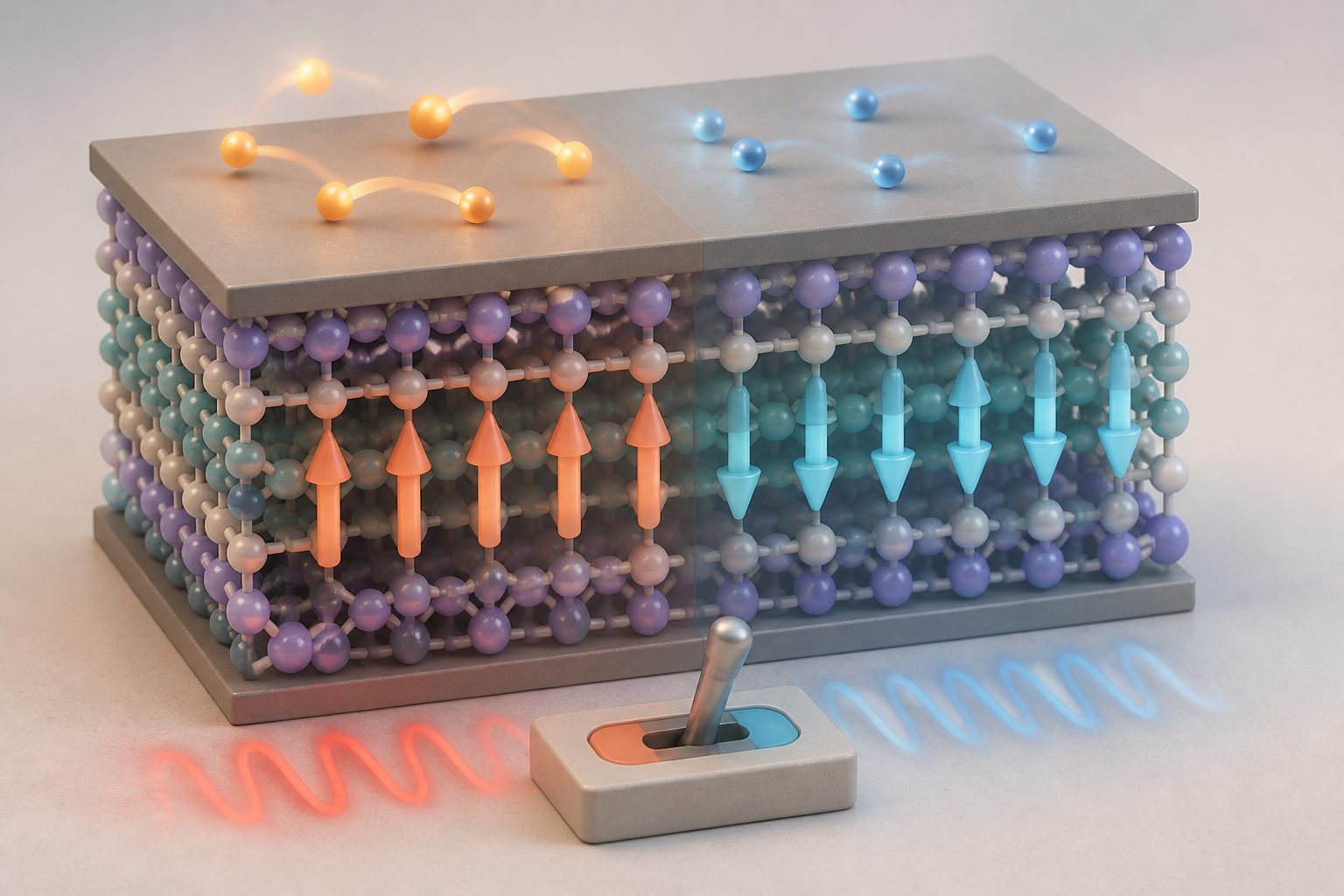
Experiments and calculations indicate that thin Nb3Cl8 can host unusual electron states alongside rotating lattice vibrations and a breathing atomic structure.
Researchers studied the layered material Nb3Cl8, finding that its niobium and chlorine atoms can form a breathing kagome pattern: alternating triangles contract and expand. This structure can produce switchable electric polarization between layers.
Optical measurements found absorption linked to unusually flat electronic bands in thin samples, while thicker samples showed a semiconductor-like absorption edge. The material also displayed strong optical activity, several chiral phonons—lattice vibrations with a preferred rotational direction—and temperature-dependent changes linked to electronic or magnetic behavior.
What the material shows
The researchers report that Nb3Cl8 has an in-plane breathing kagome lattice, in which alternating triangles move inward and outward, together with alternating gaps between neighboring layers. They conclude that this structure can produce breathing ferroelectricity: switchable electric polarization associated with the atomic distortions.
Optical measurements found exciton-like absorption peaks involving flat electronic bands in thin samples. In thicker samples, the material instead showed a semiconductor-like absorption edge. The energies of these features matched the researchers’ theoretical calculations. The study also found strong optical activity and multiple chiral phonons, which are lattice vibrations with a handed, or directional, rotational motion.
Measurements across temperature showed changes in phonon modes and flat bands that were consistent with several temperature-induced electronic-phase or magnetic-related transitions.
Evidence and open questions
The study combines structural analysis, electrical and optical measurements, temperature-dependent measurements of phonon modes and electronic bands, and theoretical calculations for Nb3Cl8. The abstract does not give sample sizes, numerical measurements or device tests. It also describes the cause of the thickness-dependent absorption change as possible rather than established, and characterizes some temperature-driven changes as electronic-phase or magnetic-related transitions.
// Source
Nature Communications · 2026 · DOI: 10.1038/s41467-026-76538-9
Authors: Yilun Yu, Fengrui Sui, Beituo Liu, Shuai Yang, Changjun Li, Ruofan Li, Yufan Zheng, Rong Jin, Jiawen Dai, Heng Gao, Ruijuan Qi, Shujing Jia, Wei Ren, Junhao Chu, Fangyu Yue
Institutions: Shanghai University, Zhengzhou University of Science and Technology, East China Normal University, Shanghai Institute of Technical Physics, University of Shanghai for Science and Technology, Institute of Refrigeration, Zhengzhou Railway Vocational & Technical College