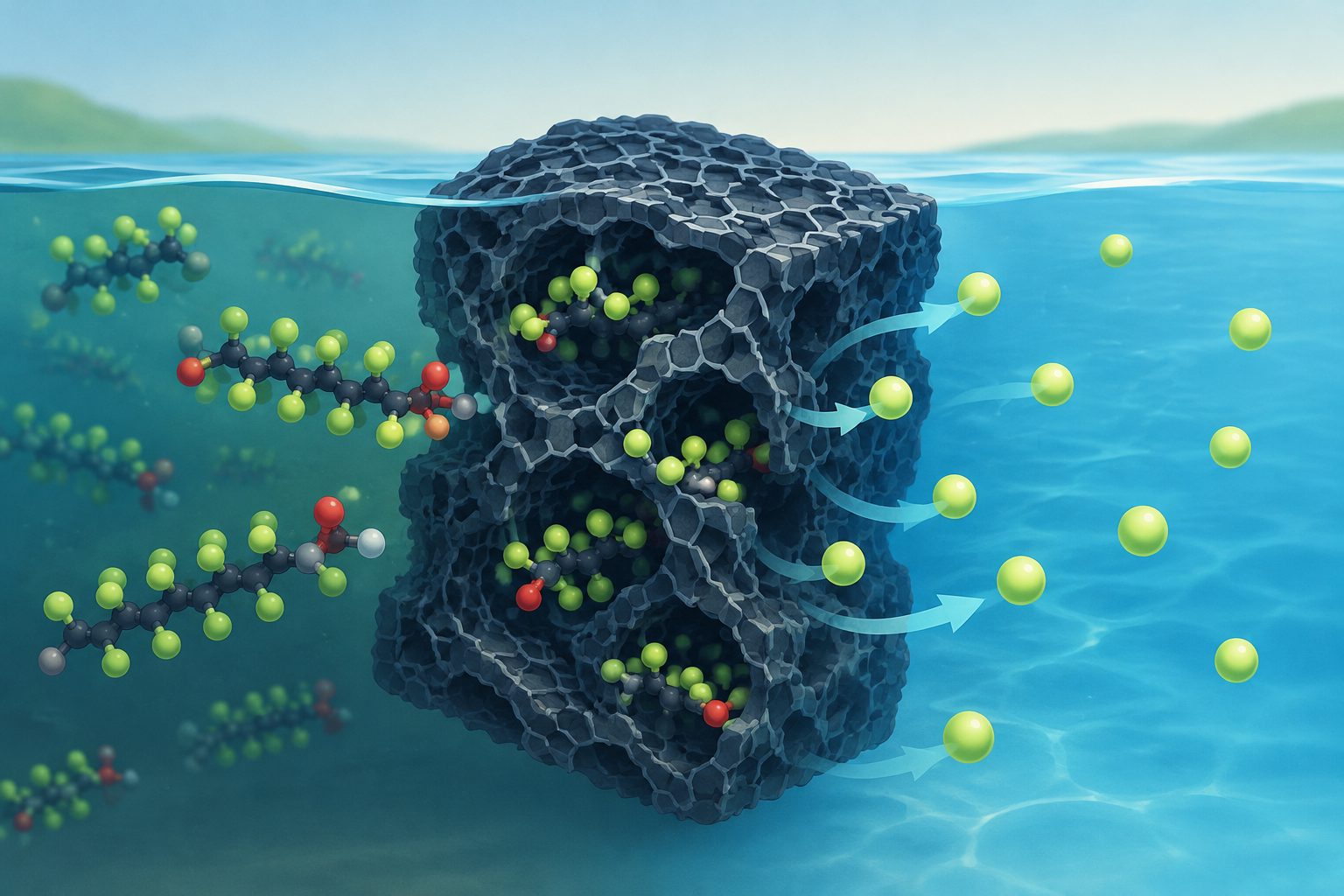
A material that confines a light-activated catalyst removed fluorine from several PFAS, including the shorter-chain chemical PFBA.
The team embedded the metal-organic framework MIL-125-NH2(Ti) in a graphene aerogel. Under ultraviolet light, the composite produced hydrated electrons and hydroxyl radicals, allowing reduction and oxidation reactions to occur in one confined system.
The graphene aerogel increased the material’s attraction for PFAS with different chain lengths by more than 30% and reduced the energy needed to break carbon–fluorine bonds by as much as 10.8%, according to the study. In tests lasting 12 hours, the system achieved its highest reported defluorination for PFOA, followed by PFHxA and PFBA.
What the material does
The researchers report that the composite generated both reductive hydrated electrons and oxidative hydroxyl radicals under ultraviolet light. These reactive species supported a cascade of reactions that degraded PFAS and removed fluorine in the same system.
The graphene aerogel improved PFAS adsorption by more than 30% across compounds with different chain lengths and lowered carbon–fluorine bond energy by a maximum of 10.8%. After 12 hours, the reported defluorination ratios were 90.2% for perfluorooctanoic acid, 65.3% for perfluorohexanoic acid and 51.8% for perfluorobutanoic acid.
Why the approach matters
PFAS are difficult to destroy because their carbon–fluorine bonds are strong. Existing reduction or oxidation treatments can leave shorter-chain products that are harder to degrade. The reported material addresses this problem by combining both types of reaction in one nanoconfined system and by keeping PFAS near the reactive sites.
The results are notable because the system also defluorinated PFBA, a shorter-chain PFAS, although the reported percentage was lower than for the longer-chain compounds. The study therefore points to a possible approach for treating PFAS that remain after partial degradation.
Evidence and caveats
The evidence comes from laboratory experiments and mechanistic investigations of a metal-organic framework enclosed in a graphene aerogel under ultraviolet irradiation. The reported performance was measured for named PFAS over a 12-hour period.
The supplied material does not establish how the system performs in environmental waters, at larger scale, over longer operating periods or with a wider range of PFAS. It also does not show that the material can fully mineralize every PFAS molecule; the reported measure is defluorination for the tested compounds.
// Source
Nature Communications · 2026 · DOI: 10.1038/s41467-026-78192-7
Authors: Jingjing Tang, Xiang Zhang, Jie Li, Hongchao Li, Yuqian Jia, Wanyi Fu, Weiming Zhang, Jieshu Qian, Bingcai Pan
Institutions: Nanjing University, Nanjing University of Science and Technology, Wuxi University