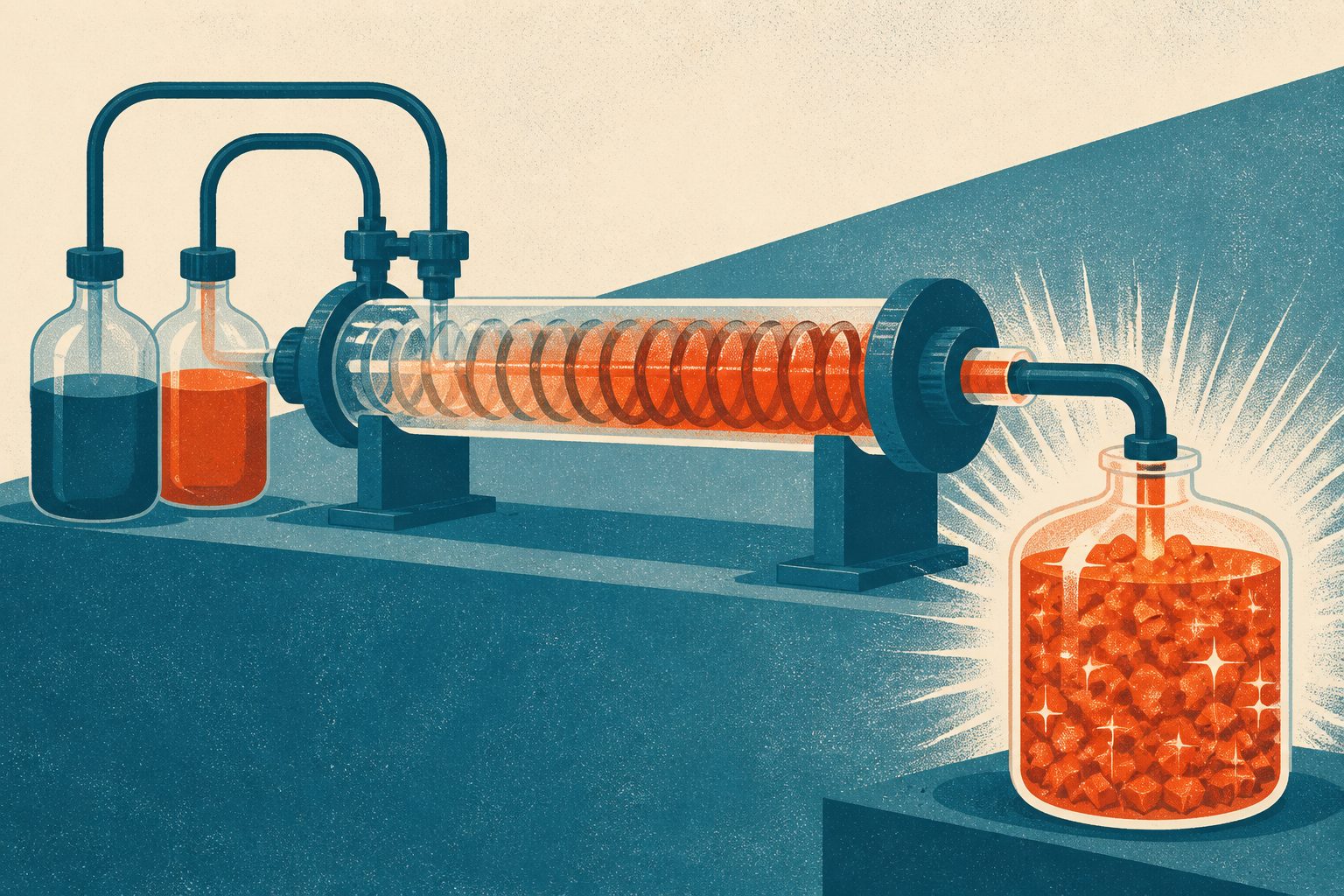
The system formed the light-emitting particles and treated their surfaces in one continuous process.
The reactor continuously combined the formation of CsPbBr3 perovskite nanocrystals with an in-line surface treatment using benzoic acid and 4-phenylbutylamine. The researchers also compared three mixer designs to assess how precursor mixing affected the particles’ emission properties.
The best-performing vortex mixer produced particles with a light-emission peak at 519 nanometers and a narrow emission width of 18.4 nanometers. After the in-line treatment, the emission efficiency rose from 69% to 95%, while the emission width remained narrow at 18.6 nanometers.
Evidence and caveats
This is a laboratory reactor study that compares three mixer designs, measures the particles’ optical properties, and reports output from a three-hour continuous run. The abstract supports production at the reported 1.8-liter and 6.12-gram scale, but it does not report longer-term operation, performance in display devices, or how the process compares with other production methods on cost, yield, or stability. The findings therefore show the operation of this continuous process rather than its full industrial scalability.