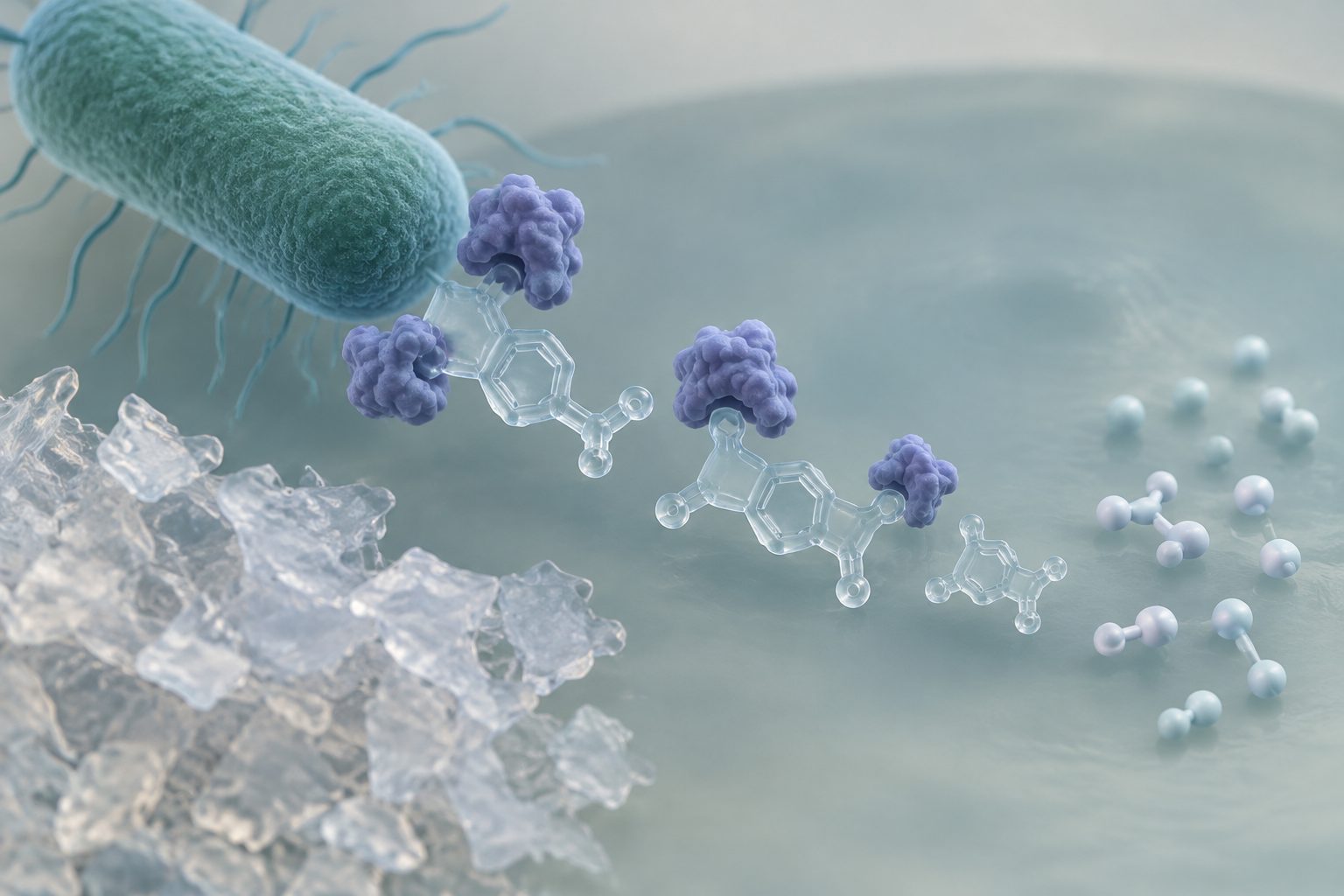
In laboratory tests, the enzyme converted two PET breakdown products more efficiently than several comparison enzymes, but had only modest activity on PET powder.
The enzyme, called BhEstB, was found through a sequence-based search of Bacillus halotolerans proteins and produced in engineered Escherichia coli cells. It showed broad esterase activity, with peak activity on the tested model substrates at pH 8 and 20–30 °C.
In laboratory reactions, BhEstB completely converted 50 millimoles per liter of BHET within one hour at 30 °C. It also converted 77% of 39.8 millimoles per liter of MHET into terephthalic acid within 24 hours. Its activity on commercial semi-crystalline PET powder was described as moderate and was strongest at elevated temperatures.
What the enzyme breaks down
BhEstB is structurally different from canonical PET-degrading enzymes and most characterized MHETases, but is more closely related to other carboxylesterases. It outperformed the engineered LCC ICCG enzyme and the archaeal enzyme PET46 in tests with BHET and MHET. BhEstB completely converted 50 mM BHET within one hour at 30 °C. Its measured turnover rate for BHET was 15.57 ± 1.25 per second, with a catalytic efficiency of 2.38 × 10³ M⁻¹ s⁻¹. In a separate test, it converted 77% ± 0.7% of 39.8 mM MHET into terephthalic acid within 24 hours. By contrast, its overall activity against the bulk polymer was modest, although it showed moderate activity against commercial semi-crystalline PET powder at elevated temperatures.
Evidence and caveats
This was a laboratory study of a recombinant enzyme. The researchers identified BhEstB using a sequence-based search, produced it in engineered E. coli, and tested its activity with model ester substrates, soluble PET intermediates and commercial semi-crystalline PET powder. The strongest results were obtained with soluble BHET and MHET, not bulk PET. Activity on PET powder was only moderate, and the study did not establish performance in industrial recycling, on real plastic waste or in a complete PET-degradation process. The researchers also reported that the enzyme’s thermal-stability profile did not fully explain product release from PET powder at 60–70 °C; because they did not measure activity and product release over time, the mechanism remains unresolved.
// Source
Applied Microbiology and Biotechnology · 2026 · DOI: 10.1007/s00253-026-14056-w
Authors: Hadjira Bounabi, Bilal Yahiaoui, Meriem Gasmi, Meroua Safa Mechouche, Nico Bäse, Marno Gurschke, Rebecka Molitor, Pablo Pérez-García, Wolfgang R. Streit
Institutions: Heinrich Heine University Düsseldorf, Universität Hamburg, Forschungszentrum Jülich, University Ferhat Abbas of Setif, Biotechnology Research Center