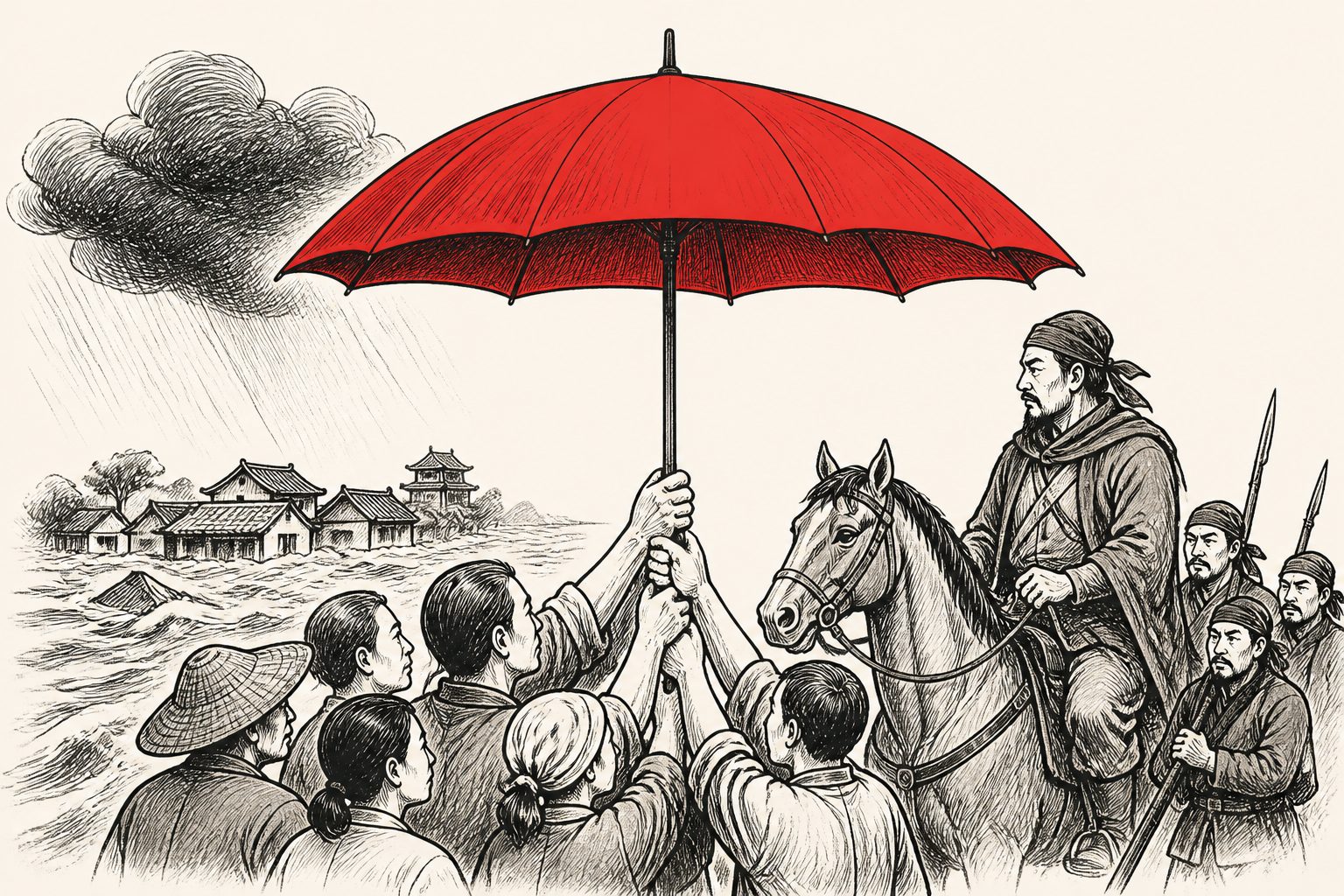
The crisis prompted Anhui natives in Shanghai to use newspapers, telegrams and public associations to demand protection and accountability.
The article reconstructs how the Ni clan’s control over local defense weakened Fuyang’s ability to protect itself. When the “Old Foreigner” bandit clique seized the city, the resulting administrative paralysis exposed how little separated state protection from banditry in the region’s fragmented political system.
It then traces how Anhui natives in Shanghai responded through press reports, public telegrams and native-place associations. Their campaign sought immediate protection, community survival and restored order, while also creating a wider arena for holding warlords accountable. The study presents this mobilization as both humanitarian action and political contestation, rather than as a straightforward democratic movement.
How Fuyang’s defenses failed
The study finds that the Ni clan’s takeover of local defense produced a fragile, self-serving security system rather than stronger public protection. The Old Foreigner bandit clique was able to exploit weaknesses created by this private control of military power and seize Fuyang in 1922.
After the city’s defenses and administration collapsed, Anhui natives in Shanghai used modern media, telegrams and public associations to build concern and action across regional boundaries. These networks responded to urgent needs for safety and order, but they also sought to challenge warlord impunity and create forms of political accountability. The article says this civic mobilization was ultimately constrained and shaped in part by revolutionary and partisan interests, including the later political roles of some campaign leaders.
A crisis became political action
The Fuyang case shows how the breakdown of state authority could produce more than social fragmentation. In this instance, the failure of local protection pushed civic and political actors to create networks that crossed regional boundaries and used public communication as a tool for accountability.
The study also complicates simple accounts of the warlord period. Civic action was neither fully independent from political movements nor merely an idealized democratic awakening; it grew from immediate humanitarian needs while also serving longer-term efforts to contest military rule.
Sources and limits
The article uses press reports, public telegrams, historical memoirs and native-place association records to reconstruct local power relations, military practices and the response to the crisis. These materials are also examined as evidence of how literate Anhui natives in urban China, chiefly Shanghai, circulated and framed news of Fuyang.
The study focuses on one 1922 case and cautions against treating it as a simple model of all Beiyang-era warlordism. Its sources largely reflect the perspectives and rhetoric of urban, literate Anhui networks. The civic mobilization it describes was temporary, politically mixed and constrained, rather than an autonomous or fully democratic movement.
// Source
International Journal of Asian Studies · 2026 · DOI: 10.1017/s1479591426100965
Authors: Junhua Zhang
Institutions: Anhui University, Anhui and Huaihe River Institute of Hydraulic Research