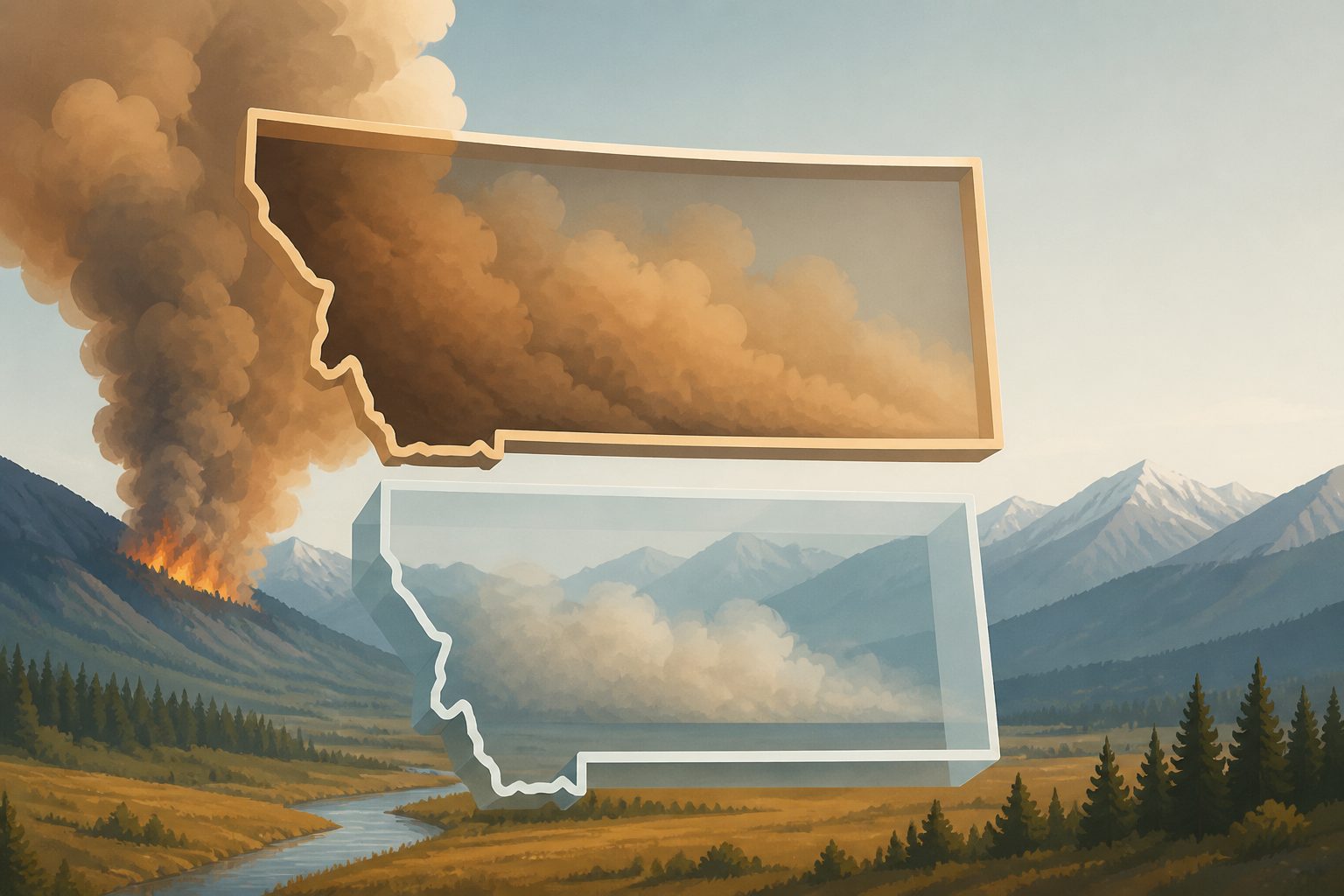
Measurements in Missoula found that smoke from distant fires raised pollutants, while the related cancer-risk estimate was about 40% higher than the model predicted.
Researchers measured aged wildfire smoke in Missoula, Montana, during a major 2020 smoke event. Smoke that had traveled from California and the Pacific Northwest raised carbon monoxide, fine particles and many volatile chemicals, while the model used to represent the event underestimated several pollutants.
Using those concentrations, the researchers estimated that a wildfire season like 2020 repeated every year would produce an excess lifetime cancer risk of about 100 cases per million people. The model underestimated that smoke-related cancer risk by about 40 percent and the chronic non-cancer hazard index by about 10 times.
What the smoke contained
Smoke that had traveled for at least three days from California and the Pacific Northwest increased carbon monoxide, fine particulate matter known as PM2.5, and total measured volatile organic compounds by factors of 2 to 8. Hourly peaks reached 800 parts per billion for carbon monoxide, 120 micrograms per cubic meter for PM2.5, and 85 parts per billion for the measured volatile compounds.
Nitrogen oxides were not higher than the urban background. Ozone responded differently depending on smoke intensity: its daily maximum eight-hour average increased under light smoke but flattened or declined when PM2.5 exceeded about 30–40 micrograms per cubic meter. GEOS-Chem did not reproduce this pattern.
The researchers estimated that, if a 2020-style wildfire season occurred every year, the excess lifetime cancer risk would be 100 in 1 million people—about seven times the non-smoke baseline. About 90% of that estimated cancer risk came from PM2.5. Formaldehyde, benzene, acrolein and acetaldehyde dominated the estimated chronic non-cancer hazard, which reached a hazard index of 3.0.
The model captured the major smoke intrusions but underestimated carbon monoxide, PM2.5 and volatile organic compounds by 30%–90%. The resulting health estimates were also lower: cancer risk by about 40% and the chronic non-cancer hazard index by about 10 times. The researchers attribute the model errors to underpredicted fire emissions and missing chemical reactions involving volatile organic compounds.