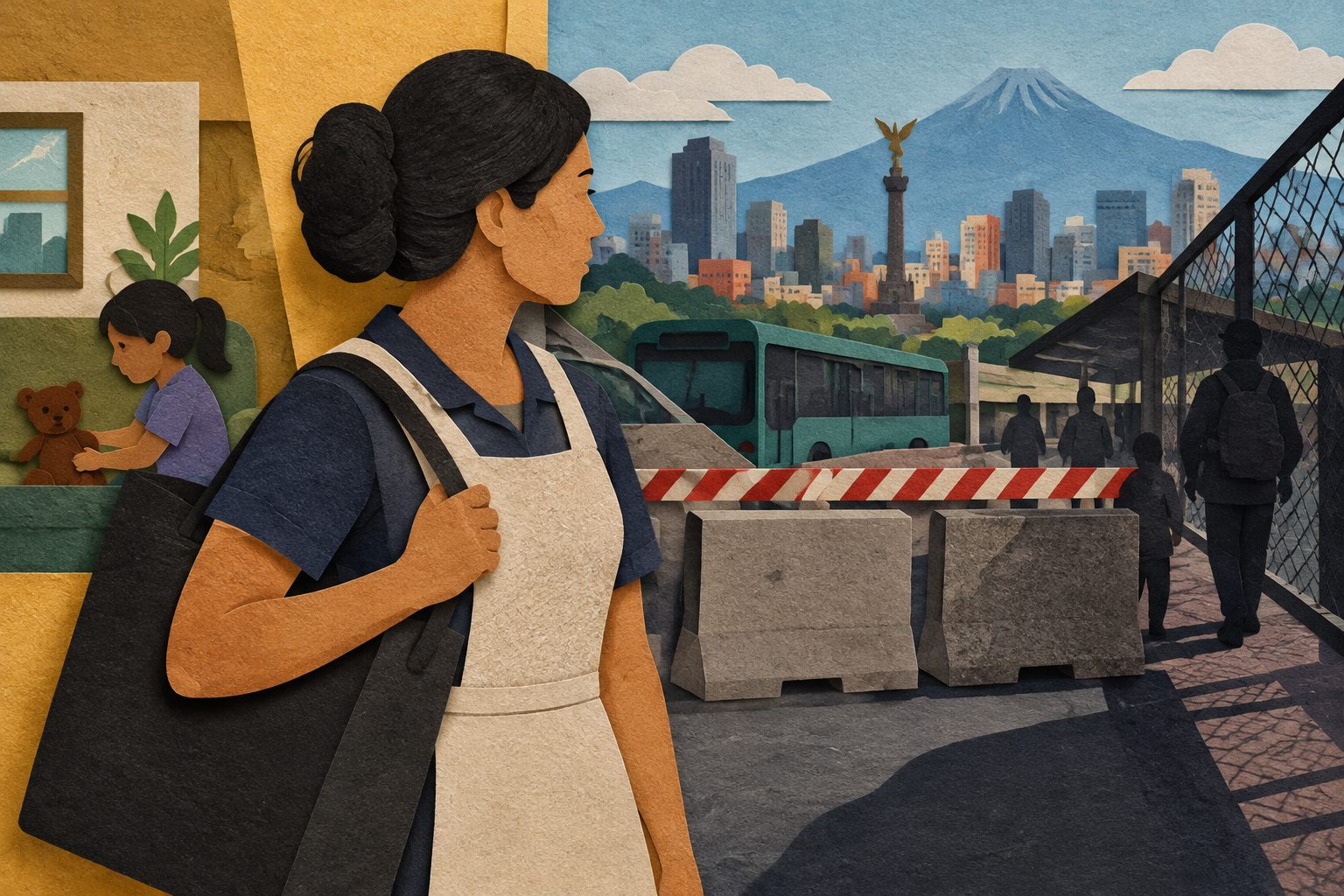
A study of four women finds that changing access problems can combine to limit both travel and technology-based care.
The article examines how four domestic workers negotiate work and care while living in peripheral social housing developments. It argues that access to the city cannot be understood only through distance or transport efficiency: security, social relationships, time and other vulnerabilities also shape what people can do.
When workers cannot provide care in person, they may use technology to care from a distance. But security concerns and fear can restrict mobile-phone use, creating another barrier. The article calls this changing pattern the “modulation of barriers to access,” an approach developed from Latin American urban research.
How barriers combine
The researchers found that access barriers affecting domestic workers are not fixed. Their frequency changes, and they can interact through people’s presence with one another, their responses and chains of consequences. These interactions can either increase or reduce the difficulty of reaching workplaces, services and care networks.
For the four women studied, living in remote housing developments made in-person caregiving difficult and contributed to care practices carried out at a distance through technology. At the same time, insecurity and fear limited access to mobile phones, restricting those care strategies. The article also finds that women’s mobility can be both necessary for paid work and a constraint on other daily activities, including care.
Why access matters
The study shows why improving transport or adding services alone may not address the unequal access experienced by women in peripheral housing developments. Policies that consider how insecurity, mobility and social vulnerabilities interact may have wider effects on caregiving and income-generating activities.
It also presents a contribution from Latin American urban research: access is treated as a social and relational ability to manage time, space and connections, rather than simply as physical proximity. The proposed approach may be useful in other settings where fixed measures of accessibility miss the changing experience of urban mobility, although this article focuses on Mexico City.
Evidence and limits
This is an article based on the experiences of four domestic workers living in social housing developments on the outskirts of Mexico City, and it develops a theoretical and analytical framework from that case. The evidence describes how access barriers and care practices interact in this specific setting; it does not establish how common these experiences are among domestic workers more broadly.
The article argues that the framework could apply beyond Mexico City, but the excerpts do not report tests in other places. The findings should therefore be read as a detailed account and conceptual contribution, not as a population-wide estimate or a demonstration of cause and effect.
// Source
Transactions of the Institute of British Geographers · 2026 · DOI: 10.1111/tran.70095
Authors: Erandi Paula Barroso Olmedo
Institutions: Universidad Nacional Autónoma de México, Universidad Autónoma de la Ciudad de México